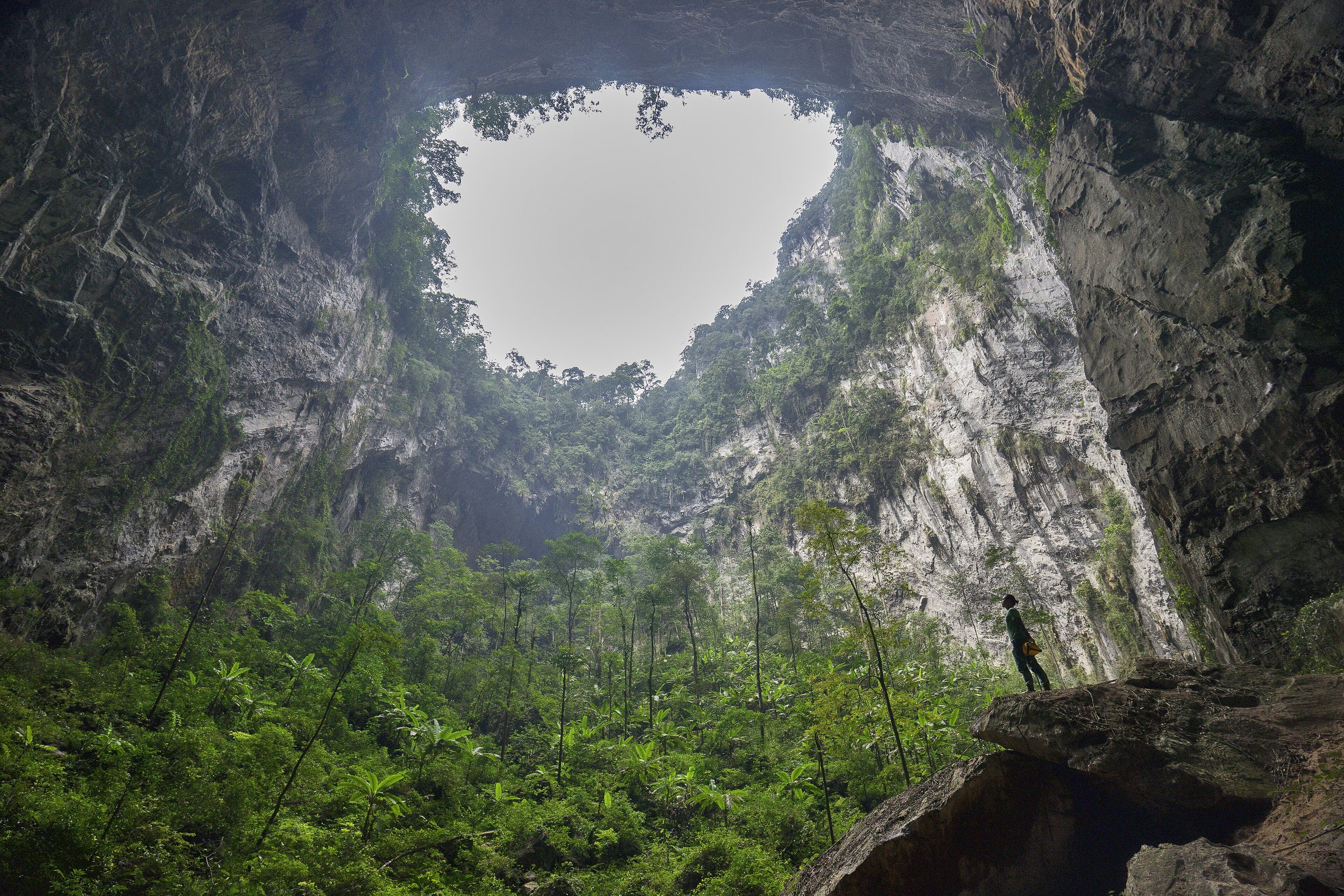
Son Doong CaveHang Sơn Đoòng
Scale and physical character
Hang Sơn Đoòng — the name means roughly "mountain river cave" in the local dialect — was surveyed by the British Cave Research Association in collaboration with Vietnamese scientists between 2009 and 2010, following its wider introduction to the scientific community after a local man, Hồ Khanh, rediscovered the entrance in 2008. He had first stumbled upon it in 1990 but lost the location for nearly two decades.
The main passage reaches measured dimensions of approximately 200 metres high, 150 metres wide and over five kilometres in explored length, making it the largest single cave passage by volume yet documented anywhere on Earth. The passage contains its own localised weather: clouds form inside it, and a fast-flowing underground river runs along the floor for much of its length. Enormous stalagmite formations, some exceeding 70 metres, rise from the cave floor.
The dolines and interior jungle
Two points along the passage are open to the sky, where the cave ceiling collapsed at some point in geological history. These openings, known as dolines, allow sufficient light and rainfall to reach the cave floor to sustain dense tropical jungle growth inside the cave itself. The larger of the two — informally called the Garden of Edam by early expedition members — supports a distinct microclimate with trees reaching tens of metres in height, mist, and wildlife including birds and monkeys that move between the interior and the surface.
The contrast between the dark cave interior, the shafts of light descending through the dolines, and the green vegetation growing hundreds of metres underground is among the most cited features of the cave for those who have entered it. The second doline, closer to the cave's rear, is associated with a calcite wall that early expeditions called the Great Wall of Vietnam, which temporarily blocked further exploration until a route around it was found.
Access, permits and the licensed operator
Son Doong sits within the core zone of Phong Nha-Ke Bang National Park, a UNESCO World Heritage Site. The Vietnamese government has granted a single company — Oxalis Adventure, based in the town of Phong Nha — an exclusive licence to operate tours into the cave. No independent access is permitted, and no other operator is currently authorised to enter.
The number of tourists permitted inside the cave per year is capped by agreement with park authorities. Tours run only during the dry season, roughly February to August, as the underground river floods to dangerous levels during the wet months. Each group is accompanied by a team that includes certified cave guides, porters, a park ranger and — on all Son Doong tours — members of the original British-Vietnamese survey team in an advisory capacity.
Booking opens well in advance and places are typically claimed quickly after each release. A waiting list operates in most years. Tour duration is around six days and five nights, with camping inside the cave.
Physical requirements
The tour involves multi-day jungle trekking before the cave entrance is reached, scrambling over large cave formations, swimming or wading through sections of the underground river, and ascending and descending fixed ropes at the dolines using climbing harnesses. Total daily distances on foot range from several to over ten kilometres across uneven terrain.
Oxalis publishes a fitness self-assessment for applicants. Participants are expected to have a reasonable base of physical fitness — regular hiking, swimming or equivalent activity — and prior caving experience, while not mandatory, is considered advantageous. The company reserves the right to withdraw a participant from the expedition on safety grounds. Age restrictions apply, and the tour is not open to children below a stated minimum age.
Specific medical conditions affecting cardiovascular function, balance or mobility may preclude participation; applicants are advised to consult the operator's health guidelines before booking.
Alternatives for those who cannot access Son Doong
Several caves in Phong Nha-Ke Bang are accessible on shorter or less demanding tours and give a meaningful sense of the park's karst landscape without the physical and logistical requirements of Son Doong.
- Hang En: the third-largest cave in the world by passage volume, also operated exclusively by Oxalis. A two-day or three-day trek is required. Like Son Doong, it contains a river, a large doline and a camping area inside the cave itself. Physical demand is moderate to high.
- Paradise Cave (Thiên Đường): accessible by a boardwalk system for its first kilometre, with a longer section open to guided groups on a day basis. The dry passage contains dense stalactite and stalagmite formations. No camping or river crossing is involved.
- Phong Nha Cave: entered by boat along the Son River, making it accessible to a wide range of visitors. The illuminated river passage is the historic centre of the park and gives access to a dry upper gallery.
Conservation context and ongoing debate
Son Doong has been the subject of recurring discussion about the appropriate level of tourist access. A proposal in the mid-2010s to construct a cable car into the cave — which would have substantially increased visitor numbers — was rejected following opposition from conservation groups, UNESCO, and the British-Vietnamese caving teams involved in the original survey. The cave's cap on annual visitors remains in place, though the precise number allowed has been adjusted periodically.
The cave ecosystem is fragile: the mud banks lining the floor contain micro-organisms adapted to the cave environment, and the introduced light from photography equipment can affect the growth of cave pearls and other speleothem formations over time. Guides enforce strict rules about where participants may walk and what surfaces may be touched. The debate about whether any level of tourism is compatible with long-term preservation of the cave's interior environment remains open among scientists and park managers.
Where it is
Also known as / see also
被以下页面引用
来源
- Vietnam National Authority of Tourism — VNAT 访问于 29 August 2026
Supports: the rules and definitions on this page - Hang Sơn Đoòng — Wikipedia (CC BY-SA 4.0) 访问于 3 September 2026
Supports: background - Hang Sơn Đoòng — Wikipedia (Vietnamese) (CC BY-SA 4.0) 访问于 3 September 2026
Supports: background, Vietnamese edition
Current 最后核实: 3 September 2026. Rules, fares and prices change — check the official source before acting on anything here. Report a mistake.
Picture credits (1)
Son Doong Cave DB (3), Dave Bunnell, CC BY-SA 4.0, Wikimedia Commons