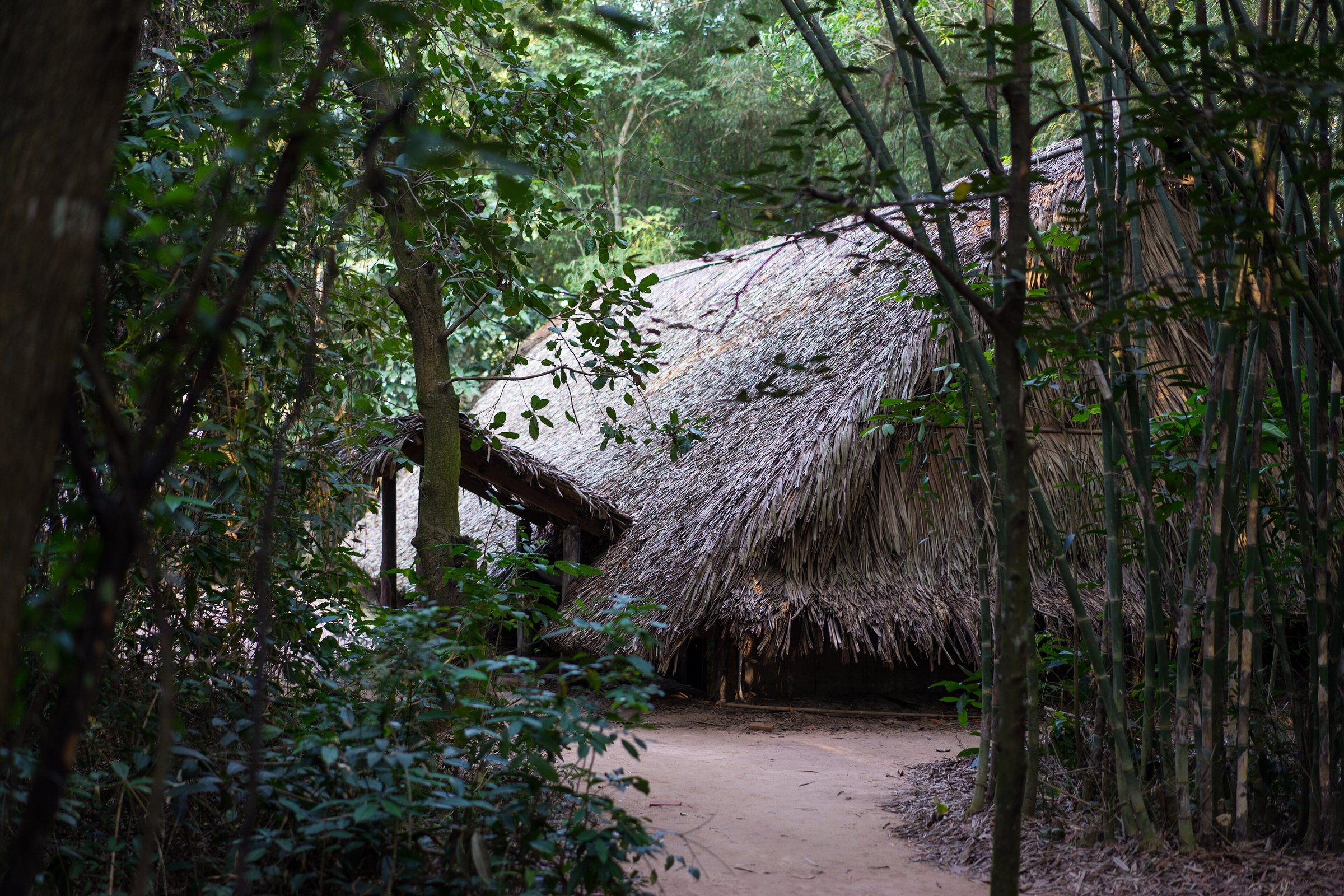
Cu Chi TunnelsĐịa đạo Củ Chi
What the tunnels are
The Cu Chi tunnel network is an interconnected system of underground passages dug primarily between the 1940s and the late 1960s, first against French colonial forces and then, more extensively, during the American War. At its greatest extent the network stretched for roughly 250 kilometres, running on multiple levels and linking sleeping quarters, field hospitals, weapons workshops, kitchens and command rooms. Ventilation shafts were concealed in termite mounds or beneath thick vegetation. The tunnels allowed Viet Cong units to operate, resupply and survive in a district that the United States military designated a free-fire zone and subjected to sustained aerial bombardment, including the use of B-52 carpet-bombing runs in Operation Rolling Thunder and later operations. The ground above was heavily defoliated with herbicides. That fighters and civilians lived underground for years in this environment is the central historical fact the site communicates.
Ben Dinh and Ben Duoc: the two sites
Two separate entrance points serve different parts of the network. Ben Dinh, the closer site to Ho Chi Minh City, is smaller and receives the larger share of day-trippers and organised tour groups. The demonstration area is compact and the experience is more condensed. Ben Duoc is further north-west, larger in area, and includes a substantial memorial temple — the Đền Bến Dược — dedicated to the dead of the resistance, with a tower visible across the surrounding forest. Ben Duoc tends to attract fewer visitors at any given time and gives more space to explore the above-ground reconstructions of wartime camp life. Neither site is strictly superior; the choice depends on how much time is available and whether the memorial element is a priority. Visitors combining both sites in one day should account for the distance between them.
The sites are located in Cu Chi Tunnels, within the former Cu Chi area now part of Ho Chi Minh City province following the 2025 provincial mergers.
The demonstration tunnels and the originals
Original tunnel passages average around 80 centimetres in height and 50 to 60 centimetres in width — dimensions that reflect the smaller average build of Vietnamese fighters and were deliberately designed to impede larger American soldiers. These original sections are not, for the most part, what visitors crawl through. The demonstration tunnels shown to visitors have been widened and reinforced with concrete to accommodate tourists, and are significantly more spacious than the wartime originals. Short sections of original-width tunnel do exist at the sites and can sometimes be accessed separately; they give a more accurate physical sense of the conditions. Above ground, reconstructions include camouflaged trapdoors set into earth that are strikingly difficult to spot even when a guide stands directly beside them, which is one of the more memorable demonstrations on the tour.
Trap displays and above-ground exhibits
Both sites maintain a series of displays showing the concealed pit traps — known in Vietnamese as bẫy — that Viet Cong forces deployed against advancing soldiers. Designs on display include hinged bamboo spike pits, rotating plank traps and variants using sharpened stakes of bamboo or metal, some designed to wound rather than kill so as to burden enemy units with casualties requiring evacuation. The displays are graphic in intention; they are presented as part of the historical record of asymmetric warfare rather than sanitised. Above ground, visitors can also inspect a collection of destroyed American armoured vehicles and artillery pieces left in situ, as well as recreations of daily tunnel life including a rudimentary kitchen equipped to vent smoke horizontally through the soil to avoid detection from the air.
The shooting range
Both Ben Dinh and Ben Duoc operate a shooting range where visitors can fire live rounds from weapons associated with the war, including the AK-47, M16 and several others. Ammunition is sold per round. The range is loud, consistently so, and audible from a considerable distance within the site. Opinion among visitors varies widely: some find the experience historically contextualising; others find it incongruous or uncomfortable within a site commemorating mass death. It is entirely optional. Visitors who prefer to avoid the noise can ask guides to schedule their tunnel entry and above-ground tour during periods when the range is less active, though this cannot always be arranged. Ear protection is provided at the range itself.
Half-day versus full-day visits
A visit to a single site — either Ben Dinh or Ben Duoc — is generally completed in two to three hours, making a half-day trip from Ho Chi Minh City feasible. Most organised tours from the city are structured as half-day excursions, departing in the morning and returning by early afternoon, or departing after lunch and returning by early evening. A full-day visit makes sense for those covering both sites, for those with a strong interest in the period who want to spend time at the Ben Duoc memorial temple, or for visitors combining the tunnels with other stops along the route. The surrounding area holds additional wartime sites and a section of the Saigon River used during the conflict, which some independent travellers explore by rented vehicle. Travel time from central Ho Chi Minh City to Ben Dinh is roughly 70 kilometres; Ben Duoc is somewhat further.
Practicalities
Both sites are open daily. Guided tours in Vietnamese and English run continuously through the day at Ben Dinh; Ben Duoc has a slightly different rhythm given its larger grounds. Wearing dark or plain clothing is sometimes suggested by tour operators, partly for practical reasons in a dusty environment and partly as an informal nod to the site's character — light-coloured clothing shows soil markings from the tunnel walls. The tunnels themselves are warm, humid and confined; visitors with claustrophobia should note that even the widened demonstration sections involve sustained low-ceiling crawling. Photography is permitted throughout, except in a few explicitly marked areas. Prices vary by season and by whether entry is purchased independently or as part of an organised tour package.
Where it is
Also known as / see also
被以下页面引用
来源
- Vietnam National Authority of Tourism — VNAT 访问于 29 August 2026
Supports: the rules and definitions on this page - Củ Chi tunnels — Wikipedia (CC BY-SA 4.0) 访问于 31 August 2026
Supports: background - Địa đạo Củ Chi — Wikipedia (Vietnamese) (CC BY-SA 4.0) 访问于 31 August 2026
Supports: background, Vietnamese edition
Current 最后核实: 3 September 2026. Rules, fares and prices change — check the official source before acting on anything here. Report a mistake.
Picture credits (1)
Củ Chi Tunnels, Ludovic Lubeigt, CC BY-SA 2.0, Wikimedia Commons