Reunification PalaceDinh Độc Lập
What the building is
The Reunification Palace — formally Dinh Độc Lập, Independence Palace — served as the seat of government and official residence of the presidents of the Republic of Vietnam from 1966 until the fall of Saigon. It stands at the northern end of a large landscaped compound in Ho Chi Minh City centre, a short walk from Notre-Dame Cathedral and the former Central Post Office.
The site has a longer history: a French colonial governor-general's residence occupied the same ground from 1868. That building was badly damaged in a 1962 bombing raid by two South Vietnamese air force pilots attempting to assassinate President Ngô Đình Diệm, and was subsequently demolished. The present structure replaced it.
The 1960s architecture
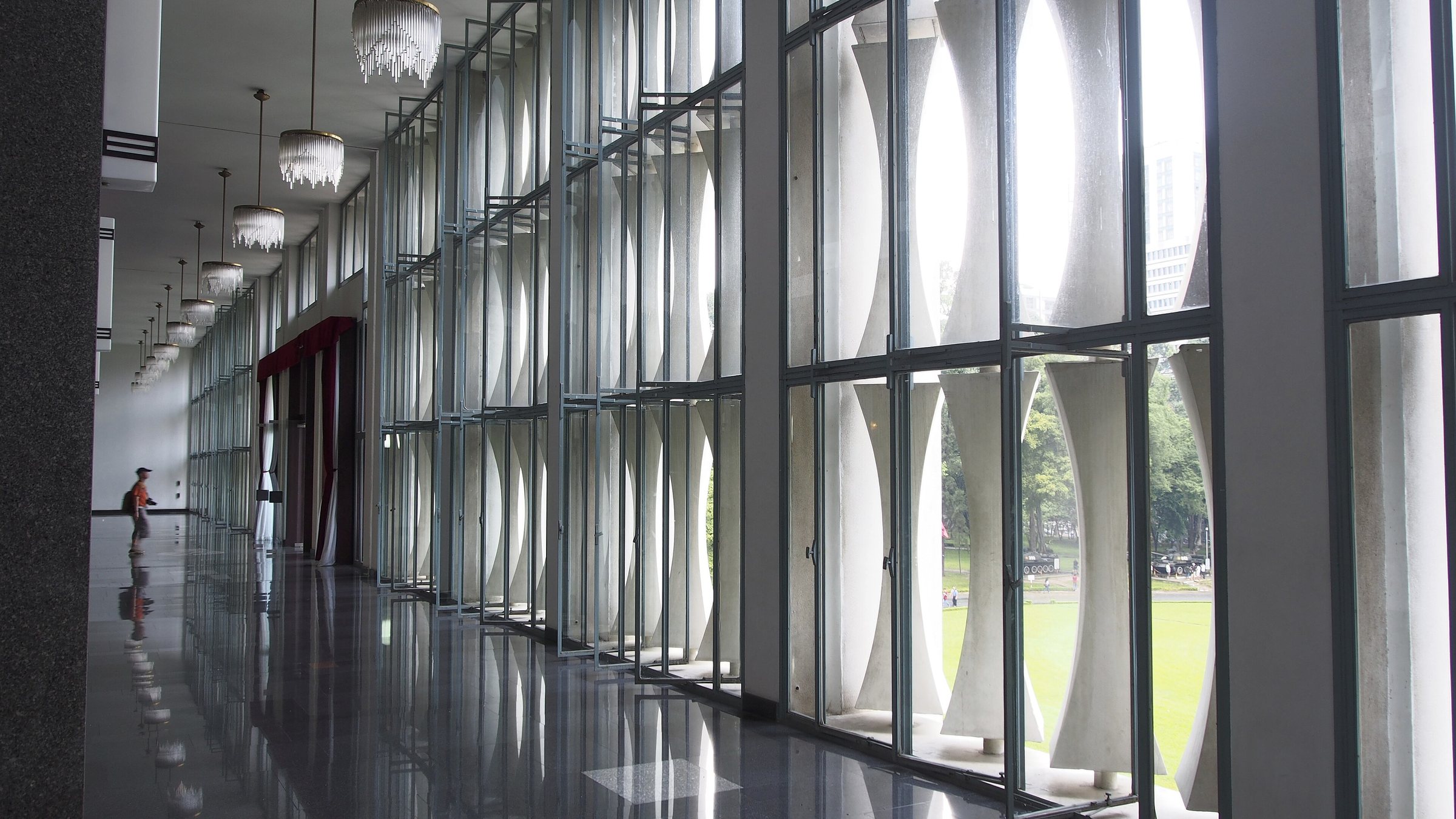
The current palace was designed by Vietnamese architect Ngô Viết Thụ, the first Vietnamese winner of the Grand Prix de Rome (1955), and completed in 1966. Ngô Viết Thụ incorporated references to traditional Vietnamese architectural motifs into a modernist concrete frame — the front façade's vertical fins echo the Chinese character for luck, and the rooftop terrace is shaped to resemble the character for the south.
Internally the building has five floors above ground and runs to around 4,500 square metres of usable space. State rooms on the upper floors retain their original mid-century furnishings: lacquerwork panels, rattan seating, government-issue crockery and a cinema room used for presidential briefings. The aesthetic is a specific period piece — confident, formal and largely untouched since 1975.
30 April 1975 and the preserved interior
At approximately 11:30 on the morning of 30 April 1975, Tank 843 of the People's Army of Vietnam's 203rd Armoured Brigade pushed through the palace's iron gates, followed shortly by Tank 390, which broke them open completely. General Dương Văn Minh, who had assumed the presidency only two days earlier, was inside and broadcast an unconditional surrender that afternoon.
The palace was not looted or substantially altered after that point. The government of unified Vietnam chose to preserve it as a museum, and the majority of rooms remain as close to their 1975 state as conservation allows. Personal effects, communication equipment, maps and documents are still in place. Tank 843 is displayed in the grounds; Tank 390, or a representative vehicle, is also present at various times.
The command bunker
Beneath the building lies a self-contained underground complex that operated as the South Vietnamese military command centre during the war. The bunker extends across multiple levels and includes a telecommunications room fitted with radio and teletype equipment of 1960s and early 1970s vintage, a map room used to track troop movements, a code room, and quarters for staff who would remain operational during air raids.
The communications hardware — much of it American-supplied — remains in place, still labelled and arranged as it was during active use. The bunker sections are among the more visited parts of the complex because they offer direct physical evidence of the war's operational infrastructure rather than its ceremonial face. Lighting is functional rather than atmospheric, and some passages are narrow.
Visiting in practice
The palace is open daily except during official state functions, when parts or all of the building may be closed without advance notice — this is worth confirming on the day of a planned visit. An audio guide is available in several languages including English and is the primary interpretive tool, as room-by-room signage in English is limited. The audio guide covers both the ceremonial floors and the basement complex.
Photography is permitted throughout most of the building. The grounds are large and include garden areas, a helipad used by President Nguyễn Văn Thiệu, and the two tanks. Visitors who read Vietnamese will find the labelling more detailed; those relying solely on the audio guide will still get a thorough account. Prices vary by season and visitor category.
Historical context and interpretation
How the palace is interpreted depends substantially on the visitor's starting point. Vietnamese state presentation frames 30 April 1975 as the day of liberation and national reunification. Many Western visitors, particularly Americans, arrive with a different set of associations shaped by the phrase "fall of Saigon." Both framings are present in the building simultaneously — in the official labelling and in the conversations of tour groups passing through the same rooms.
Historians note that the decision to preserve rather than repurpose the building was not inevitable; comparable structures elsewhere were demolished or converted. The palace therefore functions as an unusually complete physical record of a specific government at a specific moment, whatever interpretation is applied to that moment. Scholarly debate continues about aspects of the final days of April 1975, including the precise sequence of events inside the building on that morning.
Where it is
Also known as / see also
参照元
出典
- Vietnam National Authority of Tourism — VNAT アクセス日 29 August 2026
Supports: the rules and definitions on this page - Dinh Độc Lập — Wikipedia (Vietnamese) (CC BY-SA 4.0) アクセス日 3 September 2026
Supports: background, Vietnamese edition
Current 最終確認: 3 September 2026. Rules, fares and prices change — check the official source before acting on anything here. Report a mistake.
Picture credits (1)
Independence Palace or Reunification Palace (12110275425), Clay Gilliland, CC BY-SA 2.0, Wikimedia Commons