Paradise CaveĐộng Thiên Đường
Overview
Paradise Cave — Động Thiên Đường in Vietnamese — sits within Phong Nha-Ke Bang National Park in Quảng Bình province. Discovered in 2005 by a local logger and subsequently surveyed by the British Cave Research Association, it runs approximately 31 kilometres in total length, making it one of the longest dry caves in Asia. The cave was opened to general visitors in 2010.
Unlike the river cave at Phong Nha itself, Paradise Cave contains no underground waterway at the standard visitor level. It is a fossil cave — formed by water that has long since drained away — which accounts for the relative silence inside and the exceptional preservation of its speleothem formations.
Getting to the Entrance
The ticketed area begins at a reception building roughly 10 kilometres from the Phong Nha township. From the reception, visitors face a climb to the cave mouth. Two options exist: a wooden boardwalk staircase ascending through forest, or a motorised buggy that covers the same route. The staircase takes around fifteen to twenty minutes on foot and passes through secondary jungle; the buggy is available for those who prefer not to walk the incline. Prices vary by season and are listed separately.
The cave entrance itself is a wide, arching mouth set into a limestone cliff, shaded by overhanging vegetation. The transition from bright tropical light to the dimly lit interior is abrupt.
The Boardwalk Section
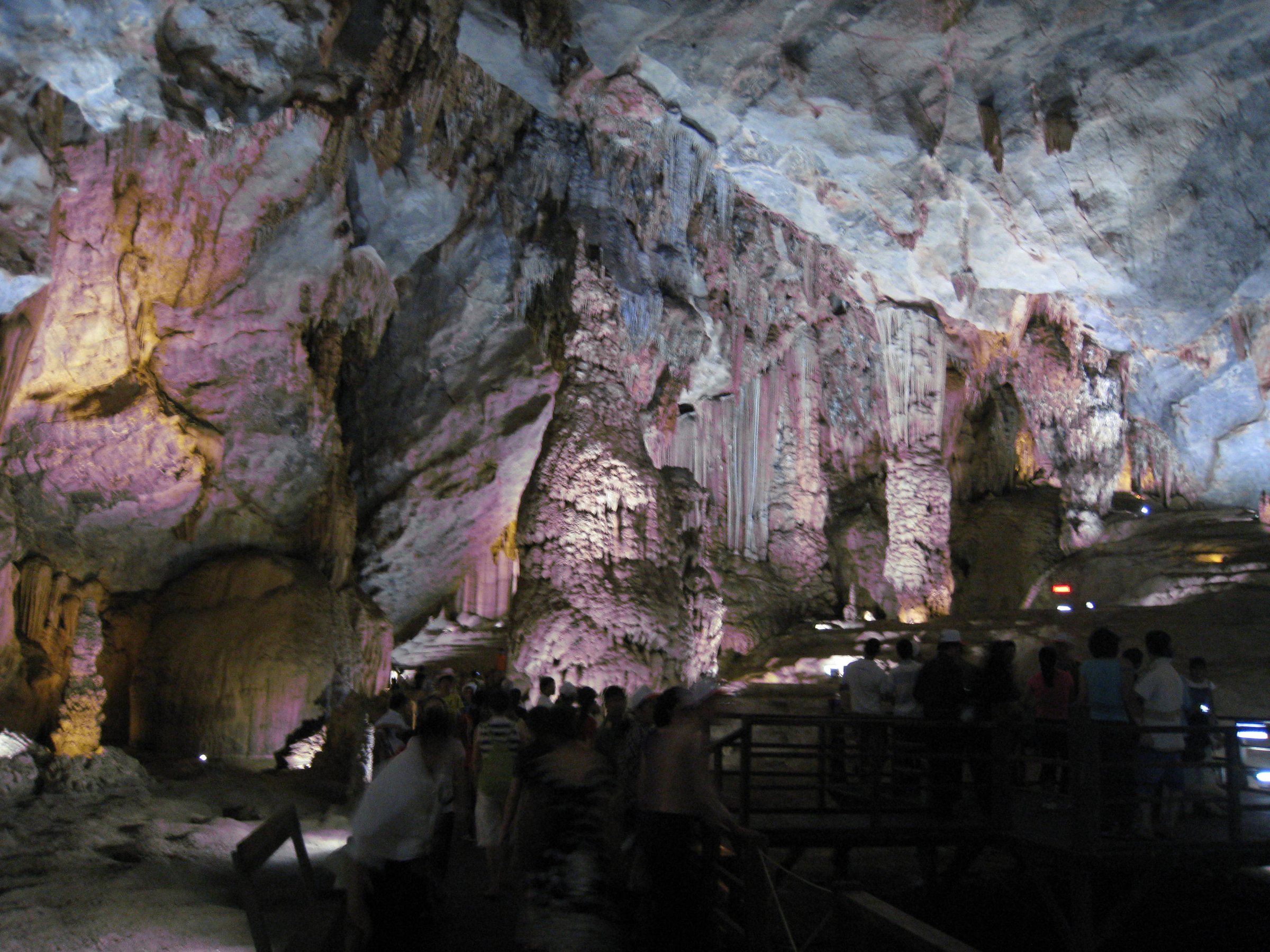
A raised timber boardwalk extends approximately one kilometre into the cave, illuminated by fixed lighting. This is the route available to all general visitors without additional permits or equipment. The boardwalk descends gradually from the entrance into a sequence of chambers that grow progressively taller; the main hall reaches a ceiling height of around 72 metres at its apex.
The formations along this section include curtained stalactites, columns formed where stalactites and stalagmites have joined, and pale flowstone floors. The lighting is directional, designed to pick out specific formations rather than illuminate the cave uniformly, which leaves large areas in shadow. The boardwalk ends at a turning platform; visitors return by the same path.
The interior temperature remains stable at around 18–20 °C regardless of the season outside, which feels notably cool after the heat of the Quảng Bình summer.
The Adventure Route
Beyond the boardwalk terminus, a longer expedition route — sometimes marketed as the 7-kilometre or full cave tour — continues into the unlit sections of the cave. This route requires advance booking through the national park authority, a guide, headlamps and basic protective clothing. Sections involve traversing sandy dry riverbeds, scrambling over boulder falls and wading shallow pools where seasonal water collects.
The deeper sections contain formations and chamber scales not accessible on the standard boardwalk visit, including areas where the cave floor is carpeted with fine sand deposited by ancient water flow. Group sizes on the adventure route are capped and departure times are fixed; independent entry beyond the boardwalk is not permitted.
Comparison with Phong Nha Cave
The two most-visited caves in the national park are frequently compared by visitors. Phong Nha cave is reached primarily by boat along the Chày River, entering through a dramatic river portal; Paradise Cave is reached overland and on foot. Phong Nha cave is a wet or active cave with a navigable underground river, giving it a different character — darker, more atmospheric in a rawer sense, and shorter in its accessible section. Paradise Cave is dry, taller in its main chambers, and generally considered to have denser and more varied speleothem formations.
Phong Nha cave's boat journey is itself a significant part of the experience, whereas Paradise Cave's appeal is almost entirely interior. Visitors with limited time sometimes choose one over the other based on this distinction; the national park ticket structure treats them as separate sites.
Practical Notes
Entry is managed by the Phong Nha-Ke Bang National Park authority. Tickets are purchased at the main reception area and cover the boardwalk visit; the adventure extension requires a separate booking made in advance. The cave operates daily, though hours and access conditions can be affected by flooding during the Quảng Bình wet season, roughly September to November, when parts of the trail and boardwalk approach may be temporarily closed.
Footwear with grip is advisable even on the boardwalk, as the surfaces can be damp and cool. Photography is permitted throughout the standard section; tripods and specialist lighting equipment may require separate arrangement. There is no mobile signal inside the cave.
Where it is
Also known as / see also
Referenziert von
Quellen
- Vietnam National Authority of Tourism — VNAT abgerufen 29 August 2026
Supports: the rules and definitions on this page - Động Thiên Đường — Wikipedia (Vietnamese) (CC BY-SA 4.0) abgerufen 3 September 2026
Supports: background, Vietnamese edition
Current Zuletzt geprüft: 3 September 2026. Rules, fares and prices change — check the official source before acting on anything here. Report a mistake.
Picture credits (1)
ThienDuongCave1, Genghiskhan, CC BY-SA 3.0, Wikimedia Commons