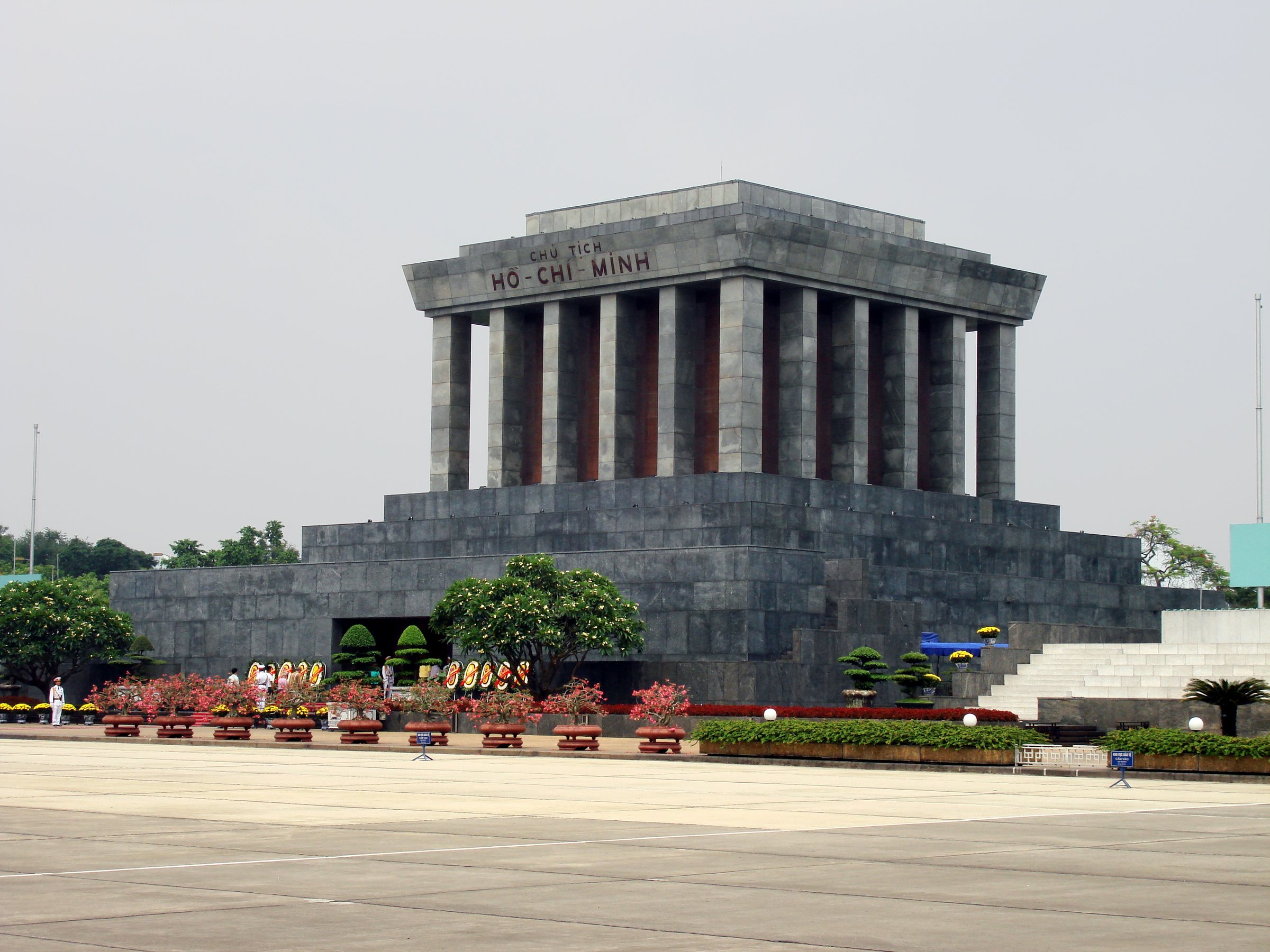
Ho Chi Minh MausoleumLăng Chủ tịch Hồ Chí Minh
What it is
The Ho Chi Minh Mausoleum (Lăng Chủ tịch Hồ Chí Minh) is a large granite structure on the western edge of Ba Dinh Square in Hanoi. It was built between 1973 and 1975 and inaugurated on 29 August 1975, almost a decade after Ho Chi Minh's death on 2 September 1969. Inside, the embalmed body of the Democratic Republic of Vietnam's first president lies in a climate-controlled glass case in a darkened chamber. The structure draws heavily on Soviet mausoleum architecture — the Lenin Mausoleum in Moscow provided both a design reference and technical assistance with the embalming — while incorporating local materials, including grey-blue granite quarried from Ngũ Hành Sơn in what is now Đà Nẵng.
Ba Dinh Square itself is the site where Ho Chi Minh read the Declaration of Independence on 2 September 1945, establishing the Democratic Republic of Vietnam.
Ho Chi Minh's own wishes
A significant and widely noted point of tension surrounds the mausoleum's existence: Ho Chi Minh's will, drafted in stages between 1965 and 1969 and made public after his death, explicitly requested that his body be cremated and the ashes divided into three urns to be buried on hills in the north, centre, and south of the country. He described cremation as more hygienic and less land-consuming than burial, and expressed a wish not to burden the people with an elaborate funeral.
The Vietnamese government chose instead to preserve his body, citing the desire to allow future generations to see him. This decision remains a subject of historical commentary. The official position frames the mausoleum as a tribute consistent with the collective will of the Vietnamese people, while historians and biographers continue to note the divergence from his written instructions.
Visiting rules
Entry to the mausoleum chamber is subject to strict conditions, enforced by military guards at multiple points along the approach.
- Dress: Shoulders and knees must be covered. Hats must be removed before entering the chamber.
- Bags and cameras: Neither is permitted inside the chamber. Storage facilities are available nearby. Phones must be put away.
- Silence and conduct: Talking is not permitted inside. Visitors move in a slow, single-file queue past the glass case and may not stop, gesture, or cross their arms.
- Queue: The line forms outside and can be long on weekends and public holidays, particularly around 2 September (National Day) and 19 May (Ho Chi Minh's birthday).
- Opening hours: The mausoleum is open only in the mornings, on specific days of the week. Hours are not listed here as they are subject to change; confirm locally or via official Vietnamese government sources before visiting.
Rules are enforced firmly. Visitors who do not comply are turned away.
Annual closure for maintenance
The mausoleum closes for approximately two months each year — typically from early September through mid-November — while Ho Chi Minh's body is sent to Russia for preservation maintenance. The exact dates shift slightly from year to year. During this closure, the surrounding grounds and some adjacent sites remain accessible, but the chamber itself is shut. Travellers whose itineraries include a specific visit to the interior should check the closure schedule before planning their trip, as the window overlaps with the post-summer travel season.
The surrounding complex
The mausoleum occupies the centre of a broader compound that contains several other historically significant structures.
- Ho Chi Minh's Stilt House (Nhà sàn Bác Hồ): A wooden house on stilts built in 1958, modelled loosely on the architecture of Vietnam's ethnic minority groups. Ho Chi Minh lived and worked here from 1958 until shortly before his death, preferring it to more formal accommodation. The interior is preserved as it was during his lifetime, including his study and personal library.
- The Presidential Palace (Phủ Chủ tịch): A yellow colonial-era building constructed by the French between 1900 and 1906 as the residence of the Governor-General of Indochina. Ho Chi Minh declined to live in it, considering it too grand. It is not open to the general public.
- One Pillar Pagoda (Chùa Một Cột): A small Buddhist pagoda standing on a single concrete column over a square lotus pond, a short walk from the mausoleum. The original structure dates to 1049 under Emperor Lý Thái Tông of the Lý dynasty, though the current pagoda is a 1955 reconstruction after the French destroyed the previous structure upon withdrawal from Hanoi.
Getting there and practical notes
The mausoleum is located in the Ba Dinh area of Hanoi, approximately two kilometres west of Hoan Kiem Lake. It is reachable on foot from the Old Quarter in around 25 to 30 minutes, or by taxi, ride-hailing app, or city bus. The main entrance for visitors is on Hung Vuong Street.
Entry to the mausoleum chamber is free of charge, though fees may apply at adjacent museums within the complex. Prices vary by season and site; check locally for current figures.
The compound is a working site with an ongoing military ceremonial function. Guards change at regular intervals in a formal ceremony visible from the square. Photography is permitted in the open grounds and square but not inside the chamber.
Where it is
Also known as / see also
Referans veren sayfalar
Kaynaklar
- Vietnam National Authority of Tourism — VNAT erişildi 29 August 2026
Supports: the rules and definitions on this page - Ho Chi Minh Mausoleum — Wikipedia (CC BY-SA 4.0) erişildi 3 September 2026
Supports: background - Lăng Chủ tịch Hồ Chí Minh — Wikipedia (Vietnamese) (CC BY-SA 4.0) erişildi 3 September 2026
Supports: background, Vietnamese edition
Current Son doğrulama: 3 September 2026. Rules, fares and prices change — check the official source before acting on anything here. Report a mistake.
Picture credits (1)
Lăng Chủ tịch Hồ Chí Minh, Unknown, CC BY 2.0, Wikimedia Commons