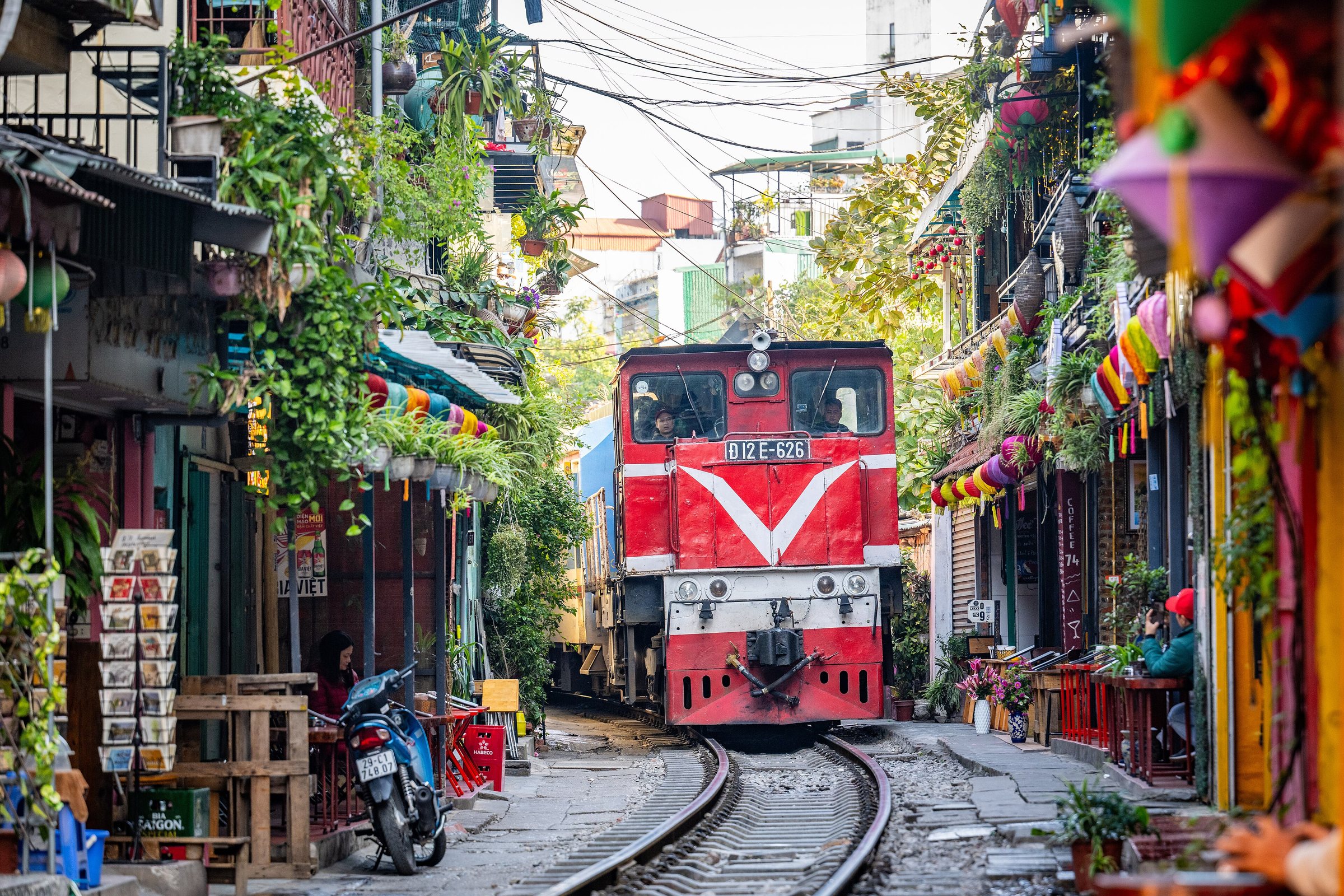
Hanoi Train StreetPhố đường tàu
What Train Street is
Hanoi's Train Street — Phố đường tàu in Vietnamese — refers primarily to a section of narrow residential alley running alongside and across the active Hanoi–Ho Chi Minh City railway line near Điện Biên Phủ and Lê Duẩn streets, roughly between Hàng Bông and Khâm Thiên. The railway itself is not incidental: it runs through a corridor so tight that the clearance between passing carriages and the walls of houses, and the chairs of anyone sitting outside, is a matter of centimetres. Residents have lived alongside the line for generations, and their daily routines — parking motorbikes, hanging laundry, running small shops — are organised around scheduled train movements.
The café era and the safety closures
From roughly 2017 onward, small cafés began operating along the lane, occupying the space between the tracks and house fronts and positioning tables directly on or immediately beside the sleepers. Photographs of trains passing through crowds of seated visitors spread widely online, drawing large numbers of tourists. Hanoi city authorities closed the cafés on safety grounds in October 2019, citing the risk to visitors who were standing on or near the live track during train passages. Cafés reopened within months, were closed again, and the cycle has continued. The core objection from authorities has remained consistent: the presence of crowds on and around an active railway constitutes a serious hazard, and the cafés were seen as commercially incentivising that presence. No permanent regulatory settlement had been reached as of mid-2025, and the access situation remained subject to change at short notice.
The railway is live
This point warrants plain statement: the tracks are part of Vietnam's operational national rail network. Trains run on this section multiple times daily, and their passage is not staged for visitors. Clearances between a moving train and a person standing at the edge of the alley are extremely small. The railway authority posts warnings and, during closures, barriers are placed at alley entrances, though these are not always staffed. Visitors who have accessed the lane during previous open periods have at times been ushered back by residents or local officials as trains approached. The trains do not stop for bystanders.
Current access position
Whether the lane is accessible to visitors at any given time depends on the current enforcement posture of Hanoi city authorities, which has changed multiple times and can shift without advance notice or wide coverage in English-language media. During closure periods, access to the alley is restricted and the cafés are shuttered. During periods of reduced enforcement, cafés have reopened and visitors have been able to walk the lane. Anyone intending to visit should check recent, dated accounts rather than relying on any single source — including this page — for the current status. The situation as described here reflects the pattern as of mid-2025; it may have changed.
Location and practicalities
The lane most associated with Train Street runs roughly parallel to Trần Phú and is accessible via narrow entrances off Lê Duẩn and nearby streets in the area south of Hoàn Kiếm. It sits within the older residential fabric of central Hanoi, not in the Old Quarter itself. The section that attracted most visitor attention is relatively short — a few hundred metres. The lane is residential throughout: houses are occupied, and the alley functions as a normal street outside of train passages. There are no formal visitor facilities, ticketing or organised viewing arrangements. Prices vary by season for any food or drink available in the vicinity when cafés are operating.
Context and character
Train Street became one of the most reproduced images of Hanoi in travel media during the late 2010s, to a degree that the authorities considered disproportionate to its safety profile. The tension between its photographic appeal and its status as functioning infrastructure in a residential neighbourhood has defined its recent history. The residents living along the lane are not performers or participants in a tourist attraction; the railway passing their doors is simply a feature of where they live, as it has been since the line was built under French colonial administration in the early twentieth century. The broader Hanoi–Ho Chi Minh City line, colloquially called the Reunification Express, runs the full length of the country.
Where it is
Also known as / see also
참조 페이지
출처 목록
- Vietnam National Authority of Tourism — VNAT 접근됨 29 August 2026
Supports: the rules and definitions on this page - Hanoi Train Street — Wikipedia (CC BY-SA 4.0) 접근됨 3 September 2026
Supports: background - Phố đường tàu Hà Nội — Wikipedia (Vietnamese) (CC BY-SA 4.0) 접근됨 3 September 2026
Supports: background, Vietnamese edition
Current 마지막 확인: 3 September 2026. Rules, fares and prices change — check the official source before acting on anything here. Report a mistake.
Picture credits (1)
Hanoi Train Street (20231225b) (53489076293), Takeshi Aida from Hong Kong, Hong Kong, CC BY-SA 2.0, Wikimedia Commons