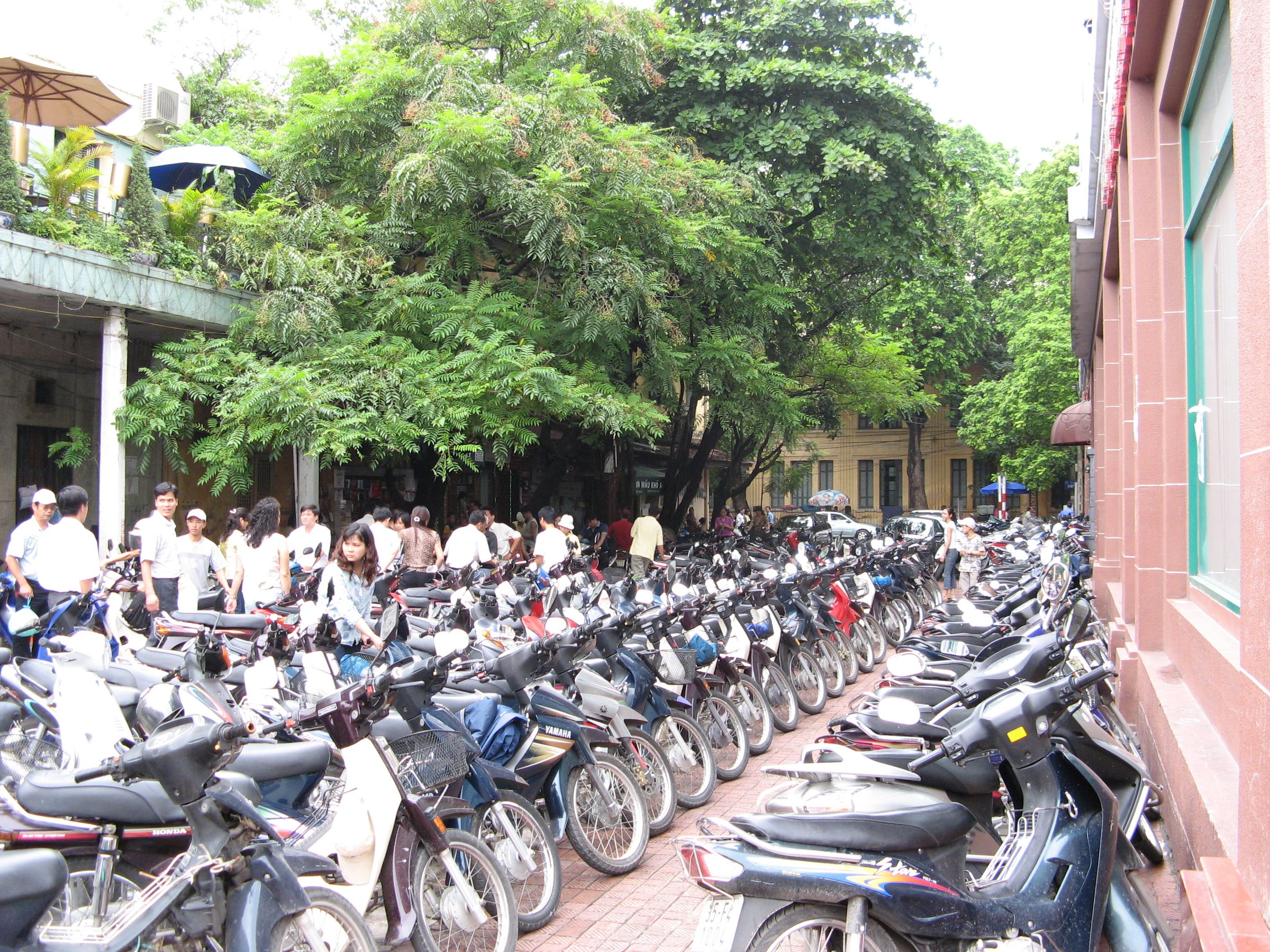
Hiring and riding a motorbikeThuê xe máy
Hiring a motorbike in Vietnam gives access to routes and areas that buses and taxis do not serve well, and is a common choice for travellers in cities such as Hanoi, Da Nang and Ho Chi Minh City as well as on longer touring routes. The legal framework around licences, insurance and helmets is clear in principle, though enforcement is uneven, and the gap between what is common practice and what the law requires is wider than in most countries.
Licence requirements
Vietnamese law requires a valid licence to ride any motorised two-wheeler on a public road. For foreign nationals, two options exist in principle: a Vietnamese driving licence, or an International Driving Permit (IDP) accompanied by the licence from the holder's home country.
The IDP category matters. An IDP endorsed only for cars does not authorise the holder to ride a motorbike. The relevant category in most IDP frameworks is the one covering motorcycles; holders should check their own permit explicitly. An IDP covering only automobiles provides no legal cover for riding in Vietnam.
Whether a particular IDP format is accepted without question by police or courts is not fully settled in practice, and the rules can change by ministerial decree. The official position of Vietnamese traffic authorities is the authoritative source, not this page or advice from hire shops.
Riding without a valid, appropriate licence is an offence. The consequences include fines, vehicle confiscation and, in the event of an accident, the probable invalidation of any insurance claim — including third-party liability coverage that might otherwise protect someone injured by the rider.
Insurance
Basic compulsory third-party insurance is typically included with a hired motorbike in Vietnam, covering injury to other parties in an accident. However, this cover is almost universally void if the rider does not hold the correct licence at the time of the incident. In that circumstance, the rider bears personal liability for any damages, including medical costs for injured third parties.
Comprehensive or collision cover — protecting the bike itself — is rarely included in a standard hire agreement. Damage to the hired vehicle is generally the hirer's responsibility, and hire shops will invoke the deposit or pursue the hirer directly for repair costs.
Some travel insurance policies include motorbike riding, but the majority exclude it entirely, or include it only when the rider holds a valid local or international licence for the category of vehicle. Travellers should check their policy wording explicitly before riding, not after an incident.
Helmets
Wearing a helmet is compulsory for the rider and all passengers on a motorbike in Vietnam. The law applies on all public roads. Helmets must meet a Vietnamese standard; novelty or decorative helmets that do not meet the standard are technically non-compliant, though enforcement focuses primarily on whether a helmet is worn at all.
Many hire shops provide a helmet with the bike. The quality varies considerably. A rider hiring from a shop that provides only a thin plastic shell may prefer to source a better-quality helmet independently; these are widely available for purchase or, at some shops, separate hire. Riding without a helmet draws police attention and a fine, and in an accident it is a significant factor in injury severity.
Deposits, passports and the hire agreement
Hire shops commonly ask for either a cash deposit or the hirer's passport as security. Leaving a passport with a third party creates real risk: if a dispute arises, recovering the document can be difficult, and travelling without a passport is itself a legal problem. Some travellers use a certified copy of the passport's photo page instead; whether a given shop accepts this varies and should be established before signing anything.
A cash deposit is generally preferable to surrendering a passport. The deposit amount and the conditions under which it is returned or withheld should be stated clearly in a written hire agreement. If no written agreement is offered, ask for one.
Before accepting the bike, inspect it thoroughly in daylight. Photograph every existing scratch, dent, cracked mirror and worn tyre, and ensure the shop acknowledges the pre-existing damage in writing or on the agreement. Disputes over damage that existed before hire are among the most common complaints from travellers. Check that the brakes, lights, horn and fuel level are as expected before leaving the premises.
Fuel
Petrol stations are frequent in cities and on main roads, and motorbikes in Vietnam typically run on standard unleaded fuel (RON 95 is the most common grade). In rural areas, roadside vendors sell fuel in glass bottles or jerricans; it is usually available but the grade is uncertain. Many riders on longer routes carry a small reserve container.
Most motorbikes available for hire in Vietnam are 100–150cc automatic or semi-automatic step-throughs. Fuel consumption is modest, and the range between fills is generally comfortable for day trips. Larger-engined bikes are available but less common in the standard hire market.
Police stops
Traffic police checkpoints are a regular feature on Vietnamese roads, particularly on busy arterial routes and during holiday periods. Officers may check licence, registration papers (the vehicle's registration document should be carried when riding), helmet compliance and the condition of the bike.
The registration papers for a hired bike should be provided by the hire shop. Riding without them is an additional infraction. A rider stopped without a valid licence faces a fine and potentially the impounding of the vehicle. The fine is paid on the spot in most cases, though the formal procedure involves a receipt.
Interactions with police are generally transactional rather than confrontational. Having documents organised and legible, and being calm and cooperative, tends to resolve stops more quickly. If a rider believes a demand is improper, noting badge numbers and seeking formal receipts for any payment is the correct response.
Risk in context
Vietnam's road fatality rate is among the higher ones in the region. Urban traffic in cities such as Ho Chi Minh City, Hanoi and Da Nang is dense and fast-moving by the standards of many Western cities. Rural roads vary from well-maintained highways to narrow mountain tracks with poor surfaces, no barriers and limited lighting at night.
The risks are real and not evenly distributed. An unlicensed rider who lacks experience on left-hand or mixed-traffic roads, who is unfamiliar with the bike, and whose travel insurance is voided by unlicensed riding, is in a substantially more vulnerable position than the surface-level ease of hiring a bike might suggest. None of this means riding is impossible to do safely — many people ride extensively in Vietnam without incident — but the risk picture should be understood before deciding, not rationalised afterwards.
Riders new to Vietnamese traffic conditions generally find that starting in quieter towns or on less-trafficked routes, and riding conservatively until the traffic patterns become familiar, reduces exposure significantly.
Also known as / see also
Bedient
Referenziert von
Quellen
- Ministry of Transport — Ministry of Transport of Vietnam abgerufen 29 August 2026
Supports: carried over from the first build - Vietnam National Authority of Tourism — VNAT abgerufen 29 August 2026
Supports: carried over from the first build
Current Zuletzt geprüft: 29 August 2026. Rules, fares and prices change — check the official source before acting on anything here. Report a mistake.
Picture credits (1)
Motorbikes at hanoi vietnam, William Whyte, CC BY-SA 2.0, Wikimedia Commons