Hanoi to Da Nang
How to get there
765 kmThe obvious flight, or the train for the Hai Van pass — the finest stretch of railway in the country is the last two hours of it.
| Option | Typical time | How often | What it is like | Best for | 運賃 |
|---|---|---|---|---|---|
| Flight Flight | 1h 20m in the air | Very frequent | Standard short-haul | Most people | not verified |
| Train Reunification Express | 16–17 hours | Several daily | Soft sleeper | The coastal run over the Hai Van pass | not verified |
Times are typical door-to-door ranges, not a timetable, and they move with traffic, weather and season. A fare is shown only where we have checked it against a published source on the date given; everywhere else it says so rather than guessing. Confirm both with the operator before you book.
Options last reviewed: 2026-09-03
Flying
Several carriers operate the route from Hanoi's Noi Bai International Airport (IATA: HAN) to Da Nang International Airport (IATA: DAD), and flights depart throughout the day from early morning until late evening. Vietnam Airlines, VietJet Air and Bamboo Airways all serve the route; the low-cost carriers dominate by volume.
Noi Bai lies around 45 km north of Hanoi's centre — allow at least 60–90 minutes from the Old Quarter by taxi or the airport bus, more during morning and evening peak hours. Da Nang's airport sits inside the city and is reachable from most of its central districts within 15–20 minutes by taxi or ride-hailing app.
Booking opens several months in advance on airline websites and aggregators. Fares fluctuate significantly with lead time and season; the Tết period (late January to mid-February) and summer school holidays (June–August) see both high demand and price spikes. Baggage allowances vary by fare class and carrier — low-cost tickets frequently include cabin baggage only.
The main things that go wrong: overbooking on busy dates, last-minute schedule changes by budget carriers, and taxi touts at arrival. Use metered taxis or pre-booked ride-hailing at both ends.
The Reunification Express
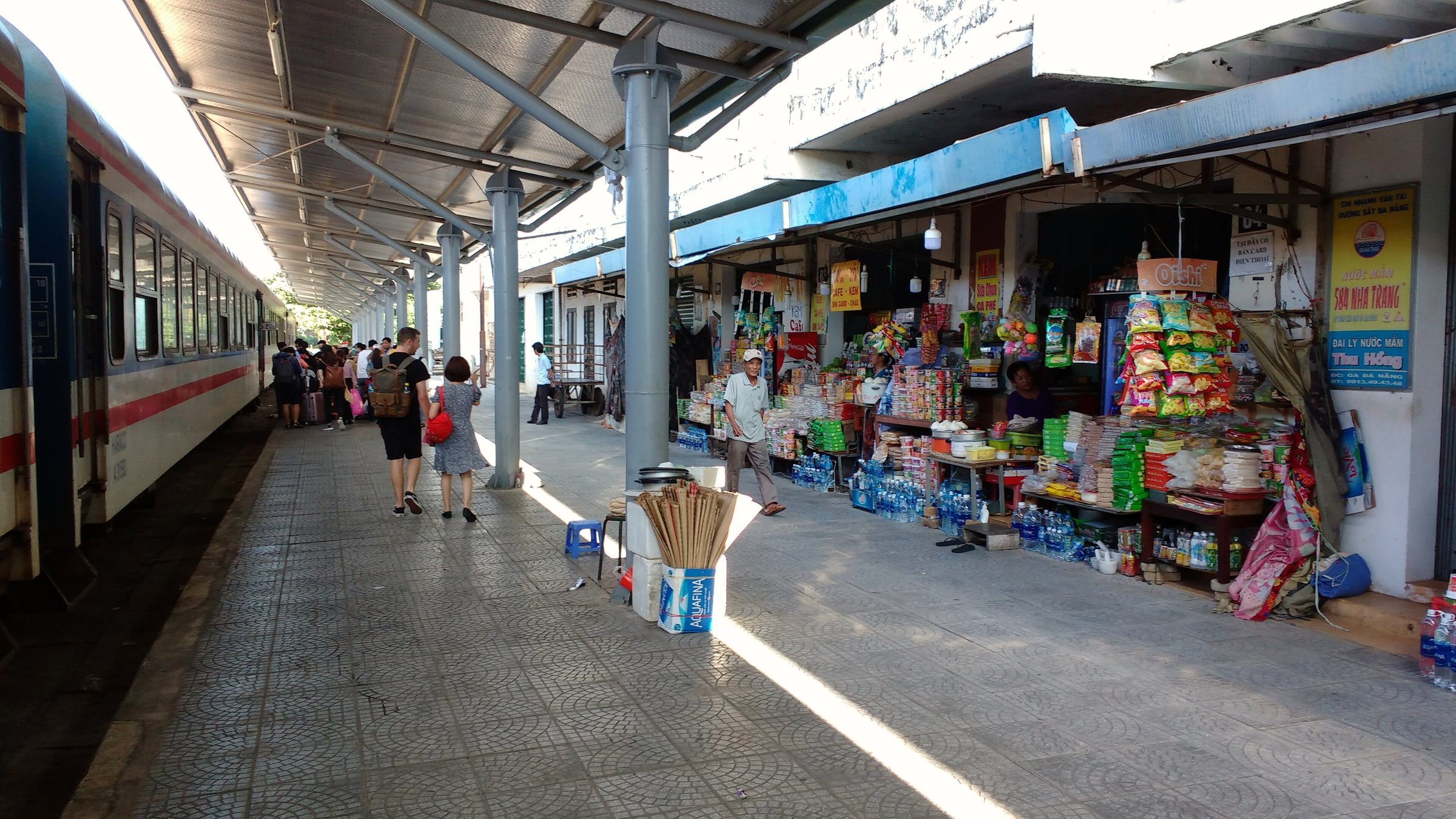
The Reunification Express (Tàu Thống Nhất) runs the length of Vietnam on a single-track metre-gauge line. Hanoi's Ga Hà Nội (Hanoi Station), near the city centre on Lê Duẩn Street, is the departure point. Da Nang Station (Ga Đà Nẵng) on Hải Phòng Street is equally central — a short taxi ride from the beach and most accommodation.
Several services run daily; the fastest cover the distance in around 16–17 hours, typically departing Hanoi in the evening and arriving in Da Nang the following morning, or departing mid-morning and arriving late at night. Soft-sleeper four-berth cabins are the standard choice for this distance: air-conditioned, with a lockable door and linen provided. Hard sleeper is cheaper but louder; the SE trains (numbered SE1–SE8) are newer and more comfortable than older stock.
Tickets are sold through Vietnam Railways' official website and at station counters. The online system requires a working email address for the e-ticket and can be slow around holidays. Third-party booking agents — both local and international — charge a service fee but simplify the process and handle issues in English. Sleeper berths on popular dates, particularly weekends and the pre-Tết rush, sell out weeks ahead.
The train does not allow changes or refunds close to departure on many fare types; read the conditions before purchasing.
The Hai Van Pass section
The last two hours of the northbound journey — or the opening two hours southbound, depending on direction — take the train across the Hai Van Pass (Đèo Hải Vân), a coastal mountain range that separates the Red River Delta climate zone from central Vietnam. The track hugs cliff faces above the South China Sea, passes through a series of tunnels, and crests at around 500 metres before descending into Da Nang.
This stretch is widely regarded as the finest railway scenery in Vietnam. Visibility is best in the dry season for central Vietnam (roughly February to August); the pass is frequently shrouded in low cloud during the north-east monsoon (September to January). Seating on the sea-facing side varies by direction of travel: westward-facing on a southbound journey, eastward-facing northbound. Passengers in sleeper cabins may need to move to a seated area or corridor to view the pass.
The road crossing of the Hai Van Pass — the old Highway 1 route — is a separate experience entirely and not covered on this route page.
Choosing between the options
The flight suits travellers prioritising time, those with tight onward connections, families with young children, and anyone who finds overnight journeys uncomfortable. It is the default choice for business travel between Hanoi and Da Nang.
The train suits travellers with a flexible schedule, those who want to arrive rested without paying for a hotel night, and anyone specifically interested in the Hai Van Pass scenery. An overnight departure from Hanoi covers distance while the traveller sleeps, arriving in Da Nang in the morning — a reasonable trade-off against the longer total journey time.
There is no bus option on this route that competes seriously with either the flight or the train at this distance — the journey by road would take upwards of 14–15 hours on a sleeper bus, with less comfort and no scenic dividend comparable to the pass by rail.
Prices vary by season, class, carrier and booking lead time; consult current listings on airline and railway websites before comparing modes.
Seasonal considerations
Hanoi and Da Nang have different climate rhythms, which affects both demand and journey conditions. Hanoi is driest October to December and wettest June to September. Da Nang's rainy season runs from September to January, driven by the north-east monsoon — the opposite pattern to the south of Vietnam.
Flight and train demand peaks during Tết (the Lunar New Year, falling in late January or February), the April–May national holidays, and the June–August summer period when domestic tourism surges. Booking well in advance is essential for travel in any of these windows. The Tết blackout period around the core holiday dates sees some services fully booked a month or more ahead.
Typhoons affecting the central Vietnamese coast — Da Nang's region in particular — occur mainly between September and November. Flights may be cancelled or delayed; train services are occasionally suspended on the coastal section. Travellers with fixed itineraries in this window should allow flexibility.
Connects
参照元
出典
- Ministry of Transport — Ministry of Transport of Vietnam アクセス日 29 August 2026
Supports: the rules and definitions on this page - Vietnam National Authority of Tourism — VNAT アクセス日 29 August 2026
Supports: the rules and definitions on this page
Ageing 最終確認: 3 September 2026. Rules, fares and prices change — check the official source before acting on anything here. Report a mistake.
Picture credits (1)
Da Nang Railway Station (48895892423), Nick, CC BY 2.0, Wikimedia Commons