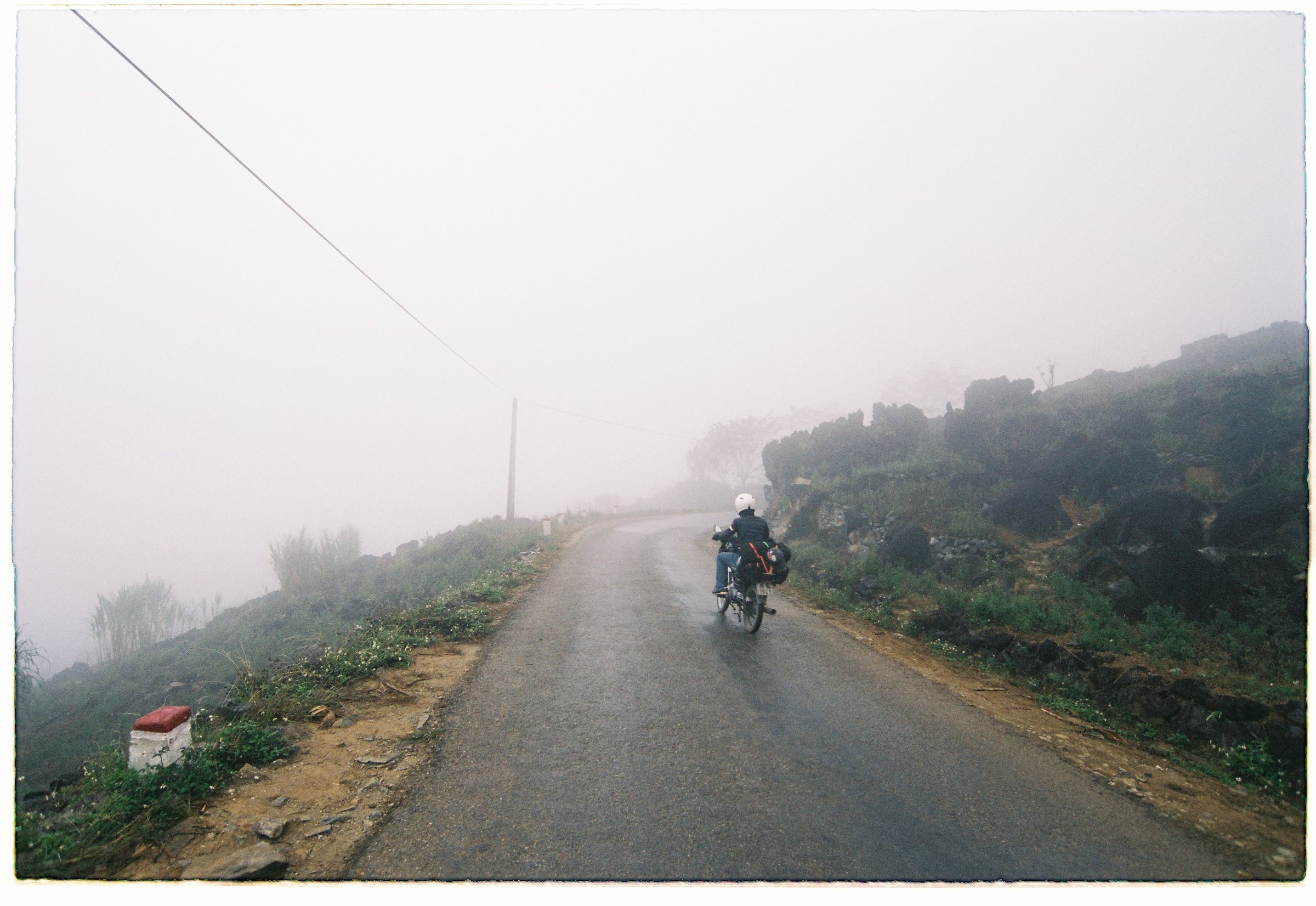
Riding the Ha Giang LoopCung đường Hà Giang
The Ha Giang Loop begins and ends in Ha Giang city, the capital of Ha Giang province in Vietnam's far north. The circuit threads through Dong Van Karst Plateau Geopark — a UNESCO-recognised landscape of limestone peaks, deep river gorges and terraced hillsides — before looping back via the market town of Meo Vac and the Nho Que River valley. Most riders complete it in three to four days.
Typical journey times
| Journey | Typical time | How often | Notes |
|---|---|---|---|
| Motorbike Ha Giang → Yen Minh | 3 – 4 hours | Day 1 | Allowing for stops; the riding time alone is shorter. |
| Motorbike Yen Minh → Dong Van | 3 hours | Day 2 | Past Lung Cu and the Hmong King's palace. |
| Motorbike Dong Van → Meo Vac | 1h 30m – 2 hours | Day 3 | The Ma Pi Leng pass. Short, and the reason you came. |
| Motorbike Meo Vac → Ha Giang | 5 – 6 hours | Day 3 or 4 | The long way back. |
Typical door-to-door ranges, not a timetable. Road times move with traffic and weather, and sea crossings are cancelled outright in rough conditions — confirm with the operator on the day. Last reviewed: 2026-09-10.
The route, day by day
There is no single canonical itinerary, but the most common direction runs clockwise from Ha Giang city. A typical breakdown over four days is as follows.
- Day 1 — Ha Giang to Dong Van: The road climbs through Quan Ba (the Twin Mountains viewpoint sits just off the main road) and continues north through Yen Minh. The scenery shifts from forested hills to open limestone karst. Dong Van old quarter, a cluster of tile-roofed houses recognised as a national heritage site, is the usual overnight stop.
- Day 2 — Dong Van to Meo Vac: The shortest day in distance but the most intense in riding. The road crosses Ma Pi Leng pass, a high ridge with sheer drops to the Nho Que River far below. A viewpoint partway along the pass is a standard rest stop. Meo Vac is a market town with a Saturday market drawing traders from surrounding communities.
- Day 3 — Meo Vac to Bao Lac or Du Gia: Riders descend from the plateau. The road surface becomes more variable. Some itineraries detour to Lung Cu, Vietnam's northernmost point and flagpole, as a side trip from Dong Van before heading south.
- Day 4 — Return to Ha Giang: The final leg passes through lower valley terrain and is generally less technical than earlier stages.
A three-day version compresses days one and two or days three and four, which makes for long hours in the saddle on mountain roads.
Self-drive versus easy rider
Riders have two broad options: hiring a bike and riding independently, or travelling pillion with a local guide — often called an easy rider arrangement.
Self-drive suits people with prior experience on manual motorbikes, ideally in variable road conditions. The route includes steep gradients, hairpin bends, unpaved sections and, in wet weather, mud and loose gravel. Riders who have only ridden automatics in flat cities consistently underestimate the demands of the passes.
Easy rider means sitting behind a local driver-guide who knows the road, can translate in villages, and handles breakdowns. The trade-off is less control over pace and stops, and the quality of guides varies considerably. Asking for references from other travellers or checking recent forum discussions is the practical way to distinguish experienced guides from opportunists.
A middle option is joining a small guided group on rented bikes, where the guide rides independently and participants follow. This suits riders who are competent but want local knowledge and a safety net.
Licences, insurance and what is actually covered
The licence question is genuinely unsettled and enforcement is inconsistent, which makes honest advice difficult. Formally, Vietnam requires a Vietnamese driving licence or an International Driving Permit (IDP) endorsed for motorbikes to ride legally on public roads. Many riders complete the loop without one and are never stopped; others are pulled over at checkpoints and face on-the-spot fines. Neither outcome can be predicted reliably.
The practical implication for insurance is more serious. Standard travel insurance policies typically exclude claims arising from riding a motorised vehicle without a valid licence for that vehicle in the country of travel. If a rider without the correct licence is injured or causes injury to a third party, the insurer is likely to decline the claim. This is not a theoretical risk on a route with the gradients and road conditions of the Ha Giang Loop.
Before hiring a bike, read the actual policy wording — not a summary page — and, if in doubt, contact the insurer directly. Some specialist travel policies cover motorbike riding without an IDP; most do not.
Renters should also clarify the hire company's own liability terms. Damage deposits are standard, and the definition of what counts as rider negligence varies.
Bike hire and pre-departure checks
Bikes are hired in Ha Giang city, where several rental shops operate near the town centre. The most commonly available options are semi-automatic trail bikes (often Chinese-manufactured Honda Win copies or genuine Hondas) and, less frequently, larger manual bikes. Automatic scooters are generally not recommended for the passes by anyone with experience of the route.
Condition varies enormously between hire companies. Before accepting a bike, a methodical check is worthwhile: brakes front and rear, tyre tread and pressure, chain tension, lights, fuel level, horn, and any visible oil leaks. Test the bike at low speed before loading luggage. Photograph existing damage thoroughly and confirm it is noted in writing on the hire agreement.
Carry a basic tool kit and a puncture repair kit, or confirm the hire company provides one. Punctures on gravel sections are common. Roadside mechanics (thợ sửa xe) exist in most villages along the route, but distances between them on the plateau can be substantial.
Fuel: Petrol stations are present in Ha Giang city, Quan Ba, Yen Minh, Dong Van and Meo Vac. Between those towns, small roadside vendors sell fuel in bottles or canisters. Carrying a small reserve container from Dong Van before the Ma Pi Leng section is a common precaution.
Road hazards and weather
The Ha Giang Loop is not a beginner's route. Specific hazards include:
- Gradient and exposure: Ma Pi Leng and several other passes involve extended descents with little barrier between road and cliff edge.
- Road surface: Paved sections alternate with unpaved or partially repaired stretches, particularly south of Meo Vac. Surfaces deteriorate after rainfall.
- Livestock and pedestrians: Cattle, water buffalo and goats cross the road without warning. Children play on road edges in village sections.
- Trucks and buses: Commercial vehicles use the same roads and occupy more than their lane on bends.
- Fog: Morning fog on the passes reduces visibility significantly, particularly from October to December.
The dry season runs roughly from October to April, with October and November considered optimal: clear skies, the rice harvest adding colour to terraced fields, and temperatures cool but manageable. From May to September, monsoon rains bring mudslides, flooded river crossings and deteriorated road surfaces. Riding in full monsoon is possible but the risk profile changes substantially. Winter (December–February) brings cold temperatures at altitude — riders in a t-shirt at sea level will be cold on the passes — and occasional frost.
The border-zone permit
Ha Giang province borders China, and parts of the loop — including Dong Van and Lung Cu — fall within a designated border zone. Foreign nationals are required to hold a border-zone permit in addition to a standard Vietnamese visa to enter this area.
The permit is processed in Ha Giang city and is straightforward to obtain; most guesthouses and tour operators in town assist with the paperwork on arrival. Processing typically takes a matter of hours. Attempting to enter the restricted zone without one risks being turned back at a checkpoint, which would mean losing a day of riding.
Permit requirements, fees and procedures are set by Vietnamese authorities and can change by decree. The authoritative source is always the current official guidance rather than traveller accounts, which may be out of date.
Homestays and accommodation
Accommodation along the loop ranges from basic guesthouses (nhà nghỉ) in Dong Van and Meo Vac to homestays in smaller villages. Homestay culture is well established in this part of the country, particularly among Hmong and Tày communities. A typical homestay offers a mattress on a raised platform, shared facilities and an evening meal cooked by the family.
Standards are variable and expectations should be calibrated accordingly: hot water, wi-fi and English-speaking hosts are not guaranteed, particularly in smaller villages. The experience of staying with a local family — eating together, watching village life in the evening — is, for many riders, one of the defining features of the loop rather than an inconvenience.
Booking ahead is advisable during peak months (October and November) and around Vietnamese public holidays. Outside those periods, turning up without a reservation is generally workable in the larger stops, less so in villages with only one or two homestays.
Ha Giang city itself is reached from the south via Tuyen Quang, which has better transport connections to Hanoi if riders are returning by bus or car rather than retracing the route.
Also known as / see also
Melayani
Dirujuk oleh
Các nguồn
- Ministry of Transport — Ministry of Transport of Vietnam đã truy cập 29 August 2026
Supports: carried over from the first build - Vietnam National Authority of Tourism — VNAT đã truy cập 29 August 2026
Supports: carried over from the first build
Current Terakhir diverifikasi: 29 August 2026. Rules, fares and prices change — check the official source before acting on anything here. Report a mistake.
Picture credits (1)
Hà Giang, 12-2014 - Flickr - Khánh Hmoong, Khánh Hmoong from Nha Trang, Vietnam, CC BY 2.0, Wikimedia Commons