Grab, taxis and ride appsGrab và taxi
Taxis and ride-hailing apps are among the most practical ways to move around Vietnamese cities. The market has consolidated around a handful of reputable operators, but lookalike vehicles and opportunistic drivers remain common near airports, train stations and tourist districts, making a basic understanding of the landscape worthwhile before arriving.
Typical journey times
| Journey | Typical time | How often | Notes |
|---|---|---|---|
| Car Hanoi Old Quarter → Noi Bai airport | 40 – 60 min | On demand | |
| Car District 1 → Tan Son Nhat airport | 25 – 45 min | On demand | Allow the upper end at peak. |
| Car Da Nang → Hoi An | 45 min | On demand |
Typical door-to-door ranges, not a timetable. Road times move with traffic and weather, and sea crossings are cancelled outright in rough conditions — confirm with the operator on the day. Last reviewed: 2026-09-10.
The main ride-hailing apps
Three apps dominate ride-hailing in Vietnam: Grab, Be and Xanh SM. All three operate in major cities including Hanoi, Ho Chi Minh City and Da Nang, though coverage thins considerably outside urban centres.
Grab is the most established and has the largest driver network, which generally means shorter wait times. It offers both car and motorbike (GrabBike) options, and in-app payment by card is widely available.
Be is a Vietnamese-owned competitor with similar car and bike services. Fare structures differ from Grab's and can be lower on certain routes, though the driver pool is smaller.
Xanh SM is the newest of the three and is notable for running an all-electric fleet — both cars and motorbikes. It is owned by the VinFast parent group and has expanded quickly in Hanoi and Ho Chi Minh City in particular.
Car versus motorbike rides
All three apps offer the choice between a car and a motorbike taxi. The trade-offs are straightforward.
- Motorbike rides are faster in congested traffic, cost less, and are the norm for short urban hops. Helmets are provided and are legally required. They are unsuitable for luggage beyond a small daypack.
- Car rides carry more passengers and baggage, are air-conditioned, and are preferable in heavy rain. They cost more and can be slower than motorbikes when traffic is dense.
In cities where traffic is particularly heavy — central Ho Chi Minh City being the clearest example — the time difference between car and bike during peak hours can be substantial. Many regular users default to motorbikes for distances under a few kilometres and cars for airport runs or travel with luggage.
Paying by card or cash
Cash (Vietnamese dong) remains the default payment method for most taxi and ride-hailing transactions, and drivers almost universally accept it. Carrying small denominations is practical, as change is not always available for large notes.
Card payment is available through the Grab and Be apps if a card is registered in advance; the charge goes through the app and no cash changes hands with the driver. Xanh SM similarly supports in-app payment. This removes any ambiguity about the fare at the end of a journey.
Whether a linked card must be issued by a Vietnamese bank or whether international cards are accepted is a question that has shifted over time and may depend on the app version and card type. Travellers intending to rely on card payment should test registration before their first journey rather than assuming it will work on arrival.
Metered taxis: reputable operators and lookalikes
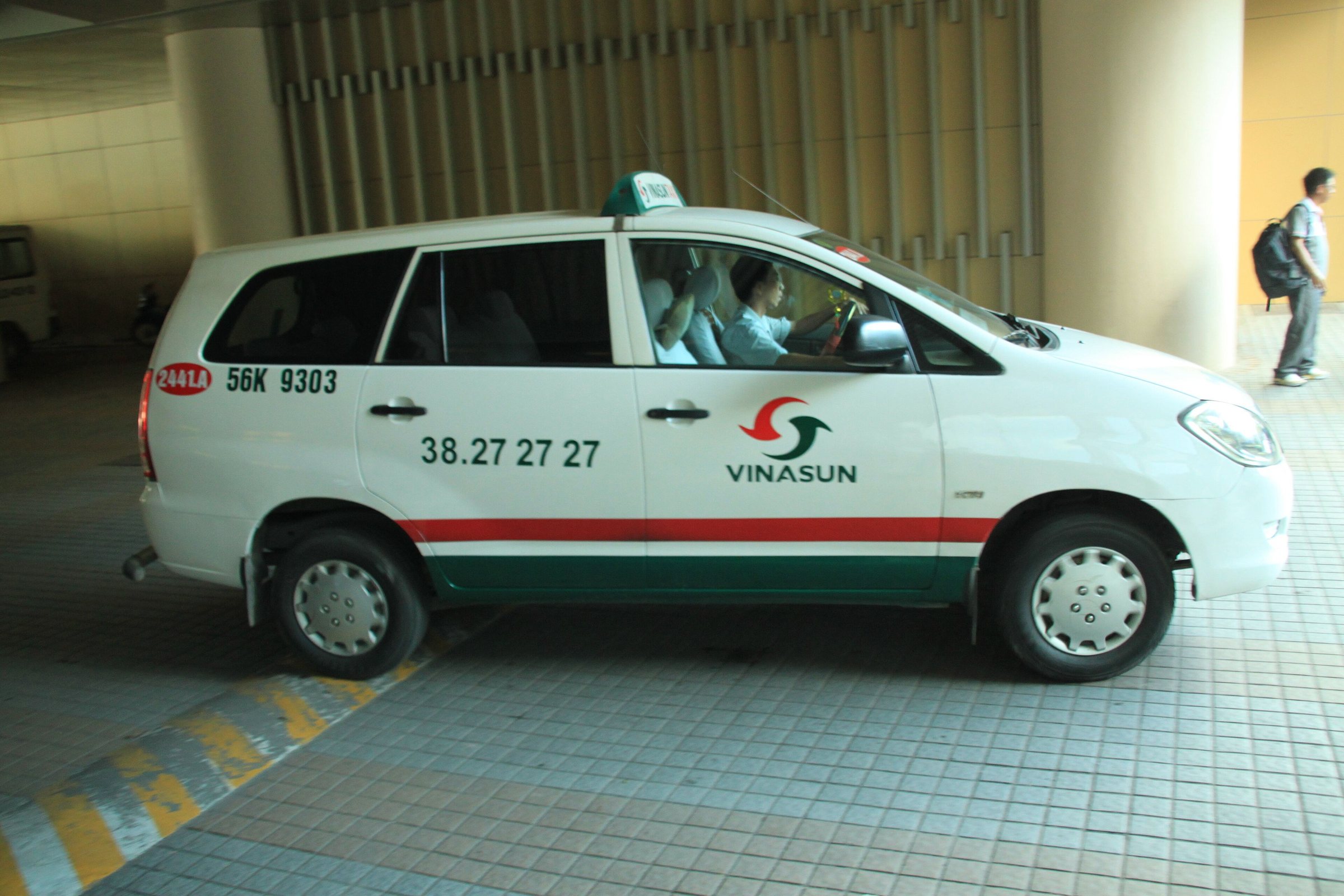
Outside the apps, metered taxis are widely available. A small number of companies have long-established reputations for using accurate meters and not taking indirect routes. Mai Linh and Vinasun (the latter primarily in southern Vietnam) are the most frequently cited. Their vehicles are clearly branded and the meter starts at the flagfall without negotiation.
Lookalike operators are a persistent issue, particularly at airports, bus stations and tourist districts. These vehicles may carry names or liveries designed to resemble trusted brands — a slight misspelling, a similar colour scheme, or generic branding. The meter in such vehicles may run faster than standard, or a high flat fare may be demanded before departure.
- Check the company name carefully on the vehicle door before getting in.
- At airports, official taxi queues managed by airport staff are generally safer than drivers who approach arrivals directly.
- Agree on whether the meter will be used before the journey starts, or use an app where the fare is set in advance.
Airport pickup rules
Each major airport has its own rules about where ride-hailing drivers may collect passengers, and these rules change periodically by airport management decree. At some airports, app-booked drivers must collect from a designated zone that is separate from — and sometimes a significant walk from — the arrivals hall. At others, collection points have shifted between terminals or levels.
The current pickup zone at any given airport is best confirmed inside the arrivals hall, where signage and airport staff can direct passengers. The apps themselves display driver location once a booking is confirmed, which helps locate where the vehicle is waiting.
Pre-booked taxis from hotel concierges or airport transfer desks are an alternative; the fare is agreed in advance but there is typically a premium over a metered or app fare. Whether that premium is worth the simplicity is a matter of preference and circumstance.
Fare expectations
Specific fares are not listed here, as they vary by city, distance, time of day, surge pricing, app promotions and whether a car or motorbike is used. The fare for a given journey can also differ between Grab, Be and Xanh SM at the same moment.
What can be said in general terms: motorbike fares are lower than car fares for the same distance; airport runs cost more than equivalent in-city distances because of airport surcharges or longer routes; and surge pricing applies during peak hours and bad weather across all three apps.
The advantage of app-based booking is that the estimated fare is displayed before the journey is confirmed, removing uncertainty. Metered taxis do not show a fare in advance, but a functioning and accurate meter means the final amount reflects the actual distance and time travelled.
Whether a written receipt is required — useful for expense claims — is worth requesting at the start of a taxi journey, as not all drivers carry paper receipts. The apps generate in-app records automatically.
Also known as / see also
제공 지역
참조 페이지
출처 목록
- Ministry of Transport — Ministry of Transport of Vietnam 접근됨 29 August 2026
Supports: carried over from the first build - Vietnam National Authority of Tourism — VNAT 접근됨 29 August 2026
Supports: carried over from the first build
Current 마지막 확인: 29 August 2026. Rules, fares and prices change — check the official source before acting on anything here. Report a mistake.
Picture credits (1)
HoChiMinh-VinasunTaxi, User: (WT-shared) Ovidius1313 at wts wikivoyage, Public domain, Wikimedia Commons