War Remnants MuseumBảo tàng Chứng tích Chiến tranh
Overview
The War Remnants Museum (Bảo tàng Chứng tích Chiến tranh) stands on Võ Văn Tần Street in Ho Chi Minh City centre. It is consistently the most-visited museum in the city and draws a large international audience alongside Vietnamese school groups and domestic tourists. The building was originally the United States Information Service offices before 1975, and the museum opened in its current form in 1975, though its name and scope have been revised several times since.
The museum presents the conflict — referred to in Vietnamese as the American War (Chiến tranh chống Mỹ) — from the perspective of the Socialist Republic of Vietnam and its predecessor, the Democratic Republic of Vietnam. Visitors should be aware that the framing is explicitly that of the Vietnamese state: the exhibition does not attempt neutrality and does not present a balanced account of all parties' conduct. This does not diminish the factual weight of much of what is shown, but it is the context in which the collection should be read.
Outdoor hardware collection
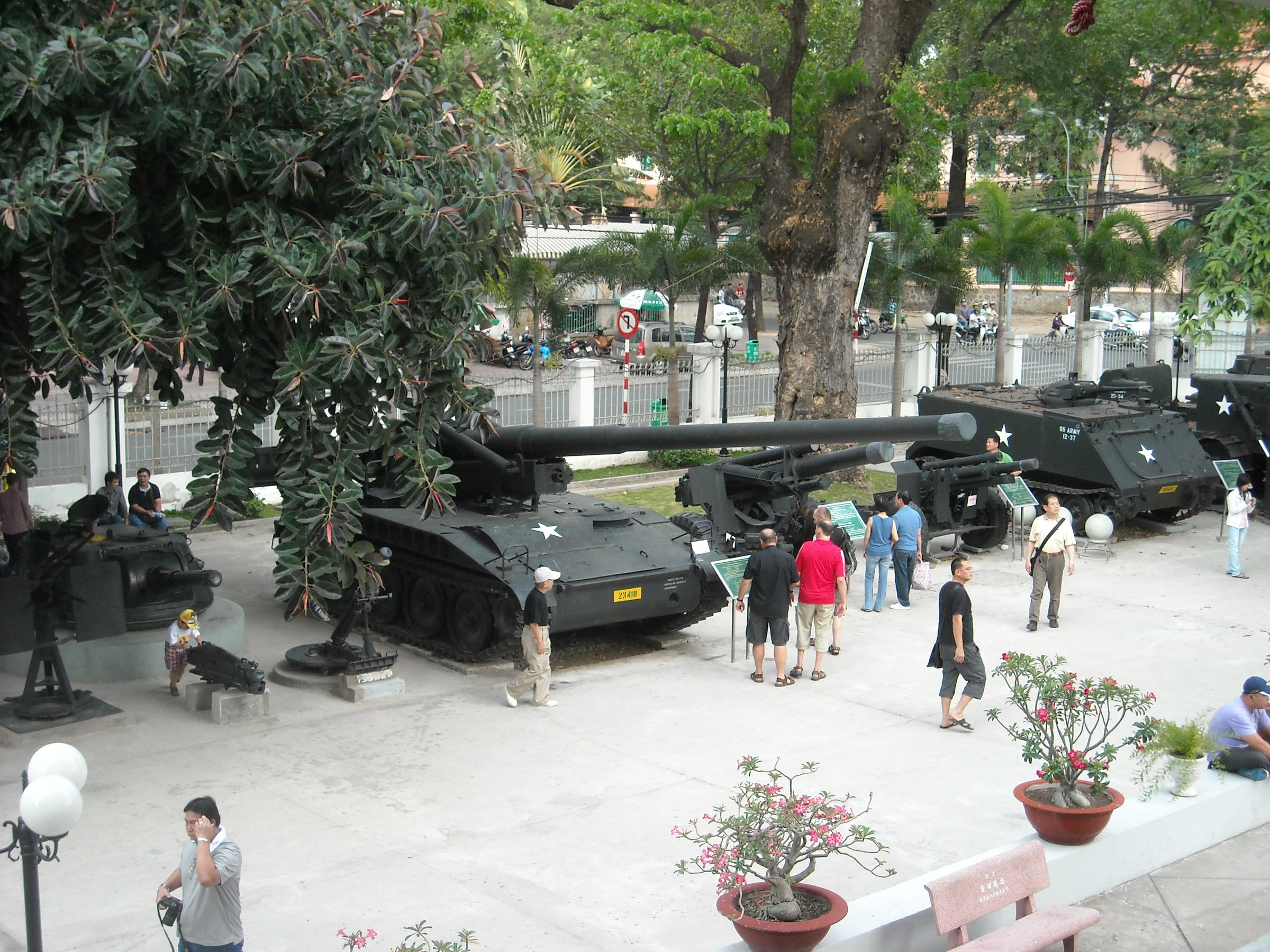
The museum's courtyard holds a substantial collection of military hardware used by US and South Vietnamese forces. Among the aircraft are an F-5A fighter, a UH-1 Huey helicopter and an A-37 Dragonfly ground-attack aircraft. Armoured vehicles on display include an M48 Patton tank and an M107 self-propelled artillery piece. Several examples of aerial ordnance — cluster bomb units, napalm canisters and large general-purpose bombs — are arranged in the open air with identification placards.
A Cessna O-1 Bird Dog observation aircraft and a CH-47 Chinook helicopter are also present, though the condition and arrangement of individual items changes as conservation work is carried out. The outdoor section can be walked through in fifteen to twenty minutes and gives a useful sense of scale before entering the indoor galleries.
Photojournalism galleries
The museum's most internationally recognised rooms are dedicated to photojournalism from the war. The collection includes work by Nick Ut (whose 1972 photograph of Phan Thị Kim Phúc is displayed with extended context), Eddie Adams, Larry Burrows and several Vietnamese photographers including Võ Anh Khánh and Đinh Đăng Định, some of whom were killed while working.
A dedicated section commemorates the Requiem project, which gathered the work of photographers from multiple countries who died covering the Indochina wars. The photographs are large-format and unedited for graphic content. Images include executions, civilian casualties, napalm injuries and the aftermath of specific operations. The museum does not restrict entry by age, and there are no content warnings at gallery entrances. Visitors who are sensitive to graphic imagery should be aware of this before entering these rooms.
Agent Orange and consequences of war
One of the museum's most visited and most contested sections documents the use of Agent Orange and other herbicide defoliants under Operation Ranch Hand, which ran from 1961 to 1971. The active compound, dioxin (TCDD), is linked to a range of cancers and to developmental conditions in subsequent generations.
The gallery presents medical photographs, preserved specimens and personal testimonies documenting conditions attributed to dioxin exposure, including in children born to parents who were exposed. The scientific and legal questions around causal attribution remain contested internationally, and compensation claims brought by Vietnamese plaintiffs against US chemical manufacturers have been rejected by US courts. The museum presents the Vietnamese government's position, which holds the United States responsible for ongoing health consequences. These exhibits are among the most distressing in the building, and many visitors find them difficult to view.
A separate room addresses the tiger cages of Côn Sơn Island prison, with reconstructed cells and photographs of conditions there under South Vietnamese administration.
Practical information
The museum is located at 28 Võ Văn Tần, in the area sometimes called the museum quarter of Ho Chi Minh City centre, close to the Reunification Palace. It is open daily. Prices vary by season and visitor category; a current admission fee applies.
Allow a minimum of ninety minutes for a thorough visit, and two hours or more if you intend to read the extended captions, which are in Vietnamese, English and French. The photojournalism floors in particular reward slow attention. The building is air-conditioned but the outdoor courtyard is exposed, and the site can be crowded during peak morning hours. A small bookshop near the entrance sells publications related to the collection.
Visitors regularly describe the museum as emotionally taxing. It is not recommended as a first activity on arrival, and those travelling with children should be prepared for questions the exhibits will raise.
Historical and curatorial context
The museum opened on 4 September 1975 under the name Exhibition House for US and Puppet Crimes. It was renamed the Museum of American War Crimes in 1990 and took its current name — War Remnants Museum — in 1995, the year Vietnam and the United States normalised diplomatic relations. The renaming was in part a gesture toward the diplomatic context, though the exhibition content has not been substantially reframed to reflect a more multilateral narrative.
Some historians and critics note that the museum does not address atrocities committed by North Vietnamese or Viet Cong forces, including the Huế Massacre of 1968, in which several thousand civilians were killed. The museum's remit, as stated by its curators, is to document crimes committed against the Vietnamese people, not to serve as a comprehensive history of the war. Visitors approaching the collection as a primary historical source rather than as testimony should supplement it with other accounts.
Where it is
Also known as / see also
Dirujuk oleh
Các nguồn
- Vietnam National Authority of Tourism — VNAT đã truy cập 29 August 2026
Supports: the rules and definitions on this page - War Remnants Museum — Wikipedia (CC BY-SA 4.0) đã truy cập 3 September 2026
Supports: background - Bảo tàng Chứng tích chiến tranh — Wikipedia (Vietnamese) (CC BY-SA 4.0) đã truy cập 3 September 2026
Supports: background, Vietnamese edition
Current Terakhir diverifikasi: 3 September 2026. Rules, fares and prices change — check the official source before acting on anything here. Report a mistake.
Picture credits (1)
War Remnants Museum 04 (5539147611), Sistak, CC BY-SA 2.0, Wikimedia Commons