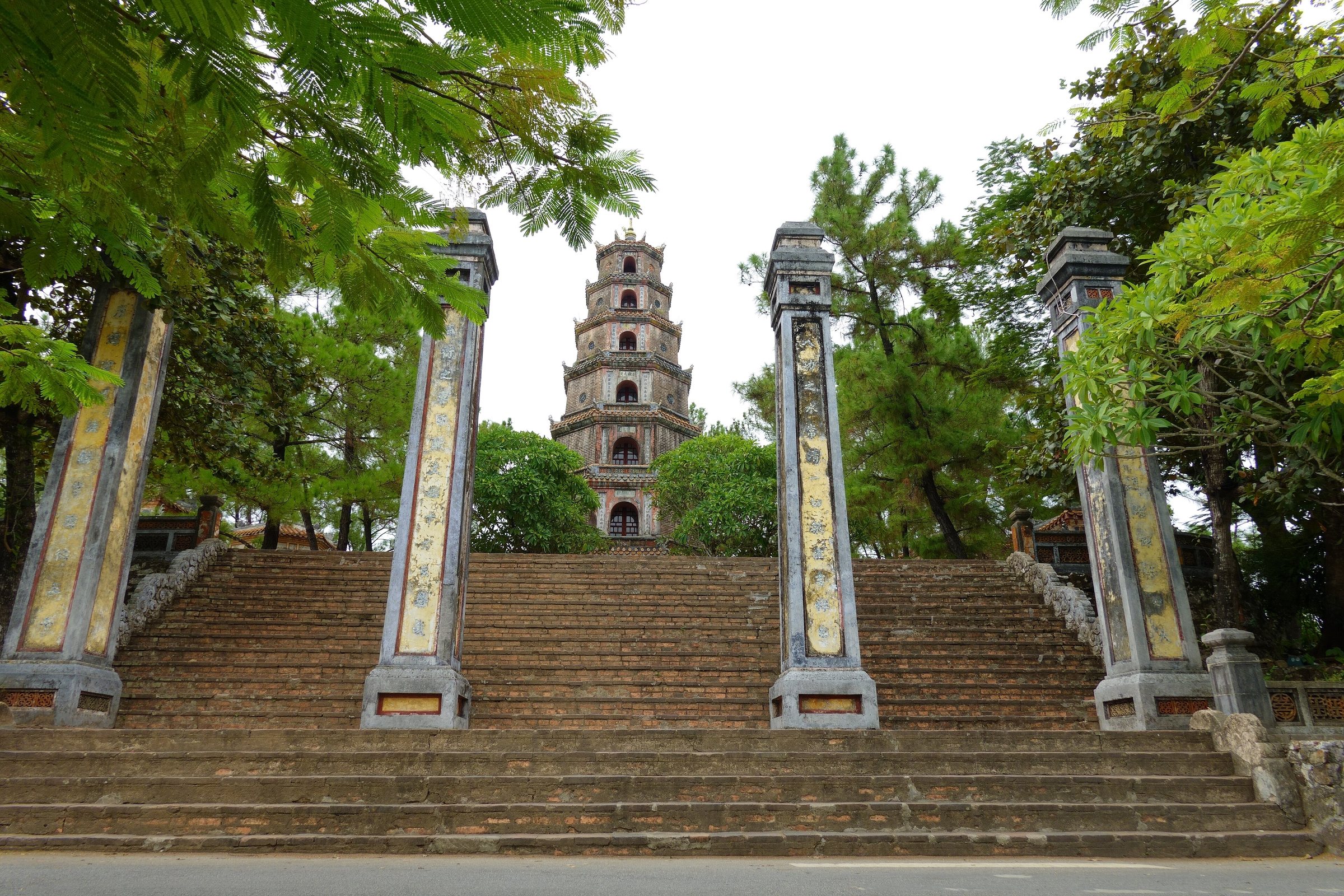
Thien Mu PagodaChùa Thiên Mụ
Overview
Thien Mu Pagoda — formally Chùa Thiên Mụ, meaning Pagoda of the Celestial Lady — stands on Ha Khe Hill above the left bank of the Perfume River, roughly three kilometres west of central Hue. The seven-storey Phuoc Duyen tower is visible from the river and from several points around the city, and has become the most widely reproduced image of Hue in Vietnamese iconography. The site functions simultaneously as an active place of worship and as one of the most-visited historical monuments in the former imperial capital.
Founding legend
The pagoda's origins are traced to 1601, when the Nguyen lord Nguyen Hoang visited Ha Khe Hill and heard a local legend about an old woman — a celestial apparition — who had prophesied that a lord would come to build a pagoda on the site for the country's prosperity. Nguyen Hoang ordered construction to begin, naming the temple after the celestial figure. The story remains central to the site's identity, and versions of it appear on interpretive materials throughout the complex. The pagoda was expanded and rebuilt over subsequent centuries, most significantly under the Nguyen lords and later the Nguyen emperors.
The Phuoc Duyen tower
The Phuoc Duyen tower was commissioned by Emperor Thieu Tri and completed in 1844. It rises through seven octagonal storeys to a height of approximately 21 metres, with each storey housing a Buddha statue. The tower is built of brick and is notable for the consistency of its proportions across each level, tapering gradually toward a spire. It stands at the river-facing edge of the complex and is the element most immediately associated with the pagoda in popular imagery. Behind the tower lie successive courtyards containing the main sanctuary, a large bronze bell cast in 1710, and a stone stele mounted on a carved marble tortoise recording the pagoda's history.
The Austin car and Thich Quang Duc
A grey Austin Westminster saloon car is displayed in a pavilion within the complex. This is the vehicle in which the monk Thich Quang Duc travelled from Hue to Saigon before his self-immolation at the intersection of Phan Dinh Phung and Le Van Duyet streets on 11 June 1963. The act, a protest against the policies of President Ngo Dinh Diem's government toward the Buddhist community, was photographed by AP correspondent Malcolm Browne and became one of the defining images of the Vietnam War period. Thich Quang Duc had been associated with the pagoda, and the car has been preserved here as a memorial object. The display includes documentary photographs.
Getting there
The pagoda is accessible by two main routes from central Hue. The road approach follows the northern bank of the Perfume River westward; the route is straightforward by bicycle, motorbike or taxi. The more traditional approach is by dragon boat along the Perfume River, a service operating from the riverside near Hue's historic centre. The boat journey takes roughly 30 to 45 minutes depending on conditions, and the approach from the water provides a clear view of the tower from the angle most commonly seen in photographs. Combined boat excursions often include stops at royal tombs further upstream. The pagoda's grounds are open to visitors, though dress covering shoulders and knees is expected as it remains an active monastery.
Practical notes
The complex includes the main sanctuary, the Phuoc Duyen tower, a garden cemetery for former abbots, and the pavilion housing the Austin car. There is no admission charge, though this is subject to change. Photography within the grounds is generally permitted; the interior of the sanctuary warrants the usual discretion observed in active places of worship. The site can become busy during morning hours when boat tours arrive, and is quieter in the late afternoon. Hue city is the logical base for a visit, with the pagoda readily combined with a river excursion to the Nguyen royal tombs.
Where it is
Also known as / see also
被以下页面引用
来源
- Vietnam National Authority of Tourism — VNAT 访问于 29 August 2026
Supports: the rules and definitions on this page - Chùa Thiên Mụ — Wikipedia (Vietnamese) (CC BY-SA 4.0) 访问于 3 September 2026
Supports: background, Vietnamese edition
Current 最后核实: 3 September 2026. Rules, fares and prices change — check the official source before acting on anything here. Report a mistake.
Picture credits (1)
Entrance chua thien mu, Gaodanielbo, CC BY 4.0, Wikimedia Commons