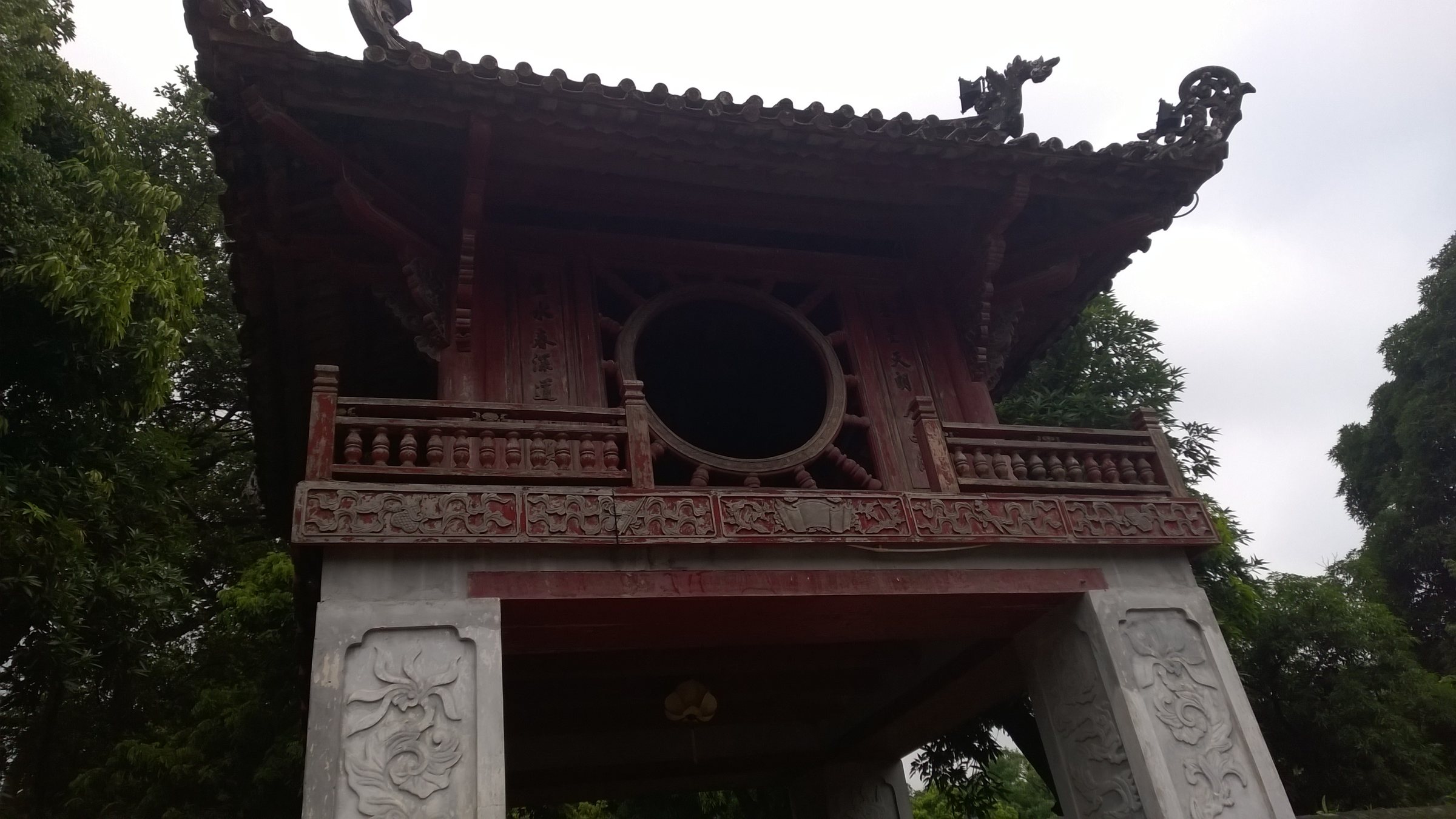
Temple of LiteratureVăn Miếu – Quốc Tử Giám
Foundation and purpose
Văn Miếu – Quốc Tử Giám was established in 1070 under Emperor Lý Thánh Tông, initially as a temple dedicated to Confucius, his disciples and the Duke of Zhou. Six years later, in 1076, Emperor Lý Nhân Tông founded Quốc Tử Giám — literally the "National Academy" — within the same walls, making it Vietnam's first institution of higher learning.
For centuries the complex served as the intellectual and administrative heart of the Đại Việt state. Candidates who passed the rigorous imperial examinations (khoa cử) received their doctorates here, and the institution trained the mandarins who staffed the royal bureaucracy. Instruction was grounded in the Confucian canon: the Four Books, the Five Classics and classical Chinese composition.
The academy functioned continuously until 1779, when the Nguyễn lords relocated it to Huế. The Hanoi site remained a temple and examination venue into the early twentieth century, before the French colonial administration abolished the examination system entirely in 1919.
Layout: the five courtyards
The complex is arranged along a north–south axis and divided into five successive walled courtyards, each entered through a gate and progressively more restricted in historical practice.
- First courtyard (Văn Miếu Gate to Đại Trung Gate): a landscaped entry space with the main ceremonial gateway facing Quốc Tử Giám Street.
- Second courtyard: contains the Khải Thánh Gate and two pavilions housing stone stelae mounted on tortoise bases.
- Third courtyard (Thiên Quang Well): a square pond flanked by the two remaining stele pavilions; this is the most photographed part of the complex.
- Fourth courtyard: the ceremonial heart, containing the Great House of Ceremonies (Đại Bái Đường) and the House of the Sages (Thượng Điện), where Confucius and his principal disciples are venerated.
- Fifth courtyard: the former site of Quốc Tử Giám itself. The original buildings were destroyed and later reconstructed; the courtyard now holds a museum of the academy's history.
The stone stelae and their tortoise bearers
The most historically significant objects in the complex are 82 stone stelae (bia đá), each mounted on the back of a carved stone tortoise. They record the names, places of origin and academic results of 1,307 doctoral graduates (tiến sĩ) who passed the imperial examinations between 1442 and 1779.
The stelae were not all erected at once. The oldest surviving ones date from 1484, commissioned under Emperor Lê Thánh Tông, who ordered retrospective records carved for examinations held as far back as 1442. Inscription continued intermittently until the late eighteenth century.
The tortoise was chosen as a base because it symbolises longevity and steadfastness in Vietnamese and Chinese tradition. Each tortoise is individually carved; scholars have noted variations in style corresponding to different periods of production. The 82 stelae that survive are a fraction of the original total: records suggest there were once 116.
UNESCO inscribed the stelae on the Memory of the World Register in 2010, recognising them as primary historical documents for the study of Vietnamese education, civil administration and classical scholarship.
The Confucian examination system
The imperial examination system that the temple underpinned was modelled on Chinese precedent but adapted to Vietnamese conditions. Three levels of examination existed: local (hương), regional (hội) and palace (đình). Only candidates who cleared all three earned the title tiến sĩ and the right to have their name inscribed on a stele.
Examinations tested mastery of classical texts, the ability to compose regulated verse (thơ Đường luật) and the drafting of policy memorials in literary Chinese. The system was theoretically meritocratic — candidates came from across the country regardless of birth — though in practice the cost of years of study favoured families with existing means.
The examinations shaped Vietnamese bureaucracy for nearly nine centuries. Because advancement depended on literary accomplishment rather than military rank alone, the temple and its academy occupied a position of enormous social prestige. Families that produced a tiến sĩ often commemorated the fact in village communal houses for generations.
Contemporary use and cultural significance
The Temple of Literature remains an active cultural site rather than a purely archaeological one. Vietnamese university graduates, particularly those from Hanoi, frequently hold graduation photograph sessions within the courtyards, a practice that has grown substantially since the 1990s. Before major examinations — especially the national university entrance examination held each summer — students visit to make offerings and pay respects at the altars, a custom that reflects the site's enduring association with scholarly aspiration.
The complex hosts periodic ceremonies marking the lunar new year and Confucius's birthday. A traditional music ensemble occasionally performs ca trù and nhã nhạc within the fourth courtyard, though scheduling varies and is not fixed year-round.
The fifth courtyard museum displays examination artefacts, scholar's robes, and explanatory panels on the history of Vietnamese education. Texts are presented in Vietnamese, English and French.
Visiting: entry and layout practicalities
The main entrance gate faces Quốc Tử Giám Street on the southern side of the complex. A smaller gate on Văn Miếu Street to the west also provides access. The site is managed by the Hanoi People's Committee and an admission fee is charged; prices vary by season and visitor category.
The complex opens daily, though hours are reduced on certain public holidays and for maintenance. Audio guides in several languages are available for hire at the entrance. Visitors are expected to dress modestly; removing shoes is required when entering the inner sanctuaries of the fourth courtyard.
The stelae in the third courtyard are protected behind low barriers. Rubbing or touching the stones is prohibited, a rule enforced after decades of contact caused surface erosion. Photography is permitted throughout the open courtyards without additional charge.
The site can become crowded during the university entrance examination season (typically June–July) and during Tết. Early morning visits on weekdays are generally quieter.
Where it is
Also known as / see also
Verwezen door
Bronnen
- Vietnam National Authority of Tourism — VNAT geraadpleegd 29 August 2026
Supports: the rules and definitions on this page - Temple of Literature, Hanoi — Wikipedia (CC BY-SA 4.0) geraadpleegd 3 September 2026
Supports: background - Văn Miếu – Quốc Tử Giám — Wikipedia (Vietnamese) (CC BY-SA 4.0) geraadpleegd 3 September 2026
Supports: background, Vietnamese edition
Current Laatst geverifieerd: 3 September 2026. Rules, fares and prices change — check the official source before acting on anything here. Report a mistake.
Picture credits (1)
Văn Miếu - Quốc Tử Giám September 2015 4, Cookie Nguyen, CC BY-SA 4.0, Wikimedia Commons