One Pillar PagodaChùa Một Cột
What it is
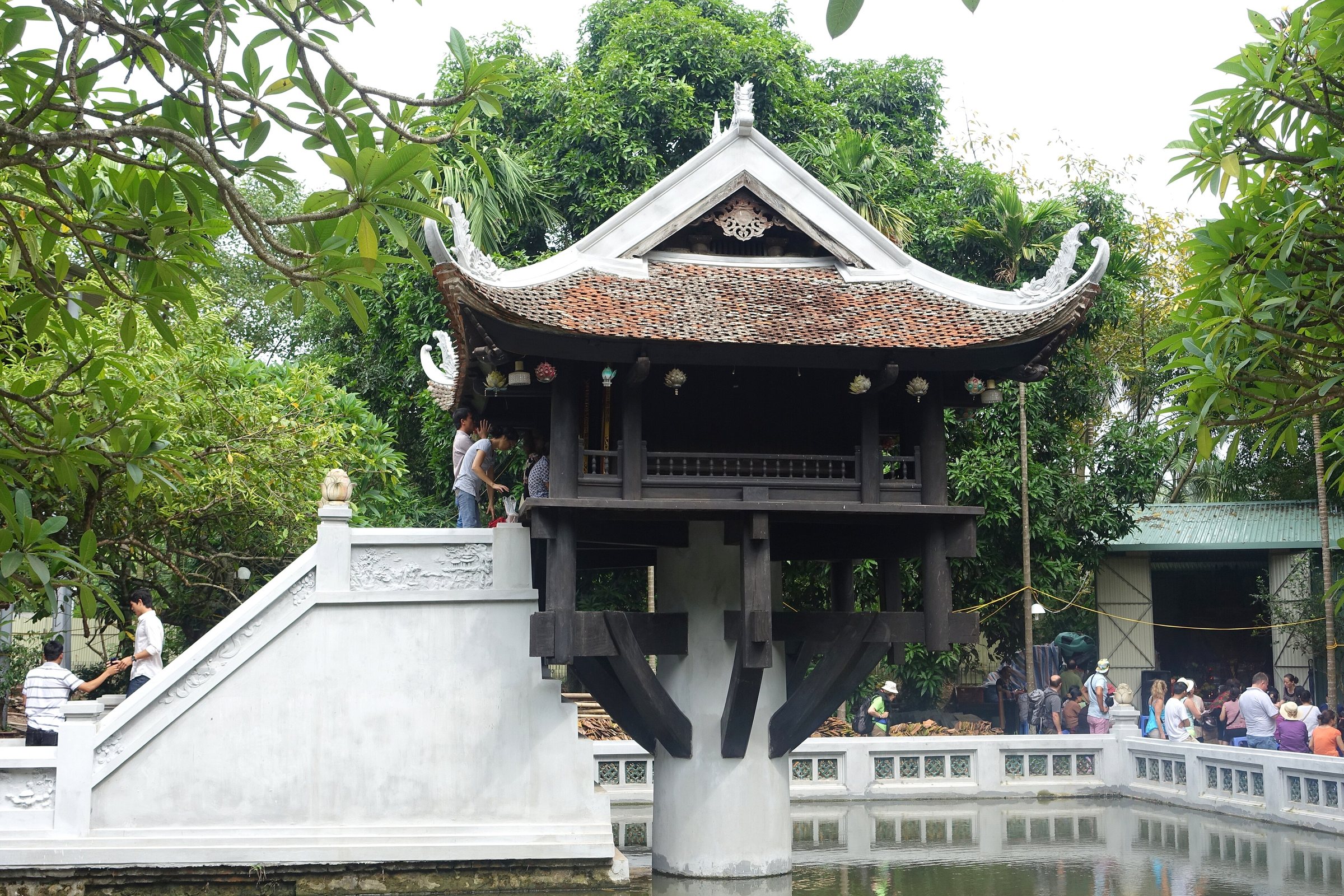
The One Pillar Pagoda — Chùa Một Cột in Vietnamese — is a small wooden structure set atop a single cylindrical stone pillar rising from a square lotus pond. The pagoda chamber itself is modest: a single room housing an altar dedicated to Quan Am, the Bodhisattva of compassion. The pillar and its reflection in the water below are designed to evoke a lotus blossom emerging from the surface, a Buddhist symbol of purity arising from muddy ground. Despite its outsized fame, the structure is compact, and visitors accustomed to large temple complexes are sometimes surprised by its scale.
Founding legend and Lý-dynasty origins
Historical records attribute the original construction to Emperor Lý Thái Tông, who ordered the pagoda built in 1049 following a dream in which the Bodhisattva Quan Am appeared to him seated on a lotus throne and presented him with a son. The emperor, who had no male heir at the time, took the vision as a divine sign. Shortly after, his consort gave birth to a prince. In gratitude, Lý Thái Tông commissioned a pillar pagoda replicating the lotus throne from his dream, and monks were directed to circumambulate it daily, chanting prayers for the emperor's long life.
The pagoda was subsequently renovated by later rulers of the Lý dynasty and continued to function as a site of imperial devotion throughout the dynasty's tenure in Hanoi, then known as Thăng Long.
Destruction in 1954 and reconstruction
The structure standing today is not the original. As French forces withdrew from Hanoi in September 1954, following the Geneva Accords that ended the First Indochina War, French soldiers demolished the pagoda — an act that remains contested in terms of intent, with some accounts describing it as deliberate destruction and others as the removal of a military obstruction. The pillar and pond survived largely intact.
The newly established government of the Democratic Republic of Vietnam ordered an immediate reconstruction. Vietnamese craftsmen rebuilt the wooden superstructure using traditional joinery techniques, closely following historical records and photographs. The reconstructed pagoda was completed within months of the French withdrawal and has remained in its current form since. Some restoration work has been carried out in subsequent decades to address structural deterioration.
Architecture and materials
The pagoda rests on a single stone pillar approximately 1.25 metres in diameter, with the exact height varying in different historical accounts. The wooden chamber above measures roughly four metres on each side. The roof curves upward at its corners in the style characteristic of northern Vietnamese religious architecture, finished with glazed ceramic ridge tiles. The structure is painted in dark lacquer red.
A small staircase runs up one side of the pillar to the chamber entrance. The lotus pond below is enclosed by low stone balustrades. The overall composition — pillar, reflection, surrounding water — is intended to be read as a single unified form rather than a building set beside a decorative pond.
Location within the Ba Đình complex
The One Pillar Pagoda stands within a cluster of significant political and historical sites in the Ba Đình area of Hanoi. It sits immediately to the south-west of the Hồ Chí Minh Mausoleum and is accessed through the same general precinct, which also contains the Hồ Chí Minh Museum, the Presidential Palace compound, and Ba Đình Square. The pagoda is technically a separate site with its own entrance, though most visitors approach it as part of a broader circuit of this area.
The juxtaposition of an 11th-century Buddhist shrine with the mausoleum of the founder of the modern Vietnamese state gives the precinct an unusual layered character, spanning roughly nine centuries of Vietnamese history within a compact area.
Practical notes
The pagoda is a functioning religious site as well as a tourist landmark. Visitors are expected to dress modestly — shoulders and knees covered — and to behave respectfully near the altar. Photography of the exterior is unrestricted; photography inside the chamber near the altar may be subject to informal guidance from attendants on site.
The pond and surrounding garden area can become crowded during national holidays and on weekends. The site is closed during certain religious observances, though schedules are not fixed year to year. Prices vary by season for any guided tours of the wider Ba Đình complex that include the pagoda.
Where it is
Also known as / see also
참조 페이지
출처 목록
- Vietnam National Authority of Tourism — VNAT 접근됨 29 August 2026
Supports: the rules and definitions on this page - One Pillar Pagoda — Wikipedia (CC BY-SA 4.0) 접근됨 3 September 2026
Supports: background - Chùa Một Cột — Wikipedia (Vietnamese) (CC BY-SA 4.0) 접근됨 3 September 2026
Supports: background, Vietnamese edition
Current 마지막 확인: 3 September 2026. Rules, fares and prices change — check the official source before acting on anything here. Report a mistake.
Picture credits (1)
One Pillar Pagoda - Hanoi, Vietnam - DSC03500, Daderot, CC0, Wikimedia Commons