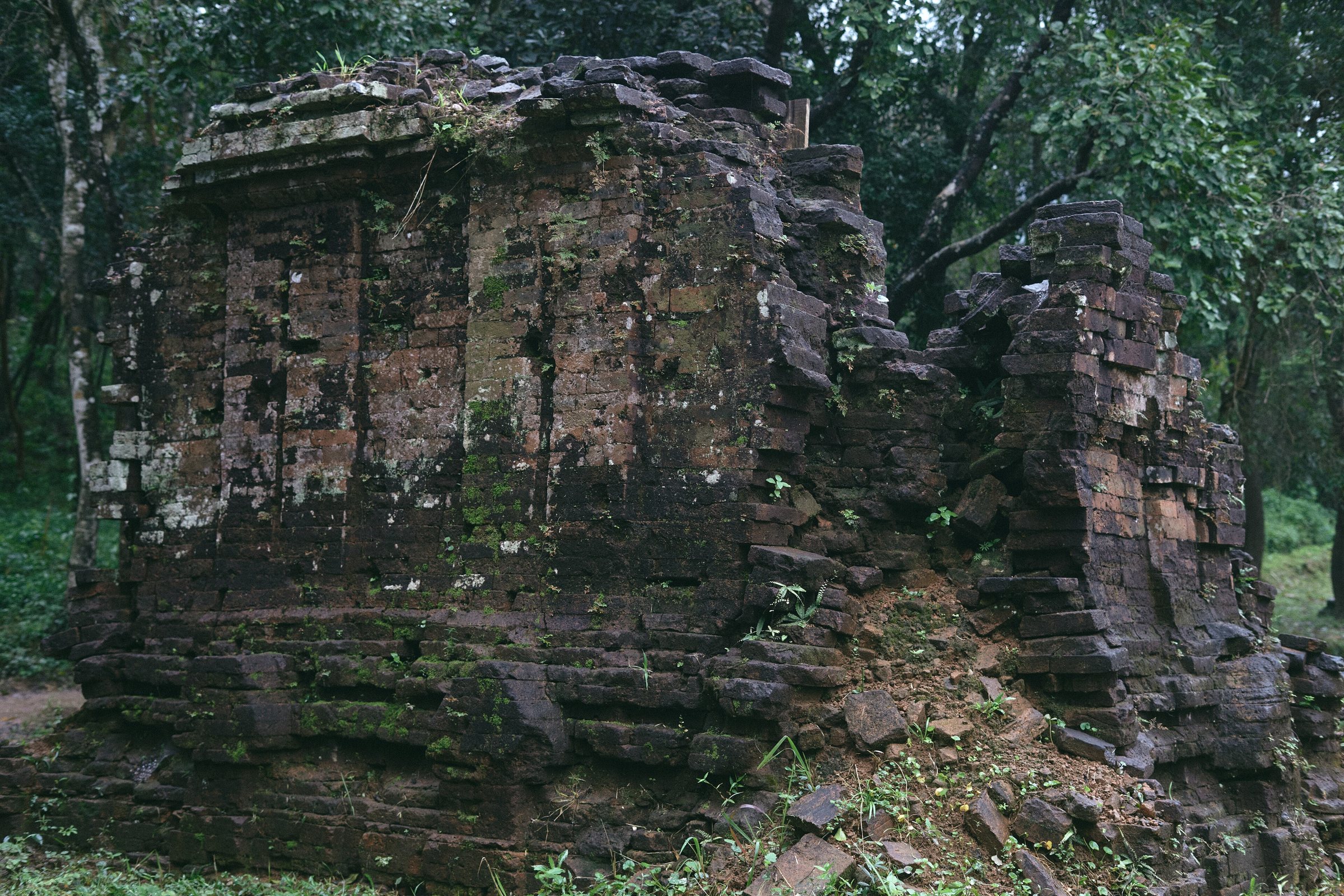
My Son SanctuaryThánh địa Mỹ Sơn
What My Son Is
My Son (Thánh địa Mỹ Sơn) is a complex of Hindu temples and towers constructed by successive kings of the Champa kingdom across roughly a thousand years, from around the 4th century CE to the 14th. The site sits in a narrow valley ringed by forested hills, about 40 km south-west of the sanctuary area. At its peak the complex held more than 70 structures; approximately 20 towers remain standing to varying degrees. The Cham people were the dominant civilisation of what is now central and southern Vietnam before Vietnamese expansion southward, and My Son served as their primary religious centre — a place of royal consecration and worship dedicated above all to the god Shiva, here venerated under the name Bhadresvara.
The Brick Towers and the Lost Mortar
The towers at My Son are built almost entirely from fired brick laid with exceptional precision. What has long puzzled architects and archaeologists is the binding agent: the mortar holding the bricks together has never been definitively identified. Theories include a resin from the dầu rái tree, a plant-based paste, or a form of fired brick-on-brick technique in which surfaces were ground together before firing. The result, wherever it survives intact, is jointing so fine as to be nearly invisible.
The towers follow a repeating form: a tall central sanctuary (kalan) representing Mount Meru, the cosmic axis, flanked by smaller mandapa entrance halls and repository towers. Carved sandstone decorates the facades — apsara dancers, kala demon faces, floral scrollwork — in a style that shifted across the centuries as outside influences from Java and the Khmer empire filtered in.
The Tower Groups
French scholars from the École française d'Extrême-Orient, who began systematic study of the site in the 1890s, assigned the surviving clusters letters from A through K. Not all groups are accessible or standing.
- Group B, C and D form the most coherent surviving ensemble and are the focal point of most visits. Group B contains the main kalan tower; Groups C and D include mandapa halls and repository towers whose carved lintels and pediments have partly survived.
- Group A was the grandest sanctuary, described in early French records as the finest single tower at the site. It was destroyed in a 1969 US air strike (see below) and now exists only as a field of collapsed brick.
- Groups E, F and G lie further into the valley and are in poorer condition, though carved stonework remains in place in several.
- Groups H, K and others are partially excavated or largely ruined and may be closed to visitors at any given time.
The numbering and grouping reflect French categorisation rather than any Cham administrative logic, and some scholars now use revised designations in academic literature.
Bomb Damage
My Son suffered severe damage during the Vietnam War. The valley's jungle cover made it a location used by National Liberation Front forces, and the site was subjected to repeated US bombing raids, most destructively in 1969. Group A's main kalan, which French archaeologist Henri Parmentier had described in the early 20th century as the most impressive tower at the site, was largely obliterated. Craters are still visible in the valley floor, and unexploded ordnance in the surrounding hills has constrained restoration work and access to outlying groups.
Restoration has been carried out in phases, with significant contributions from Italian and Polish conservation teams from the 1980s onward and continuing Vietnamese state work after UNESCO listing in 1999. Some interventions — particularly concrete underpinning applied in earlier decades — are now themselves considered problematic by conservators, and debate continues about appropriate methods for the remaining structures.
The Cham Dance Performances
A short Cham dance performance is staged at the site each morning, typically in an open shelter near the Group B complex. The dances draw on traditions associated with temple ritual in Cham culture, performed by dancers in costume styled on apsara carvings found at the towers. The performance is included in the site entry. It lasts roughly 15 to 20 minutes and runs on a fixed schedule, though that schedule can change; checking at the ticket gate on arrival is advisable. The performances are a condensed introduction to Cham performing arts rather than a full ceremonial reconstruction.
Visiting: Timing and Access
My Son opens early in the morning. The first hours after opening, before the main wave of half-day tour groups arrives from Hoi An, offer substantially quieter conditions — fewer people in photographs, less crowd noise near the towers, and cooler temperatures before the valley heats up. Tour buses from Hoi An typically begin arriving mid-morning.
The site is reached by a road through the valley. Visitors park or are dropped at the ticket area and walk or take an electric cart to the main tower clusters; the distance is manageable on foot. The valley floor is uneven and paths between tower groups are unpaved in places. Shade within the site is limited outside the forested fringes.
A combined boat trip and My Son visit, travelling part of the way by river from Hoi An, is a commonly offered tour format. It takes longer than coming directly by road but passes through riverside countryside. Prices vary by season and by operator.
Context and Significance
My Son was designated a UNESCO World Heritage Site in 1999, recognised alongside the broader sanctuary zone as an outstanding example of the cultural interchange between the Cham people and Hindu civilisation from the Indian subcontinent. The site is the most important single location for understanding Cham religious architecture, though other Cham towers survive across central Vietnam — at Phan Rang, Quy Nhon, and elsewhere — and carved artefacts from My Son are held in the Museum of Cham Sculpture in Da Nang.
The Cham kingdom's history is contested in several respects: the dating of individual towers is debated, the nature of Cham political organisation remains a subject of academic argument, and the relationship between Cham and later Vietnamese culture is a sensitive area in contemporary Vietnam. The site presents an official interpretive narrative, but visitors with a deeper interest will find academic literature — particularly work by scholars such as Trần Kỳ Phương — more detailed and more candid about uncertainty.
Where it is
Also known as / see also
Référencé par
Sources
- Vietnam National Authority of Tourism — VNAT consulté 29 August 2026
Supports: the rules and definitions on this page - Thánh địa Mỹ Sơn — Wikipedia (Vietnamese) (CC BY-SA 4.0) consulté 31 August 2026
Supports: background, Vietnamese edition
Current Dernière vérification: 3 September 2026. Rules, fares and prices change — check the official source before acting on anything here. Report a mistake.
Picture credits (1)
My Son Sanctuary, Vietnam, 2017 (52415723486), JL Cogburn, CC BY-SA 2.0, Wikimedia Commons