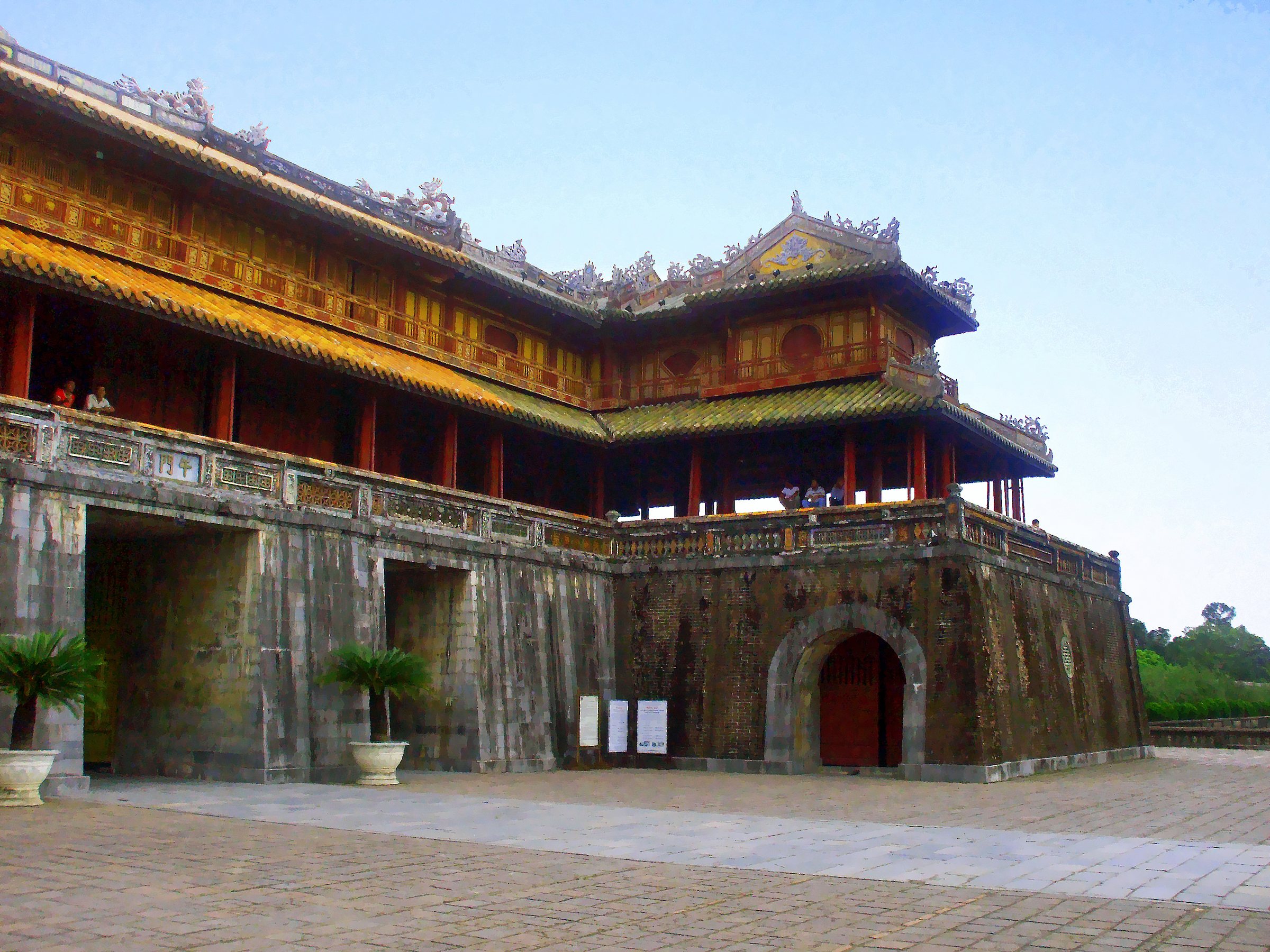
Hue Imperial CityKinh thành Huế
Overview
Hue Imperial City — Kinh thành Huế — is a walled citadel of roughly 520 hectares on the north bank of the Perfume River in Hue. Construction began in 1804 under Emperor Gia Long, the founder of the Nguyen dynasty, and continued through the reign of Minh Mang. The layout follows classical Vietnamese and Chinese geomantic principles, with the Ngo Mon (Noon Gate) as the main southern entrance, a central axis running north to Thai Hoa Palace, and beyond that the inner enclosure known as the Imperial Enclosure (Hoàng thành). Inside that lies a still smaller compound, the Purple Forbidden City (Tử Cấm Thành), which was reserved for the emperor, his consorts and immediate attendants. The outermost walls, measuring roughly 2.5 km per side, are surrounded by a moat and studded with bastions influenced by French military engineer Vauban's methods, introduced via early 19th-century Sino-Vietnamese adaptation.
Ngo Mon Gate and Thai Hoa Palace
The Ngo Mon gate is the formal ceremonial entrance on the southern wall. It is a two-storey structure: a masonry base pierced by five archways — the central one reserved in imperial times for the emperor — supports a timber pavilion called the Five Phoenix Watchtower (Lầu Ngũ Phụng). The gate's upper level was where emperors received tribute, presided over ceremonies and, in 1945, where Bao Dai formally abdicated to representatives of the Viet Minh.
Beyond a courtyard and a pool with bridges stands Thai Hoa Palace (Điện Thái Hòa), the Hall of Supreme Harmony, completed in 1833 under Minh Mang. This is the throne hall where the emperor conducted major court audiences. The interior retains lacquered columns painted red and gold, and the original throne platform. Thai Hoa Palace is among the best-preserved structures in the complex.
The Purple Forbidden City
The Purple Forbidden City occupied the innermost enclosure behind Thai Hoa Palace. Before 1968 it contained dozens of pavilions, reading halls, theatres, gardens and the emperor's private apartments. The Can Chanh Palace, where daily audiences were held, and the Kien Trung Palace, a later Franco-Vietnamese structure, were among the principal buildings. Today much of this area consists of open ground, low foundations and surviving gate structures, because intense fighting during the Tet Offensive in January and February 1968 caused catastrophic damage across this zone.
Ongoing restoration, supported by UNESCO and the Hue Monuments Conservation Centre, has brought several structures back. The Hien Lam Pavilion and the Nine Dynastic Urns — cast between 1835 and 1837 and each engraved with landscapes, flora and fauna — survived largely intact and remain in place. Kien Trung Palace has been partially reconstructed in recent years. The scale of what was lost, and what fragments remain, is itself a significant part of what the site communicates.
The 1968 Tet Offensive and Its Consequences
During the Tet Offensive, North Vietnamese and Viet Cong forces occupied the citadel on 31 January 1968 and held much of it for 25 days while US Marine and South Vietnamese Army units fought to retake it. Artillery, air strikes and direct ground combat caused destruction throughout the Imperial Enclosure and the Purple Forbidden City in particular. Estimates suggest that roughly 60 to 80 percent of the structures within the inner compounds were damaged or destroyed, though figures vary across sources and what is meant by "destroyed" versus "damaged" is contested.
The broader battle of Hue in 1968 also caused severe civilian casualties and the destruction of large parts of the surrounding city. Restoration of the citadel began modestly in the 1980s and accelerated after Hue's monuments were collectively inscribed as a UNESCO World Heritage Site in 1993.
Visiting the Site
The citadel site is entered through the Ngo Mon gate. A single ticket covers the Imperial Enclosure including Ngo Mon, Thai Hoa Palace, the Hien Lam Pavilion and the Nine Urns, the Museum of Royal Fine Arts housed in Long An Palace, and several other structures within the outer walls. The ticket does not cover the royal tombs, which are located several kilometres outside the citadel walls and require separate admission at each site.
Visitors typically allow two to three hours for a basic circuit of the main compounds; a full day permits exploration of outlying halls, garden areas and the museum. The site is large and partly exposed, so conditions vary significantly with the season — Hue receives heavy rainfall between September and December. Guided tours in English and French are available through operators in Hue. Audio guides are available at the entrance. Dress that covers shoulders and knees is expected inside the palace buildings.
Royal Tombs Outside the Walls
Seven of the thirteen Nguyen emperors have mausoleums in the hills south and southwest of the city. The most visited are those of Minh Mang (Hieu Tomb, completed 1843), Tu Duc (completed 1867, the largest complex, which Tu Duc used as a retreat during his lifetime), Khai Dinh (completed 1931, with a strongly French-influenced exterior and an elaborate mosaic interior), and Gia Long (the most remote, seldom visited independently).
Each tomb is a separate ticketed site. They can be reached by hired motorbike, car, bicycle, or boat along the Perfume River — the river approach to the Minh Mang and Tu Duc tombs is a common option. Prices vary by season and by the mode of transport or tour package used. None of the tombs is included in the main citadel ticket.
Designation and Ongoing Restoration
The Complex of Hue Monuments — encompassing the Imperial City, the royal tombs and a number of smaller sites — was inscribed on the UNESCO World Heritage List in 1993, the first such inscription in Vietnam. The Hue Monuments Conservation Centre manages the site and has overseen successive phases of reconstruction and conservation work, sometimes attracting debate about the degree to which rebuilt structures represent the originals.
Work continues as of the mid-2020s, with sections of the Purple Forbidden City still under active restoration or archaeological investigation. Some areas may be cordoned off during a visit. The site's status as a living heritage zone — with some residential use persisting within the outer walls — means it does not present itself as a static museum environment.
Where it is
Also known as / see also
Verwezen door
Bronnen
- Vietnam National Authority of Tourism — VNAT geraadpleegd 29 August 2026
Supports: the rules and definitions on this page - Imperial City of Huế — Wikipedia (CC BY-SA 4.0) geraadpleegd 3 September 2026
Supports: background - Kinh thành Huế — Wikipedia (Vietnamese) (CC BY-SA 4.0) geraadpleegd 3 September 2026
Supports: background, Vietnamese edition
Current Laatst geverifieerd: 3 September 2026. Rules, fares and prices change — check the official source before acting on anything here. Report a mistake.
Picture credits (1)
Trước cửa Kinh thành Huế, Bùi Thụy Đào Nguyên, CC BY-SA 4.0, Wikimedia Commons