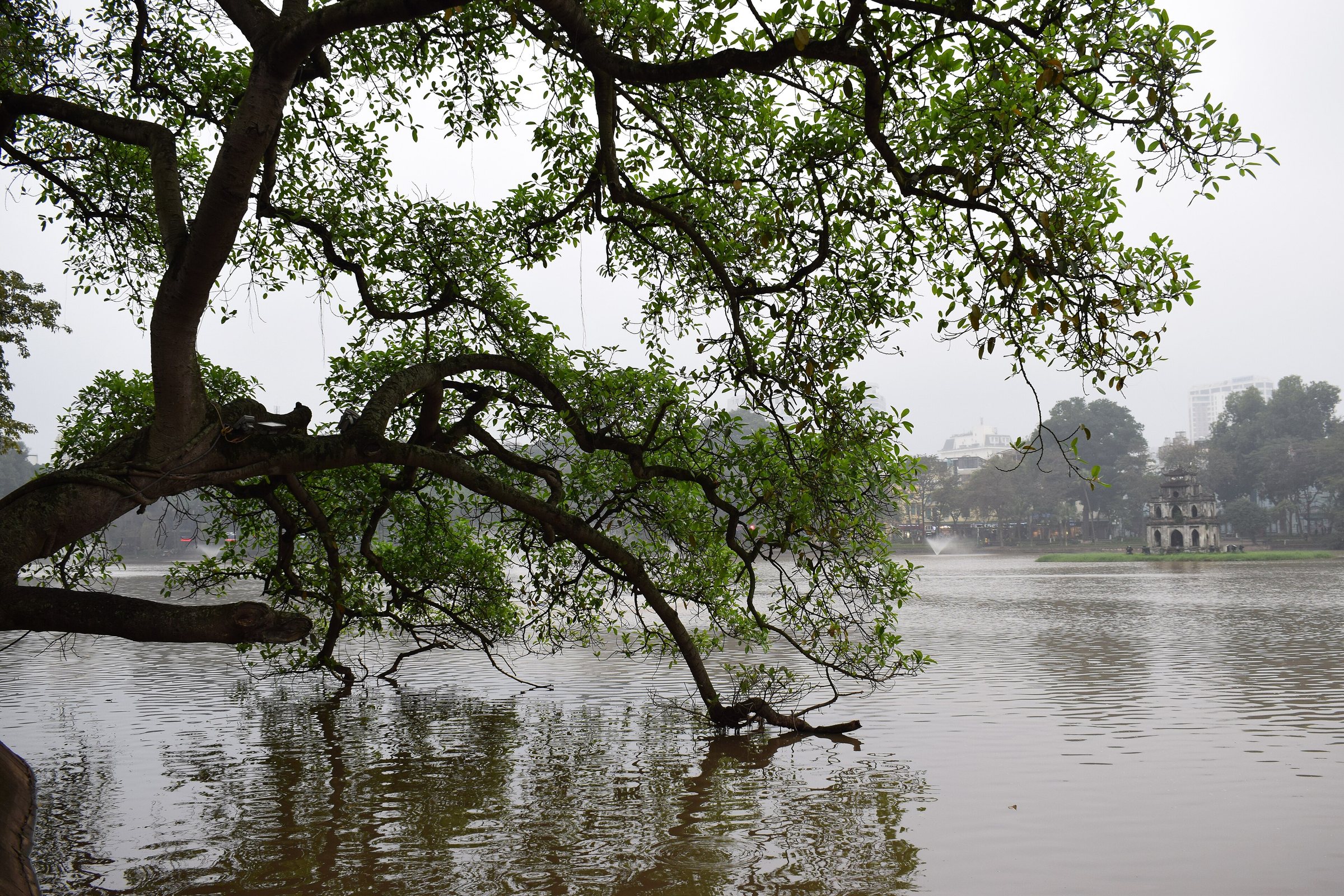
Hoan Kiem LakeHồ Hoàn Kiếm
The Legend of the Returned Sword
The lake takes its name from a legend attached to the emperor Lê Lợi, who founded the Later Lê dynasty after expelling Ming Chinese forces from Vietnam in 1428. According to the story, a divine tortoise lent Lê Lợi a magical sword that gave him victory in battle. After he became emperor, while boating on the lake, a great golden tortoise surfaced and reclaimed the sword on behalf of the Dragon King. The lake was subsequently renamed Hồ Hoàn Kiếm — Lake of the Returned Sword — from its earlier name, Lục Thủy (Green Water Lake).
The legend is closely tied to Vietnamese national identity and the founding of independent Lê rule. It is taught in schools and referenced throughout Vietnamese literature and art. The story's credibility was long bolstered by the presence of large softshell turtles (Rafetus swinhoei) living in the lake; the last confirmed individual, known locally as Cụ Rùa (Grandfather Turtle), died in January 2016.
Turtle Tower and the Lake's Appearance
Standing on a small islet near the southern end of the lake, Tháp Rùa — the Turtle Tower — is a compact, three-storey stone structure built in the 1880s during the French colonial period, though it incorporates earlier architectural elements. It sits in the water without any bridge connecting it to the shore, giving it an isolated, almost floating quality that makes it one of the most photographed compositions in Hanoi.
The lake itself is relatively modest in size — roughly 700 metres long and 200 metres wide — and sits in a shallow basin. The water is characteristically green, coloured by algae, and the shoreline is lined with willows, banyan trees and ornamental shrubs. French colonial planners in the late 19th and early 20th centuries shaped much of the surrounding streetscape, and the mix of Vietnamese and colonial architecture is visible from the lakeside paths.
Ngoc Son Temple and The Huc Bridge
Ngoc Son Temple (Đền Ngọc Sơn, meaning Temple of the Jade Mountain) stands on Jade Islet in the northern part of the lake. The temple in its current form dates largely from the 19th century, though earlier structures occupied the site before that. It is dedicated principally to Trần Hưng Đạo, the 13th-century general who repelled Mongol invasions, and to the scholar Văn Xương and the physician Lã Tổ.
Access to Ngoc Son is via The Huc Bridge (Cầu Thê Húc), meaning Bridge of the Rising Sun. The bridge is painted a vivid red-orange and curves gently across the water from the northern shore to the islet. It was first built in 1865 and has been reconstructed after partial collapse on at least one occasion. Entry to both the bridge and temple requires a ticket, purchased at the gate on the shore. Inside the temple compound, visitors can see a preserved specimen of a large softshell tortoise, believed to be one of the Hoàn Kiếm turtles recovered from the lake in the 20th century.
The Lake at 6am
From around 5am onwards, and reaching its busiest point near 6am, the lakeshore becomes an informal public gymnasium. Older residents in particular gather to practise thể dục (calisthenics), tai chi and a Vietnamese form of badminton played without a net. Groups walk brisk circuits of the lake's perimeter path. Others use the low railings and benches for stretching, or gather in loose clusters around portable speakers for group aerobics.
The atmosphere at this hour is markedly different from the rest of the day. Traffic is light, the air is cooler, and the lake surface is often still. The ritual of morning exercise around Hoan Kiem is long-established in Hanoi life and continues regardless of season, though participation drops during the coldest or wettest days. By around 8am, the exercise crowd has largely dispersed and the daytime tourist and café traffic takes over.
The Weekend Walking Street
On Friday, Saturday and Sunday evenings, and continuing through the night until the early hours, the roads immediately surrounding Hoan Kiem Lake are closed to motorised traffic and designated a pedestrian zone. The closure covers Đinh Tiên Hoàng Street along the lake's eastern edge and several adjacent streets extending into the Old Quarter.
The walking street was introduced in 2016 and has become a regular feature of Hanoi weekend life. Street food vendors, performers, games stalls and informal markets occupy the space. The character of the crowd shifts across the evening: families with young children earlier, younger groups and couples later. The lake's illuminated shoreline and the lit Turtle Tower are visible from much of the pedestrianised area. The arrangement is managed by local authorities and is subject to occasional changes in the specific roads included or the hours of operation.
Visiting the Lake
The lake's perimeter path is publicly accessible at all hours without charge. Walking a full circuit takes roughly 20 to 30 minutes at a relaxed pace. Ngoc Son Temple has its own entrance fee and set opening hours; these should be confirmed locally, as hours have varied.
The lake sits at the boundary between the Old Quarter to the north and the French Quarter and central business district to the south and west, making it a natural orientation point within Hanoi. Several bus routes stop nearby, and it is within walking distance of most central Hanoi accommodation. The surrounding streets are dense with cafés, many of which offer views across the water.
The lake area is consistently busy during daylight hours and on weekend evenings. The northern end near The Huc Bridge and Ngoc Son Temple draws the highest concentration of visitors. The southern end, near Turtle Tower, tends to be somewhat quieter.
Where it is
Also known as / see also
被以下页面引用
来源
- Vietnam National Authority of Tourism — VNAT 访问于 29 August 2026
Supports: the rules and definitions on this page - Hoàn Kiếm Lake — Wikipedia (CC BY-SA 4.0) 访问于 3 September 2026
Supports: background - Hồ Hoàn Kiếm — Wikipedia (Vietnamese) (CC BY-SA 4.0) 访问于 3 September 2026
Supports: background, Vietnamese edition
Current 最后核实: 3 September 2026. Rules, fares and prices change — check the official source before acting on anything here. Report a mistake.
Picture credits (1)
Hoan Kiem Lake (25398366277), Mig Gilbert from Brighton, CC BY-SA 2.0, Wikimedia Commons