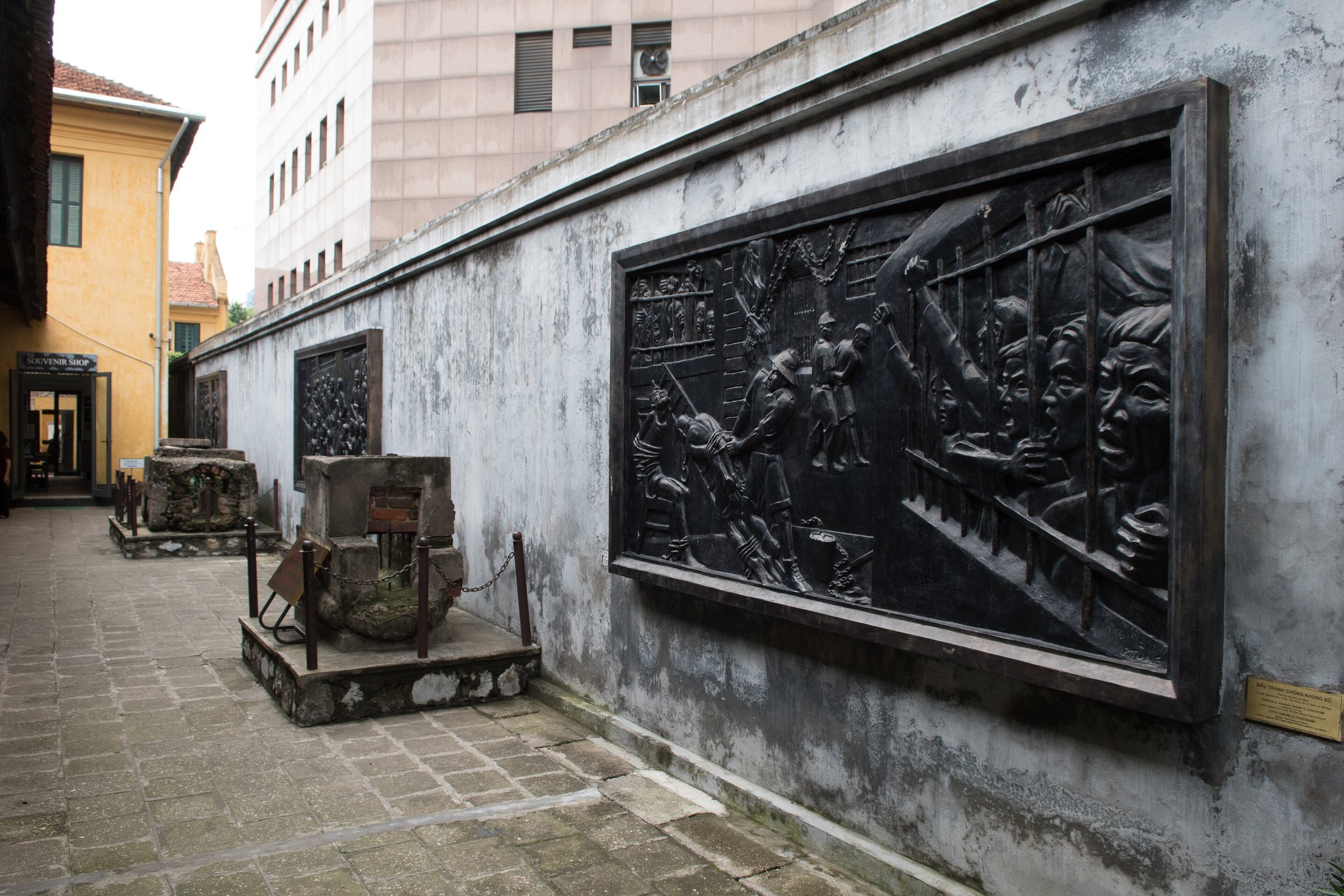
Hoa Lo PrisonNhà tù Hỏa Lò
Background and construction
Hoa Lo Prison was built by the French colonial administration between 1896 and 1901 on the site of Hoa Lo village, a neighbourhood of metalworkers whose name — meaning roughly 'fiery furnace' — the prison inherited. Designed to hold around 450 inmates, it routinely confined several times that number. The complex originally occupied a full city block in what is now central Hanoi, enclosed by high stone walls topped with glass shards and electrified wire.
The French called it Maison Centrale. Vietnamese political prisoners, including early members of the Indochinese Communist Party such as Nguyễn Văn Cừ and Trường Chinh, were held here through much of the first half of the twentieth century. Conditions were severe: cells were overcrowded, sanitation was minimal, and stocks and shackles — examples of which are still on display — were used routinely.
The French period: cells, guillotine and political prisoners
The museum's coverage of the French colonial era occupies the most substantial part of the surviving structure. Original holding cells have been preserved, including a long communal cell where leg irons are fixed to a raised concrete platform — prisoners slept chained in rows. A separate section documents solitary confinement conditions.
A guillotine of French manufacture is exhibited in one of the ground-floor rooms. The machine was used for executions carried out at the prison and at other sites around the country. Documentary photographs, death certificates and personal artefacts of executed prisoners accompany it. The museum identifies named individuals, among them anti-colonial activists sentenced to death during the 1930s and 1940s.
This section of the exhibition is presented in Vietnamese, French and English, and draws heavily on period photographs and official French colonial administrative documents. It frames the prisoners explicitly as patriots and martyrs — a framing consistent with the state narrative of the independence struggle.
The American pilots and the 'Hanoi Hilton'
From 1964 onwards, American aviators shot down over North Vietnam were held at Hoa Lo and at a network of satellite facilities around Hanoi. The prisoners themselves coined the sardonic nickname 'Hanoi Hilton'. Among the best-known captives was John McCain, whose aircraft was shot down over Trúc Bạch Lake in October 1967; he was held at Hoa Lo until 1973. Senator John McCain died in 2018, and his time at the prison has been written about extensively in American accounts of the war.
The museum devotes a separate set of rooms to this period. The exhibition emphasises that prisoners received adequate food, medical care and recreational opportunities, and displays photographs of captives playing volleyball, celebrating Christmas and receiving medical treatment. Flight suits, personal items and shoot-down documentation are exhibited. The overall tone is one of humane treatment, in contrast to accounts given by many former prisoners themselves, who described torture, prolonged solitary confinement and coercive interrogation. The museum does not address these accounts directly.
Visitor experience and the presentation gap
The divergence between the museum's narrative and published memoirs by former American prisoners is something many visitors find striking. Those familiar with accounts by McCain, James Stockdale or other former POWs tend to arrive with a very different picture of conditions than the one the displays present. The museum makes no claim to offer a neutral account; it is an official Vietnamese state institution, and its interpretive choices reflect that position.
Reactions vary considerably. Some visitors focus on the French colonial section, which they find the more historically candid of the two. Others come specifically for the American period. A number of former prisoners and their families have visited since diplomatic normalisation in 1995; documented reactions range from quiet reflection to open disagreement with the displays.
The site functions as both a historical record and an active statement about how the wars of the twentieth century are remembered in Vietnam. Neither reading cancels the other out, and the tension between them is itself part of what the place communicates.
The surviving structure
The majority of the original Hoa Lo complex was demolished in the 1990s to make way for the Hanoi Towers commercial development, visible immediately adjacent. What remains is roughly one quarter of the original footprint: the French-built gatehouse with its distinctive ochre façade and the cell blocks directly behind it. The gatehouse carries the original 'Maison Centrale' inscription above the entrance arch.
Inside, the layout retains its colonial-era arrangement of corridors, guard posts and holding areas. The preserved leg-iron platforms, the guillotine room and the solitary confinement cells are all within the surviving section. Signage is in Vietnamese, French and English throughout, though the depth of translation varies between rooms.
The site is located on Hoả Lò Street in the Hoàn Kiếm area of Hanoi, close to Hoan Kiem Lake and within walking distance of the Old Quarter.
Practical information
The museum is open most days of the week; specific opening times should be confirmed locally as they are subject to change on public holidays. An admission fee is charged. The site is small enough to cover thoroughly in an hour to ninety minutes, though visitors who read the French-period documentation carefully may take longer.
Photography is permitted in most areas. The guillotine room and some of the more graphic documentary photographs may be distressing; the museum does not display content warnings. The site is not fully accessible to visitors with mobility difficulties, as parts of the interior involve steps and uneven floors. Audio guides have been available at various points in the museum's recent history, though availability should be confirmed on arrival.
The museum sits within Hanoi's broader circuit of colonial-era and war-related sites, and is frequently visited alongside the Temple of Literature, the Vietnam Museum of Ethnology and the Ho Chi Minh Mausoleum complex.
Where it is
Also known as / see also
被以下页面引用
来源
- Vietnam National Authority of Tourism — VNAT 访问于 29 August 2026
Supports: the rules and definitions on this page - Hỏa Lò Prison — Wikipedia (CC BY-SA 4.0) 访问于 3 September 2026
Supports: background - Nhà tù Hỏa Lò — Wikipedia (Vietnamese) (CC BY-SA 4.0) 访问于 3 September 2026
Supports: background, Vietnamese edition
Current 最后核实: 3 September 2026. Rules, fares and prices change — check the official source before acting on anything here. Report a mistake.
Picture credits (1)
Hoa Lo Prison Maison Hanoi (27767374759), dronepicr, CC BY 2.0, Wikimedia Commons