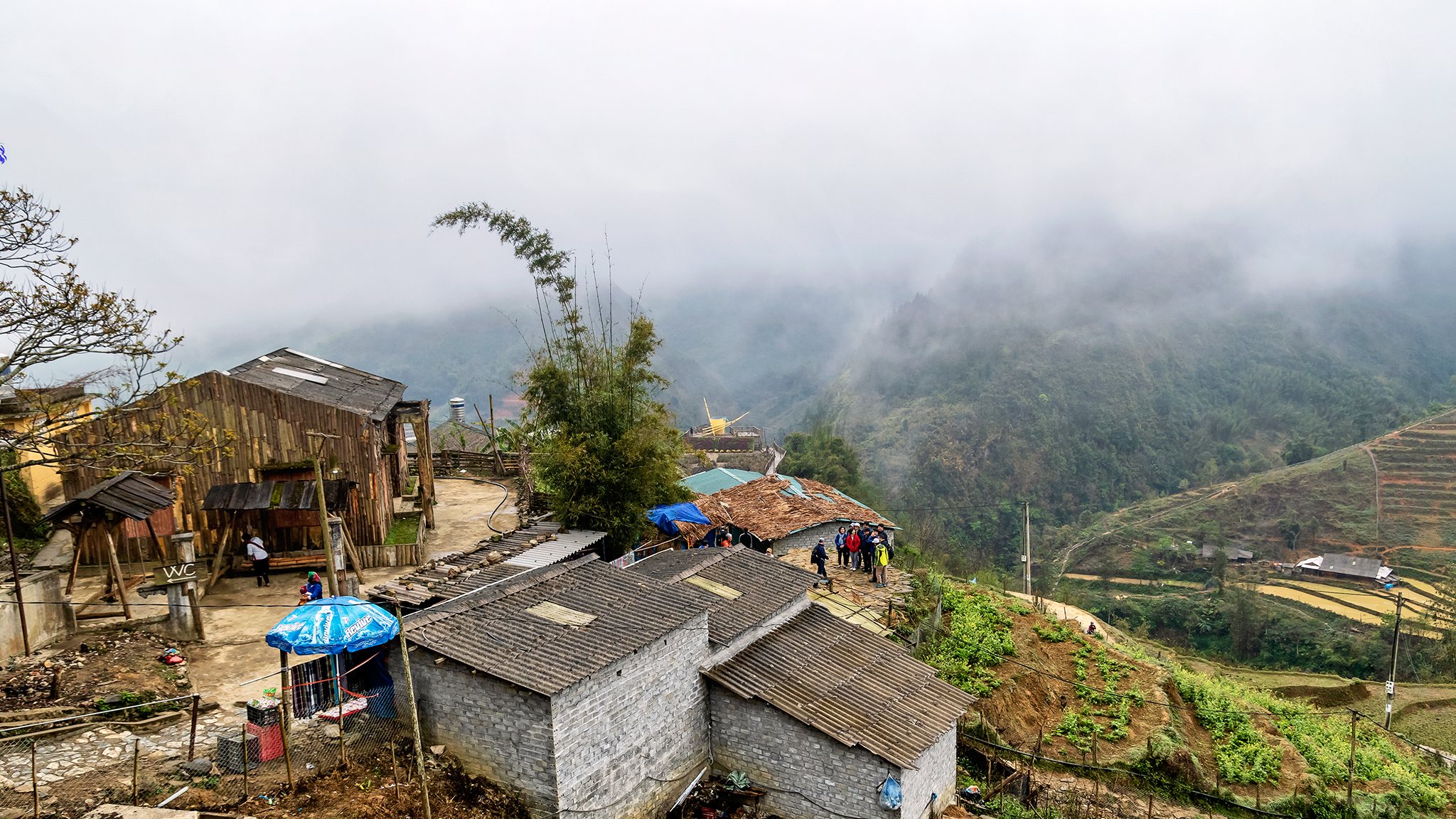
Cat Cat villageBản Cát Cát
Location and setting
Sapa sits on a ridge, and Cat Cat — known in Vietnamese as Bản Cát Cát — occupies the valley floor of the Muong Hoa stream below it. The village belongs to the Black Hmong, one of several Hmong sub-groups distinguished partly by their dark-dyed indigo clothing. The valley is narrow and terraced, with the stream running through the lower section past an old French-era hydroelectric station. The surrounding hillsides carry rice terraces that are at their most visually dramatic during the flooding season in May and June and the harvest season in September and October.
The walk from Sapa town
The route begins on Fansipan Street in Sapa town and descends continuously for roughly 2 km to reach the main part of the village. The path is paved for most of its length and passes through the managed entrance gate near the top. Steps and handrails have been installed along the steeper sections near the waterfall. The descent takes between 30 and 45 minutes at a comfortable pace. The return walk is the same route in reverse and involves significant uphill effort; visitors who find the ascent difficult can negotiate a motorbike taxi from the gate back up to town. The total elevation difference is approximately 200 metres.
Waterfall and hydroelectric station
Near the base of the main path, the Muong Hoa stream drops over a series of rocks to form the Cat Cat waterfall, which is modest in scale but notable for the stone-built hydroelectric station immediately below it. The station was constructed during the French colonial period and continued to supply electricity to Sapa town for decades after independence. The turbine hall and stone infrastructure remain largely intact and are included within the ticketed area. A suspension bridge crosses the stream near this point, giving a direct view of both the falls and the old machinery.
Entrance fee and access
Cat Cat operates a formal entrance gate with a ticketed admission system managed by the local Hmong community cooperative. Prices vary by season and visitor category. The ticket covers access to the main village path, the waterfall area, and the hydroelectric station. The gate is staffed daily. There is no secondary admission charge for individual features within the ticketed zone. Visitors arriving by motorbike or car park above the gate and continue on foot.
What to expect in the village
The central part of the village contains a cluster of stalls selling embroidered textiles, silver jewellery, and clothing associated with Black Hmong craft traditions. Weaving and embroidery demonstrations take place at several points along the main path. A stage near the waterfall hosts scheduled folk music and dance performances, typically involving traditional instruments including the kèn lá (leaf oboe) and đàn môi (jaw harp). Residential houses are interspersed with commercial structures, and some families operate small guesthouses or homestays within the village.
Commercialisation: an honest assessment
Cat Cat is the most commercialised of the villages accessible from Sapa. Its proximity to town, paved path, formal ticketing, and concentrated souvenir infrastructure mean the experience differs substantially from villages further into the Muong Hoa Valley or those reached only by longer trekking routes. The performances, while based on genuine Hmong traditions, are staged for tourist audiences on a fixed schedule. Visitors seeking a less managed encounter with Hmong agricultural life generally find it in villages such as Lao Chai, Ta Van, or the more distant hamlets of the valley, which require either a guided trek or an independent walk of several hours. Cat Cat's value is best understood as a convenient and visually coherent introduction to Black Hmong material culture rather than a representation of daily village life.
Where it is
Also known as / see also
참조 페이지
출처 목록
- Vietnam National Authority of Tourism — VNAT 접근됨 29 August 2026
Supports: the rules and definitions on this page - Bản Cát Cát — Wikipedia (Vietnamese) (CC BY-SA 4.0) 접근됨 3 September 2026
Supports: background, Vietnamese edition
Current 마지막 확인: 3 September 2026. Rules, fares and prices change — check the official source before acting on anything here. Report a mistake.
Picture credits (1)
Trong bản Cát Cát, Bùi Thụy Đào Nguyên, CC BY-SA 4.0, Wikimedia Commons