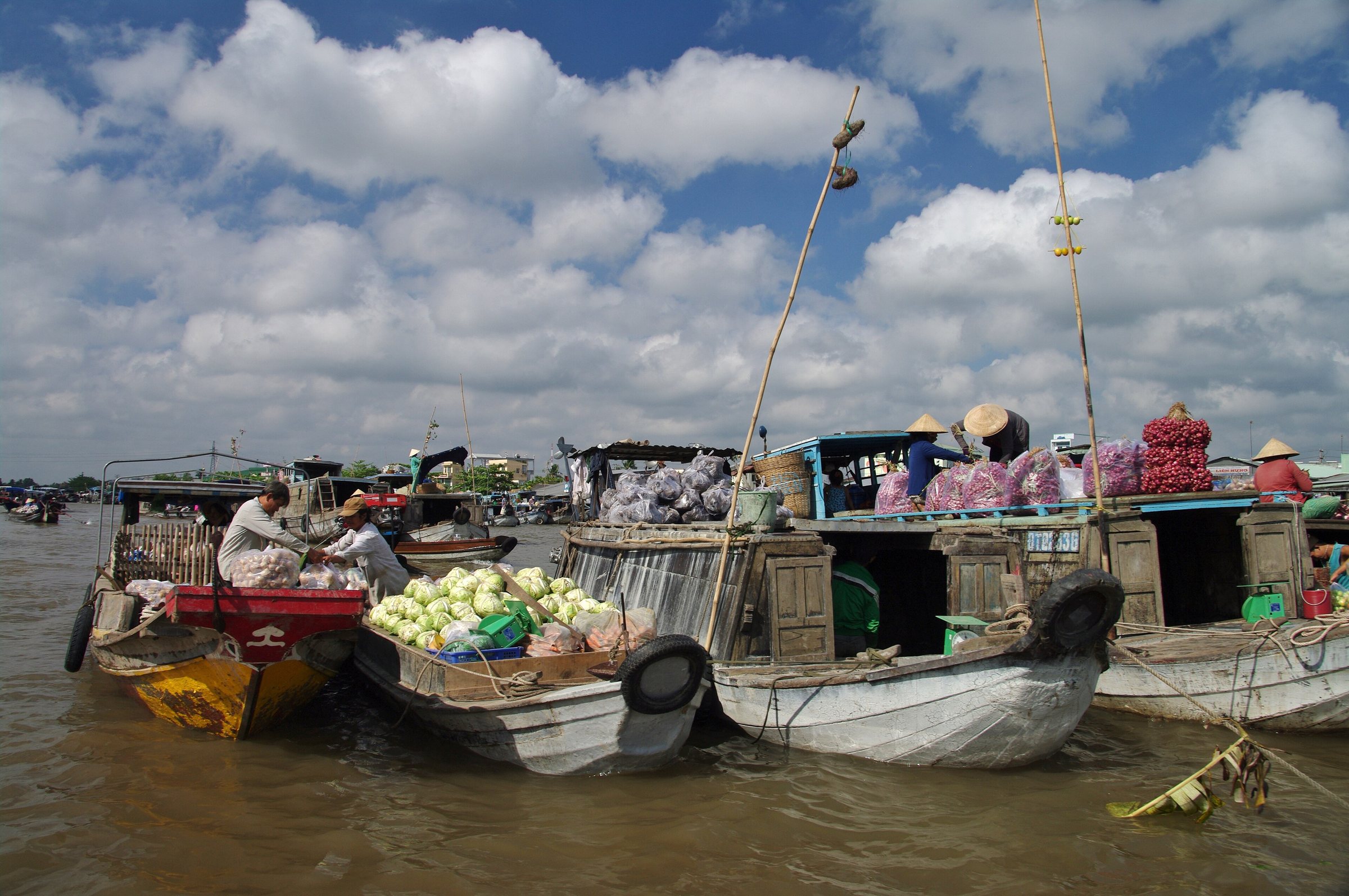
Cai Rang Floating MarketChợ nổi Cái Răng
What Cai Rang is
Cai Rang (Chợ nổi Cái Răng) is a wholesale floating market operating on the Cai Rang River, a tributary of the Hau River, roughly six kilometres south of central Can Tho. It is the largest market of its kind in the Mekong Delta, drawing traders from across the surrounding provinces to buy and sell produce in bulk from boat to boat. The market is a working commercial exchange, not a display arranged for visitors, though tourism has become an increasingly significant part of its daily activity. The Vietnamese government recognised it as a National Intangible Cultural Heritage in 2016.
Hours and the pre-dawn rhythm
Trading begins well before sunrise, typically between 04:00 and 05:00, and the market is largely finished by 08:00 to 09:00. Wholesale transactions between large vessels happen earliest; by the time most tourist boats arrive after dawn, the peak commercial activity has already passed. Visitors prepared to depart Can Tho's riverside before 05:00 see a substantially different scene from those who leave at 07:00. The market operates every day of the year, though activity drops sharply around the Tết lunar new year holiday when many traders return to their home areas.
The <em>bẹo</em> pole system
Each trading boat hangs a tall bamboo pole — called a cây bẹo — from its bow, and from this pole dangles a sample of whatever the vessel is selling. A bunch of shallots indicates shallots for sale; a whole pumpkin indicates pumpkins. Because boats are constantly moving and docking space is limited, the poles allow buyers to identify sellers from a distance without needing to shout or manoeuvre alongside. The system functions as a floating shop sign and is one of the most visually distinctive elements of Delta market culture. Smaller vessels — often women paddling narrow sampans — weave between the larger boats selling coffee, bánh mì, rice porridge and prepared food directly to traders who remain aboard their own craft.
Reaching the market and boat hire
The market sits close enough to central Can Tho that it can be reached by road — motorbike or car — and viewed from the riverbank, though the bank perspective gives little sense of the market's scale or activity. Most visitors hire a small motorised wooden boat from the Ninh Kieu wharf area in central Can Tho. Journeys by boat take roughly 30 to 45 minutes each way depending on river conditions and the route taken. Boat operators typically offer a fixed hire period covering the return trip and time spent in the market; prices vary by season and by whether the boat is chartered privately or shared. Arranging hire the evening before an early departure is common practice, as the Ninh Kieu wharf becomes busy with competing operators.
Decline and the road network
Cai Rang is smaller and less commercially active than it was two or three decades ago. The expansion of the Mekong Delta's road and bridge infrastructure — including the Cần Thơ Bridge completed in 2010, which connected the city to the southern bank of the Hau River — made it practical for traders to move goods by truck rather than by boat. Cold storage and direct farm-to-market road delivery have reduced the need for riverine wholesale aggregation. A visit today shows a market in structural decline as a commercial institution, even as it retains cultural significance and a tourism profile. The number of large wholesale vessels has fallen considerably; many of the boats now present are smaller and oriented toward retail or tourist trade.
Phong Dien as an alternative
Phong Dien floating market operates on a smaller canal approximately 20 kilometres southwest of central Can Tho. It functions primarily as a retail rather than wholesale market and is considered by many visitors to offer a quieter, less tour-group-concentrated experience than Cai Rang. Trading at Phong Dien is conducted almost entirely by paddled sampan rather than motorised vessel, which changes both the noise level and the visual character of the scene. The market is smaller by any measure, but the ratio of traders to tourists is generally lower. It operates on a similar early-morning timetable. The two markets can in principle be visited on the same morning by boat, as they lie in roughly the same direction from central Can Tho, though the logistics depend on departure time and the pace of the journey.
Practical notes
The river environment in the early morning is humid and can be cool by delta standards, particularly between November and February. Rain is common between May and October, and river conditions become choppier during peak wet-season storms. The river surface carries significant commercial boat traffic at all hours; small hired vessels navigate around larger cargo ships and ferries as a matter of course. Photography from a moving low-sided boat presents practical difficulties, and many operators will slow or pause on request. No dedicated ticketing or entry system exists for the market itself — it is a public waterway — though boat hire fees apply and some operators bundle in a stop at a riverside noodle stall as part of the itinerary.
Where it is
Also known as / see also
被以下页面引用
来源
- Vietnam National Authority of Tourism — VNAT 访问于 29 August 2026
Supports: the rules and definitions on this page - Cái Răng Floating Market — Wikipedia (CC BY-SA 4.0) 访问于 3 September 2026
Supports: background - Chợ nổi Cái Răng — Wikipedia (Vietnamese) (CC BY-SA 4.0) 访问于 3 September 2026
Supports: background, Vietnamese edition
Current 最后核实: 3 September 2026. Rules, fares and prices change — check the official source before acting on anything here. Report a mistake.
Picture credits (1)
Cai Rang floating market (15724707578), Jean-Marc Astesana from Voisins le Bretonneux, France, CC BY-SA 2.0, Wikimedia Commons