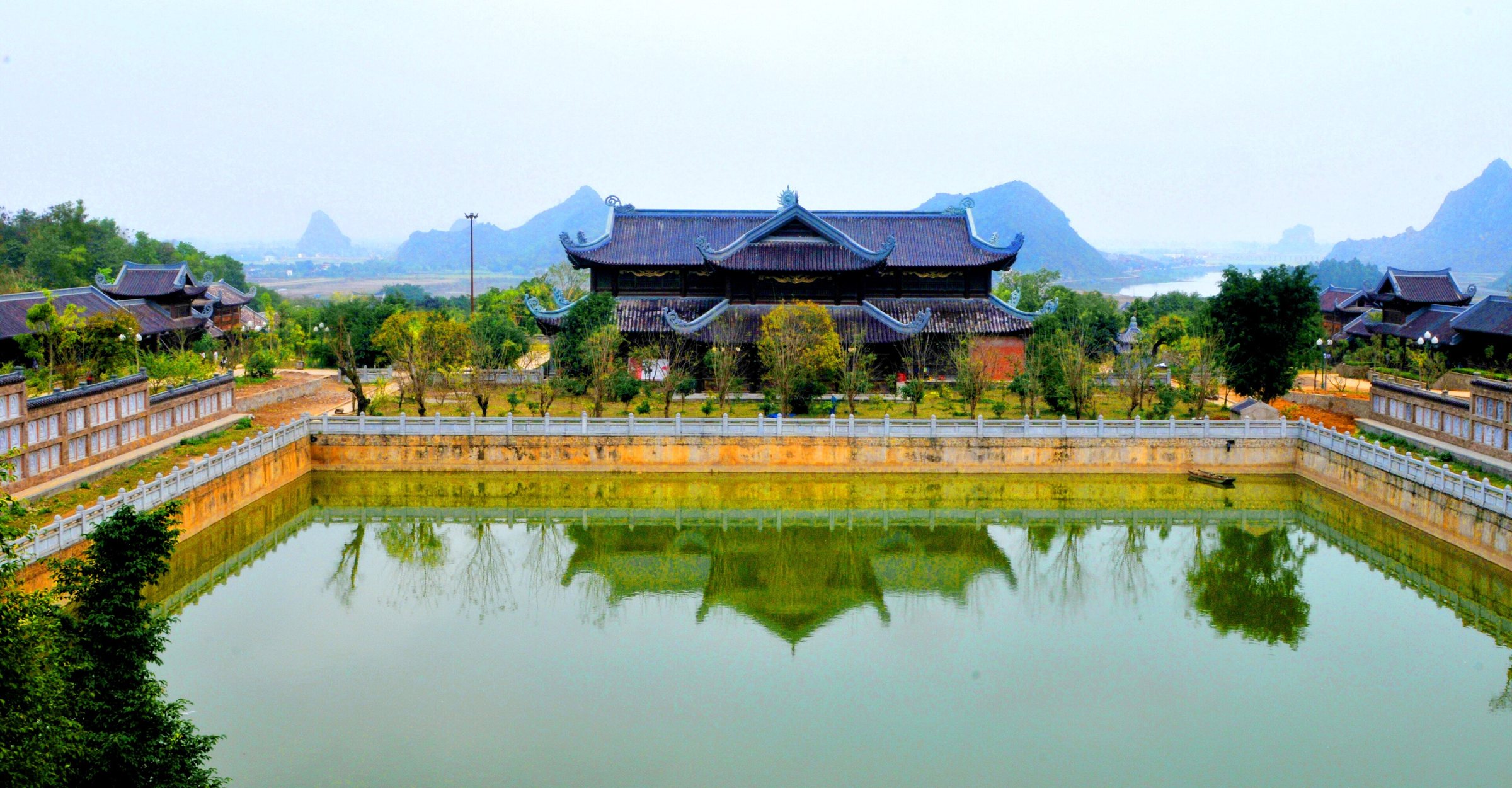
Bai Dinh PagodaChùa Bái Đính
What Bai Dinh Is
Bai Dinh Pagoda refers to two distinct parts sharing a hillside in Ninh Binh and Tam Coc: a modern complex constructed from 2003 onwards, and an older cave pagoda above it that dates to the Dinh dynasty period and was restored during the Ly dynasty in the eleventh century. The newer complex was built by the Xuan Truong construction company and consecrated progressively through the 2010s. The two sites are connected by a long stepped path, though most visitors reach the modern complex's main structures by electric buggy.
The complex sits at the edge of the limestone karst landscape characteristic of Ninh Binh, and the setting — low hills, water features, stone corridors — is deliberately monumental in scale. It functions simultaneously as an active place of worship, a pilgrimage destination for Vietnamese Buddhists, and a domestic tourism attraction.
Scale and Records
The modern complex makes several claims to regional or national scale. The main bell tower houses a large bronze bell; the principal Buddha statues — including a seated Amitabha and a Shakyamuni — are among the largest bronze castings in Vietnam. The complex covers roughly 700 hectares in total, including forested hillside.
These records are cited in Vietnamese tourism materials, though independent verification of specific rankings against other Southeast Asian sites is difficult, and some claims have shifted as other large complexes have been built or expanded elsewhere in the region. The scale is nonetheless immediately apparent on arrival: the main axis alone takes considerable time to walk, which is why electric buggies operate continuously along the route.
The Arhat Corridor
The most visually distinctive feature of the modern complex is the covered corridor running along both sides of the main processional route, lined with 500 stone arhat statues. In Buddhist tradition, arhats are enlightened disciples who have attained nirvana; the 500-arhat gallery is a common feature of large East Asian Buddhist temples, with Chinese precedents at sites such as the Western Han Dynasty Theme Park in Guangzhou and the Lingyin Temple in Hangzhou.
At Bai Dinh, the statues are carved from grey stone and vary somewhat in pose and facial expression, though they follow a standardised style. The corridor is long enough that most visitors see only a portion of it. It provides shade and a degree of quiet compared with the open plazas, and remains one of the more contemplative spaces in the complex.
The Older Cave Pagoda
Above the modern complex, reached by a long flight of stone steps, are the original cave shrines that give the site its name and historical legitimacy. The main cave contains altars to the Goddess of Mercy (Quan Am) and to the God of the Mountain (Cao Son), and a separate cave is dedicated to the Holy Mother (Thanh Mau). These shrines are genuinely old — the site is associated with the monk Nguyen Minh Khong, who is credited with bringing Buddhism to the region during the Ly dynasty.
The cave pagoda receives far fewer visitors than the modern complex below, partly because of the climb and partly because the electric buggies do not reach it. The atmosphere differs markedly: darker, smaller, with incense smoke and the sounds of the surrounding forest rather than amplified chanting and crowds.
Visiting in Practice
The complex is open daily. Electric buggies run from the main gate to the central plaza and are the standard way to cover the distance; the return journey on foot along the arhat corridor is possible for those who prefer it. The site is busiest during the Lunar New Year period (Tet) and on the first and fifteenth days of each lunar month, when pilgrim numbers are highest and queues for the buggies can be long.
Dress requirements apply as in most Vietnamese pagodas: shoulders and knees should be covered. Shoes are removed before entering the main shrine halls. Photography is generally permitted in outdoor areas; conventions vary inside the caves and shrines. Prices vary by season and by service type — buggy, parking, and entrance arrangements have changed over time and should be confirmed locally.
An Honest Assessment
Bai Dinh divides visitors more than almost any other major sight in northern Vietnam. For Vietnamese pilgrims, the scale is part of the point: a grand complex signals devotion and communal aspiration, and the site functions as a living place of worship rather than a heritage monument. For many foreign travellers, particularly those arriving from older pagoda complexes in Hue or Hanoi, the newness of the construction — raw stone, freshly cast bronze, concrete walkways — can feel at odds with expectations of a Buddhist site.
The honest question the research brief raises — whether a complex of this size and age is worth the visit — does not have a single answer. The arhat corridor and the setting within karst hills have genuine visual interest. The older cave pagoda above offers something the modern complex cannot. But the scale also means that the experience is managed, crowded and logistically busy in a way that quieter sites nearby are not. Visitors who have limited time in Ninh Binh and Tam Coc often weigh it against Trang An, Tam Coc or the Hoa Lu citadel ruins before deciding.
Where it is
Also known as / see also
Dirujuk oleh
Các nguồn
- Vietnam National Authority of Tourism — VNAT đã truy cập 29 August 2026
Supports: the rules and definitions on this page - Chùa Bái Đính — Wikipedia (Vietnamese) (CC BY-SA 4.0) đã truy cập 3 September 2026
Supports: background, Vietnamese edition
Current Terakhir diverifikasi: 3 September 2026. Rules, fares and prices change — check the official source before acting on anything here. Report a mistake.
Picture credits (1)
VŨ HÙNG, CC BY-SA 3.0, Wikimedia Commons