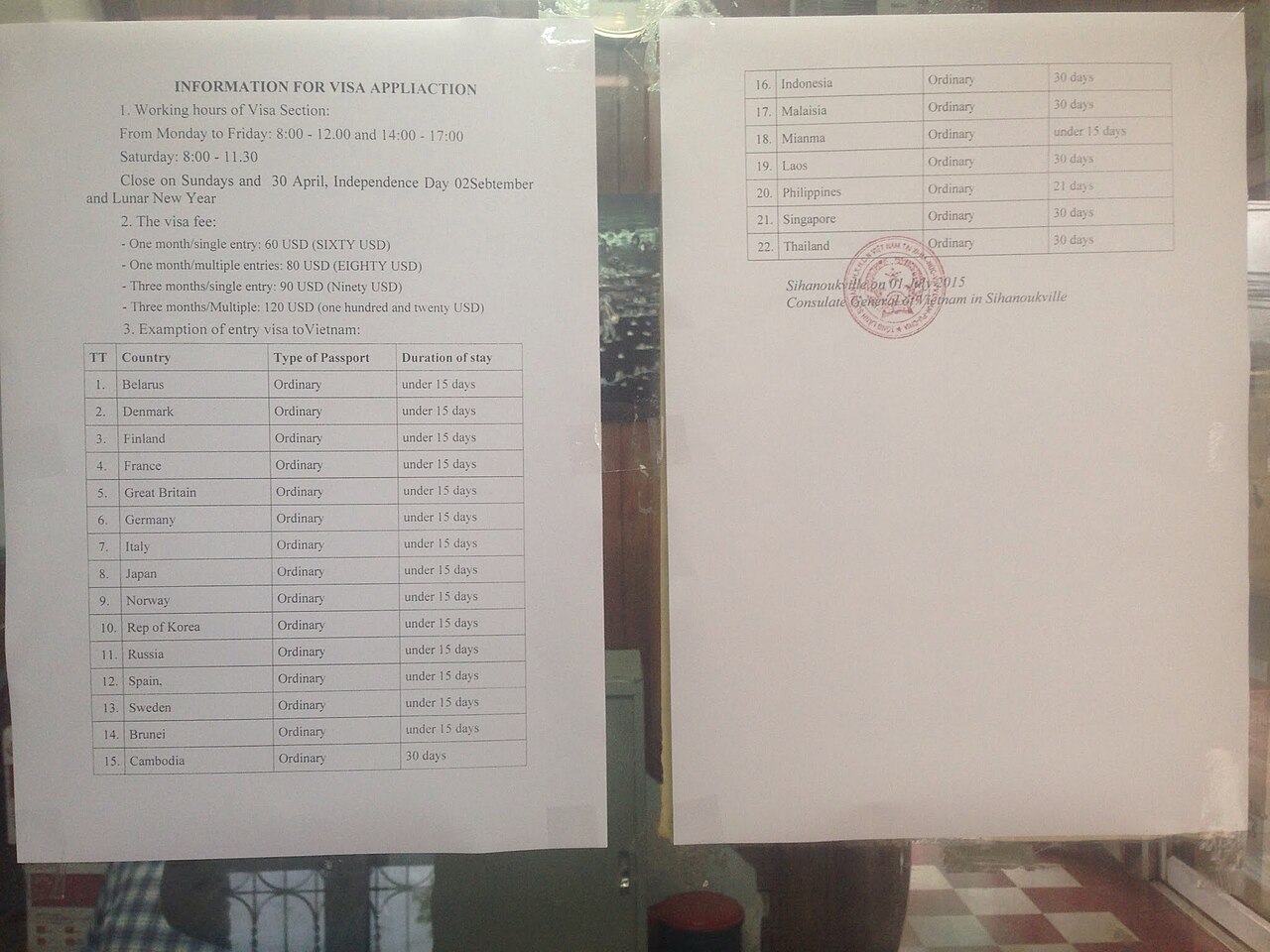
Visa exemptionsMiễn thị thực
Vietnam operates several overlapping visa-exemption arrangements: bilateral agreements with specific countries, a unilateral scheme extended periodically by decree, and a separate arrangement tied to Phu Quoc island. The permitted length of stay, whether re-entry is allowed and after what interval, and which nationalities are covered are all subject to revision. The Vietnamese Immigration Department and the nearest Vietnamese embassy or consulate are the authoritative sources on the day of travel.
How exemptions are granted
Vietnam's visa exemptions fall into two broad categories. The first consists of bilateral agreements negotiated individually with partner countries; these tend to be more stable but are still subject to revision. The second is a unilateral scheme under which Vietnam has, at various times, extended exemptions — often for fixed trial periods — to citizens of countries with which it has no formal bilateral agreement. Both types are enacted and amended by government decree, meaning a nationality that is exempt today may not be exempt after a new decree takes effect, and vice versa.
Because the legal basis is a decree rather than a treaty obligation, changes can be made relatively quickly and are not always widely publicised in advance. Travellers whose nationality falls under the unilateral scheme in particular should verify their status close to their date of travel.
Permitted lengths of stay and nationalities covered
The permitted length of a visa-free stay varies by nationality and by the type of agreement under which the exemption is granted. Common durations in recent years have included fourteen, fifteen, thirty, and forty-five days, but these figures are illustrative of the range rather than a reliable current list: specific durations are set by decree and have been changed on multiple occasions.
Citizens of ASEAN member states have generally been covered by bilateral arrangements, often for longer permitted stays than citizens of countries covered only by the unilateral scheme. Several European, North Asian, and other nationalities have been added to or removed from the unilateral list at different points. No list published in a travel guide, atlas or unofficial website should be treated as definitive. The official source is the Vietnamese Ministry of Foreign Affairs and the Immigration Department of the Ministry of Public Security.
The Phu Quoc arrangement
Phu Quoc island, located in the Gulf of Thailand and now part of Kien Giang province, has at various times operated under a separate visa arrangement that is more permissive than the national scheme. Under this arrangement, visitors of any nationality arriving directly to Phu Quoc and remaining on the island have been able to enter without a visa for a defined period. The arrangement is intended to support the island's tourism economy.
The Phu Quoc exemption is subject to the same caveat as all others: it is set by decree, the permitted duration and exact conditions have been adjusted over time, and travellers who plan to use it should confirm the current rules before departure. Crucially, the exemption does not automatically extend to the Vietnamese mainland: a visitor who travels from Phu Quoc to Ho Chi Minh City or elsewhere on the mainland without a visa risks being found in violation of immigration rules.
Re-entry gaps and consecutive stays
A question that frequently arises is whether a traveller who has used a visa exemption can leave Vietnam and immediately return for a further exempt period. Vietnam has at various times enforced a minimum interval between consecutive visa-free stays, and the rules on this point are unsettled: official policy has been interpreted and applied inconsistently at different border crossings and airports, and the formal rules have themselves been amended more than once.
Some travellers report being refused re-entry after a short absence; others report no difficulty. Whether a gap is required, and how long that gap must be, is a matter that cannot be answered definitively here. It is a question for the Vietnamese Immigration Department or a Vietnamese embassy, and even then the answer should be sought in writing if possible, since practice at the border does not always match stated policy.
Checking the current position
Because exemption lists, permitted durations and re-entry conditions are all subject to change by decree — sometimes with little public notice — any source that presents them as fixed facts should be treated with caution. This page is no exception.
The authoritative sources are the Vietnamese Ministry of Foreign Affairs, the Immigration Department of the Ministry of Public Security, and Vietnamese embassies and consulates in the traveller's home country. Airlines may also refuse boarding to passengers who do not hold the correct documentation, so it is worth confirming requirements with the carrier as well. Official sources should be consulted as close to the date of travel as is practical, and certainly not relied upon from a check carried out months in advance.
Where a visa is required or where eligibility is uncertain, Vietnam's e-visa system offers an online route to obtaining entry permission before departure.
Also known as / see also
Référencé par
Sources
- Vietnam National Authority of Tourism — VNAT consulté 29 August 2026
Supports: carried over from the first build - Vietnam National Electronic Visa Portal — Vietnam Immigration Department consulté 29 August 2026
Supports: carried over from the first build
Dernière vérification: 29 August 2026. Rules, fares and prices change — check the official source before acting on anything here. Report a mistake.
Picture credits
- Vietnamvisaexemption2015 — Jantteri666, CC BY-SA 4.0, Wikimedia Commons