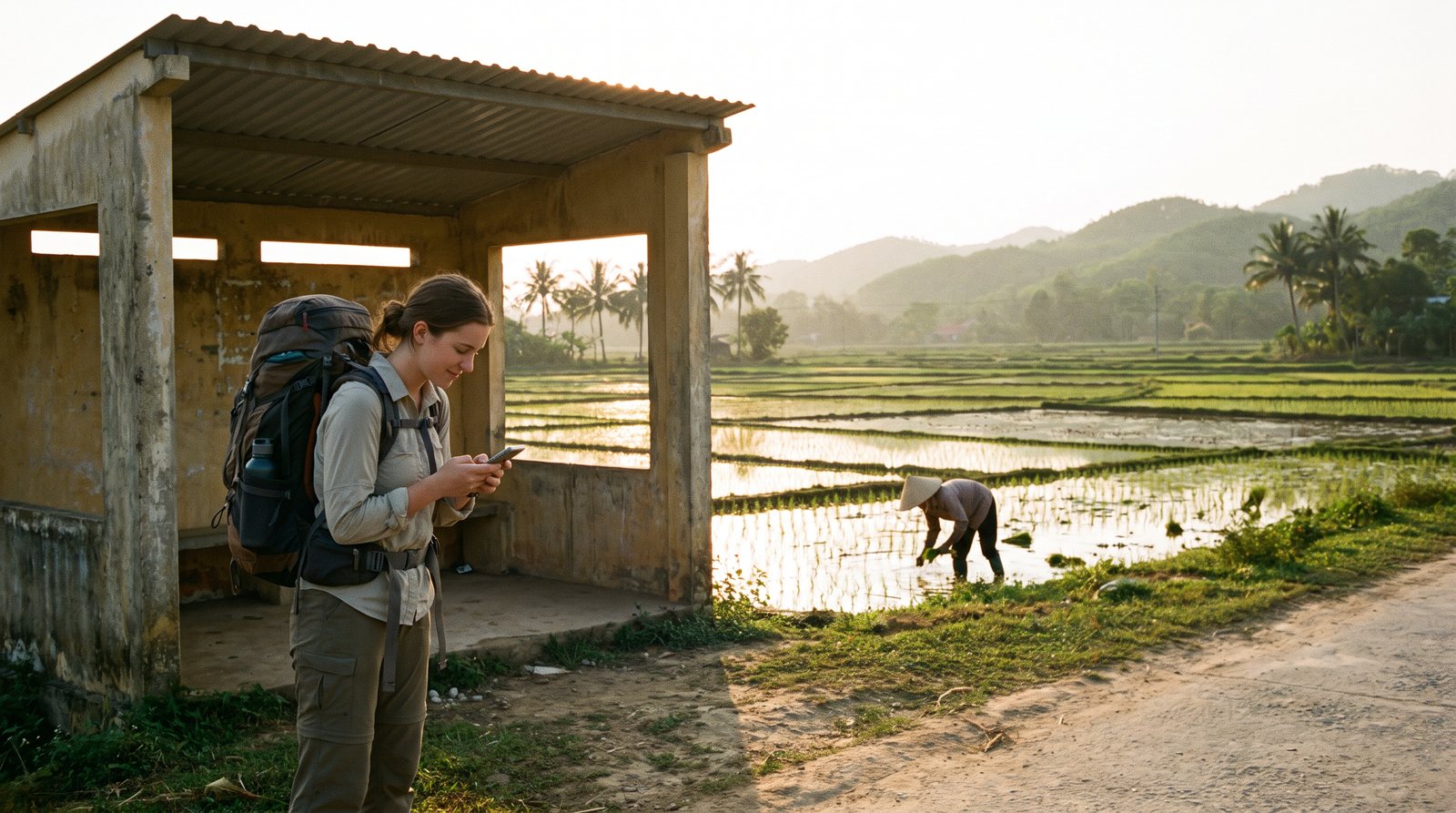
Solo and female travellersDu lịch một mình
Solo travel in Vietnam — whether by men or women — is common and well-catered for by the country's established backpacker infrastructure. The picture is not uniform: a busy tourist strip in Hội An operates very differently from a provincial bus station at midnight. This page sets out the practical conditions as they are generally reported, while noting where experience diverges and where the situation remains genuinely unsettled.
General safety picture
Vietnam is frequently ranked among the lower-risk destinations in Southeast Asia for solo travellers. Violent crime against foreigners is rare, and the country does not have a widespread reputation for the kind of serious assault that affects some neighbouring destinations. That said, petty theft — bag-snatching from motorbikes, pickpocketing in crowded markets and on busy streets — is a real and commonly reported problem in Ho Chi Minh City, Hanoi and Nha Trang in particular.
Scams targeting solo travellers exist: rigged taxi meters, inflated bills at unlicensed restaurants near tourist sites, and 'friendly stranger' approaches that end at a bar or shop with pressure to spend. These are nuisances and financial risks rather than physical ones, but they disproportionately affect people travelling alone who have no companion to consult.
The overall risk level is genuinely lower than in much of the region, but it is not zero, and solo travellers report a higher rate of minor incidents than those in groups.
Conditions for women specifically
How Vietnam compares to other Southeast Asian countries for solo female travel is a question on which reported experience varies enough that no single answer is accurate. Many women travel the length of the country without incident and describe it as comfortable. Others report persistent low-level harassment, particularly in cities and at transport hubs.
The most commonly reported form of harassment is verbal: comments, prolonged staring, or uninvited attempts at conversation that do not stop when declined. Physical harassment is reported less frequently than in some other regional destinations, though it does occur, particularly in nightlife areas late at night.
Harassment levels appear to correlate with setting. Well-trafficked tourist towns (Hội An, Đà Lạt, Sa Pa) generally produce fewer reports of difficulty than large city nightlife strips or isolated rural areas where foreign women are uncommon. This pattern is reported widely enough to be a practical consideration rather than speculation, but individual experience remains variable.
Dress norms and practical presentation
Vietnam is not a strictly conservative country in the way that some others in the region are, and outside of temples and pagodas there is no enforced dress code. In practice, however, dress norms differ noticeably between urban centres and rural areas, and between the more internationally oriented tourist circuit and areas away from it.
In cities and resort towns, Western clothing including shorts and sleeveless tops is normal and attracts no particular attention. In rural areas and smaller towns, more covered clothing is the local norm, and departing from it can attract stares or comments — not necessarily hostile, but persistent.
At religious sites — pagodas, temples, communal houses — covered shoulders and knees are expected regardless of gender. Many sites provide wraps at the entrance.
Some solo female travellers report that dressing more conservatively in transit situations (bus stations, overnight trains, provincial towns) produced noticeably less unsolicited attention. This is a reported pattern, not a prescription.
Night transport and late movement
Night transport carries different risk profiles depending on the mode. Overnight sleeper trains are widely used by solo travellers of all genders and are generally considered safe; the enclosed berth system on main routes between Hanoi and Ho Chi Minh City means passengers are not in open public space. Booking a berth in a soft-sleeper cabin rather than an open hard-seat carriage is the standard approach for anyone wanting a more controlled environment.
Overnight buses are more variable. Reports of theft from bags in the hold, and occasional incidents of unwanted contact in the dark cabin, appear in traveller accounts with enough regularity to be worth noting. Keeping valuables on the person rather than in luggage below is standard practice.
Motorbike taxis (xe ôm) at night, particularly from informal drivers rather than app-based services, carry a higher risk of overcharging and, less frequently, other incidents. App-based ride services (Grab being the dominant platform at the time of writing) provide a record of the journey and driver identity, which many solo travellers — women in particular — prefer for late-night movement.
Walking alone late at night in unfamiliar areas, especially away from the main tourist strips, is where the most incident reports concentrate.
Accommodation choices
Vietnam has a dense network of accommodation options relevant to solo travellers. Hostels with dormitory beds are widespread on the main tourist circuit — Hanoi's Old Quarter, Ho Chi Minh City's Phạm Ngũ Lão area, Hội An, Đà Lạt, Sa Pa, Nha Trang — and provide the most reliable environment for meeting other travellers. Many offer female-only dormitory rooms, which are in consistent demand.
Budget guesthouses (nhà nghỉ) are ubiquitous and inexpensive. Quality and security standards vary significantly; those in tourist areas tend to have better door locks and more attentive front desks than those catering primarily to domestic short-stay guests. Reading recent reviews for a specific property is more reliable than assuming category-level standards.
Solo travellers in Vietnam typically pay the same room rate as couples, since most budget accommodation charges by room rather than per person. This makes solo travel here less financially punishing than in destinations where single supplements are standard.
Meeting other travellers
Vietnam's tourist infrastructure actively facilitates social contact for solo travellers. The country's main circuit — Hanoi, Hạ Long Bay, Ninh Bình, Đà Nẵng, Hội An, Đà Lạt, Nha Trang, Ho Chi Minh City, the Mekong Delta — is well-trodden and generates a constant flow of travellers on similar routes.
Hostel common areas and organised hostel activities (pub crawls, cooking classes, group day trips) are the most reliable point of contact. Group tours — overnight cruises on Hạ Long Bay being the most prominent example — place solo travellers in small groups by design and are a common way to make connections.
The backpacker streets in Hanoi (Tạ Hiện, Mã Mây) and Ho Chi Minh City (Phạm Ngũ Lão) function as social hubs where solo travellers congregate. Cafés catering to remote workers have become a secondary meeting point, particularly in Đà Lạt and Hội An.
Away from the main circuit, solo travellers report longer stretches without English-language social contact. This is a function of infrastructure, not hostility — rural Vietnam is generally welcoming but not set up around international travel.
Also known as / see also

참조 페이지
출처 목록
- Vietnam travel advice — Smartraveller, Australian Government 접근됨 29 August 2026
Supports: carried over from the first build - Vietnam international travel information — U.S. Department of State 접근됨 29 August 2026
Supports: carried over from the first build - Vietnam travel advice — UK Foreign, Commonwealth & Development Office 접근됨 29 August 2026
Supports: carried over from the first build - Vietnam National Authority of Tourism — VNAT 접근됨 29 August 2026
Supports: carried over from the first build
마지막 확인: 29 August 2026. Rules, fares and prices change — check the official source before acting on anything here. Report a mistake.