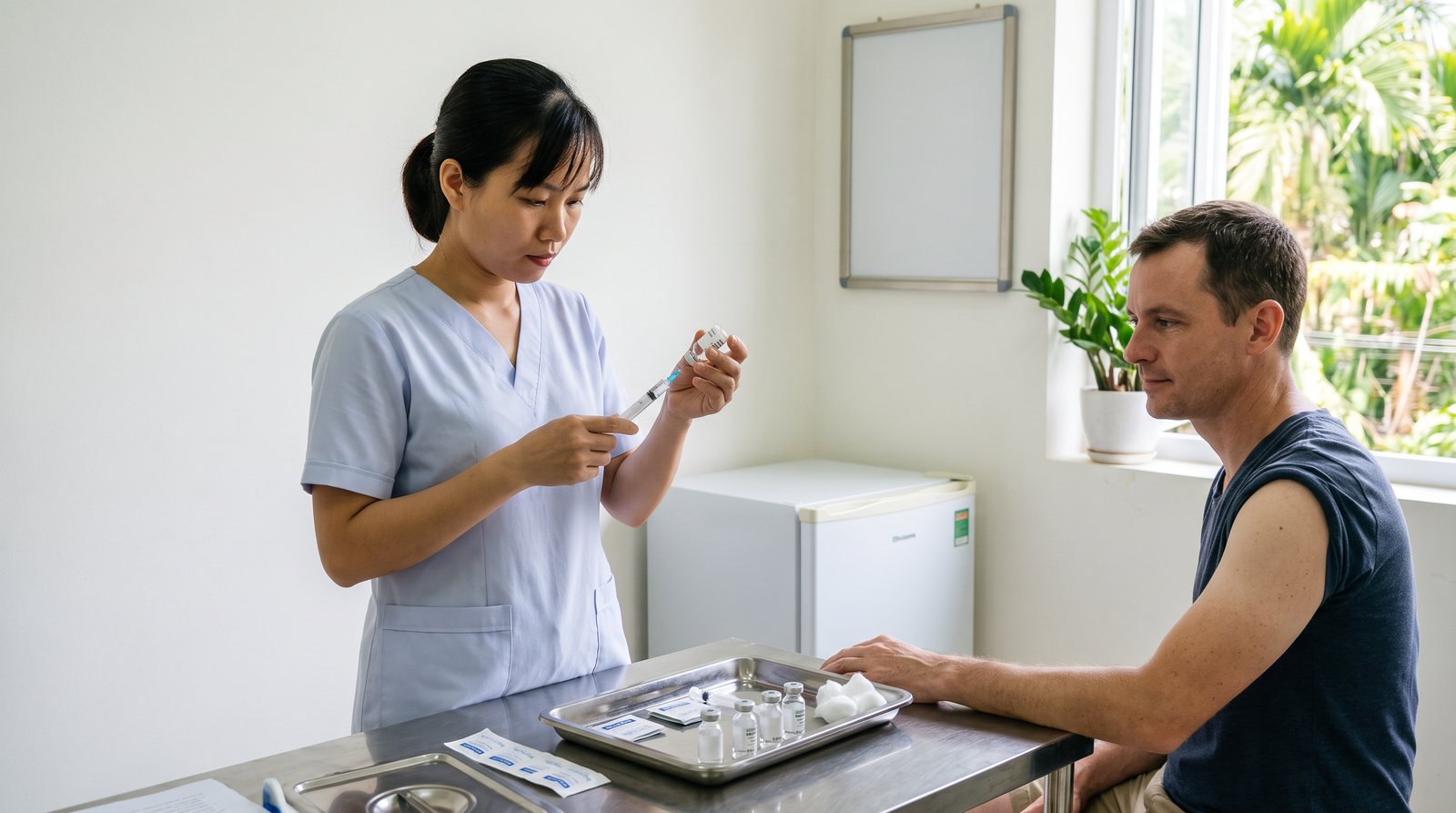
Health and vaccinationsSức khỏe và tiêm chủng
Vietnam's health landscape ranges from the urban air-quality concerns of Hanoi and Ho Chi Minh City to mosquito-borne diseases in rural and forested areas. Standards of medical care vary considerably between major cities and remote provinces. This page offers a general overview of common health considerations; it is not a substitute for personalised medical advice from a registered travel health professional.
Vaccinations commonly advised
The following vaccines are frequently recommended for travellers to Vietnam, though individual circumstances, itinerary and medical history all affect what is appropriate. A travel clinic can assess the full picture.
- Routine vaccinations: Ensuring that standard immunisations — measles-mumps-rubella, diphtheria-tetanus-pertussis, polio and influenza — are up to date is the first step for any international travel.
- Hepatitis A: Widely advised owing to the risk of contaminated food and water throughout the country.
- Hepatitis B: Recommended for longer stays or for travellers who may require medical treatment.
- Typhoid: Commonly advised, particularly for those eating outside of major hotel and restaurant settings.
- Japanese encephalitis: Relevant for extended rural travel, especially during and after the wet season.
- Rabies: Pre-exposure vaccination is considered for those spending significant time outdoors, in rural areas, or working with animals.
- Cholera: Occasionally recommended depending on itinerary and individual risk factors.
Yellow fever vaccination is not required for entry to Vietnam unless a traveller is arriving from a country with a risk of yellow fever transmission; official requirements can change by decree, so the Vietnamese embassy or consulate in the traveller's home country is the authoritative source.
Dengue fever and malaria
Both dengue fever and malaria are present in Vietnam, though their distribution and intensity differ considerably.
Dengue fever is the more widespread concern. It is transmitted by Aedes mosquitoes, which are active during daylight hours and are found throughout the country, including in cities. Risk tends to be higher during and immediately after the rainy season. There is no widely available preventive medication; the primary protection is avoiding mosquito bites through repellents, clothing coverage and treated bed nets.
Malaria risk is concentrated in forested and highland areas, particularly in the south-central provinces, parts of the Central Highlands, and border regions with Cambodia and Laos. Risk is generally low in major cities, the Red River Delta, the coast, and the Mekong Delta lowlands. The species and drug-resistance profile of malaria parasites varies by sub-region, which is one reason personalised advice from a travel clinic matters: the appropriate prophylaxis, if any, depends on the specific areas a traveller intends to visit.
General mosquito precautions — DEET-based repellents, long sleeves and trousers at dawn and dusk, air-conditioned or well-screened accommodation, and permethrin-treated nets — reduce risk for both diseases.
Food, water and stomach illness
Gastrointestinal illness is among the most common health complaints among visitors to Vietnam. Tap water is not considered safe to drink in any part of the country; bottled water is widely available, though travellers should ensure seals are intact. Ice in reputable hotels and restaurants is generally made from treated water, but this is harder to verify in smaller establishments.
Street food is a central part of Vietnamese culinary culture and is eaten safely by millions of people daily, but the risk of contamination exists. Food served very hot from high-turnover stalls tends to carry lower risk than dishes left at ambient temperature. Raw vegetables and salads washed in unfiltered water are a recognised vector.
Oral rehydration salts are available in pharmacies throughout the country and are worth carrying, particularly for travel in hot weather or remote areas. Travellers with pre-existing digestive conditions should take particular care and discuss prophylactic options with their doctor before departure.
Heat, sun and air quality
Heat and humidity are significant in the south year-round and in the north during summer months. Heat exhaustion and heat stroke are real risks for those unaccustomed to tropical conditions, particularly during physical activity. Hydration, rest during the hottest part of the day, and appropriate clothing are the standard mitigations.
Air quality in Hanoi and Ho Chi Minh City is a documented public health concern. Both cities regularly record elevated levels of particulate matter (PM2.5), with the worst episodes typically occurring in the cooler, less windy months from roughly October to March in Hanoi, and during dry periods in Ho Chi Minh City. Real-time air quality indices are monitored by several independent services. People with asthma, chronic respiratory or cardiovascular conditions should be aware of this before planning an extended urban stay.
Sun intensity is high throughout the country; UV index readings are frequently in the extreme range. Sunburn can occur quickly, particularly at altitude or on open water.
Pharmacies and medication
Pharmacies (nhà thuốc) are numerous in Vietnamese cities and towns, and a reasonable range of medications — including many that require a prescription in Western countries — is available over the counter. This accessibility is practically useful but also carries risks: medication may be counterfeit, incorrectly stored, or dispensed without appropriate clinical assessment.
Brand names differ; travellers who rely on regular prescription medication are advised to bring an adequate supply from home, along with documentation from their prescribing doctor in case of questions at customs or from local medical staff.
Antimalarials, antibiotics and some other prescription drugs are widely dispensed without prescription in Vietnamese pharmacies. This does not mean self-prescribing is advisable; incorrect use of antibiotics in particular contributes to resistance and can cause harm.
Pharmacists in major cities often speak some English. Outside cities, communication may require translation assistance.
Hospitals and international medical facilities
Medical care in Vietnam ranges from internationally accredited hospitals in the two major cities to basic district-level clinics in rural areas. The gap is significant, and for serious conditions, evacuation to a major city — or out of the country entirely — may be the appropriate response.
Ho Chi Minh City has the broadest concentration of internationally oriented hospitals and clinics, several of which operate to standards comparable with those in Western countries and have English-speaking staff. Hanoi has a smaller but still meaningful cluster of international-standard facilities.
In other provincial cities, general hospitals exist but English-language capacity is limited and specialist care may not be available. In very remote areas, even basic facilities may be hours away.
Medical evacuation insurance is strongly advisable. Standard travel insurance that covers emergency evacuation and repatriation is widely considered essential rather than optional for travel to Vietnam, given the potential cost and logistical complexity of medical evacuation from rural areas.
This page does not list specific hospitals by name or contact detail, as operational status and standards change. A travel clinic, embassy or international insurance provider can supply current recommended facility lists.
A note on this information
The information on this page is general orientation for travellers from countries such as the United States, the United Kingdom, Australia and European nations. It describes patterns and categories of risk; it does not account for individual medical history, specific itineraries, current disease outbreaks, or changes in official guidance.
Health recommendations, visa-linked vaccination requirements, and disease outbreak status all change. The authoritative sources are a qualified travel medicine clinic or GP with travel health experience, the traveller's national health authority (such as the US CDC, the UK's NHS Travel Health pages, or Australia's Smartraveller), and the Vietnamese authorities for entry requirements. These should be consulted in advance of travel, not relied upon from memory of a general reference page.
Also known as / see also
Referans veren sayfalar
Kaynaklar
- Ministry of Health — Bộ Y tế erişildi 29 August 2026
Supports: carried over from the first build - Vietnam country profile — World Health Organization erişildi 29 August 2026
Supports: carried over from the first build
Son doğrulama: 29 August 2026. Rules, fares and prices change — check the official source before acting on anything here. Report a mistake.