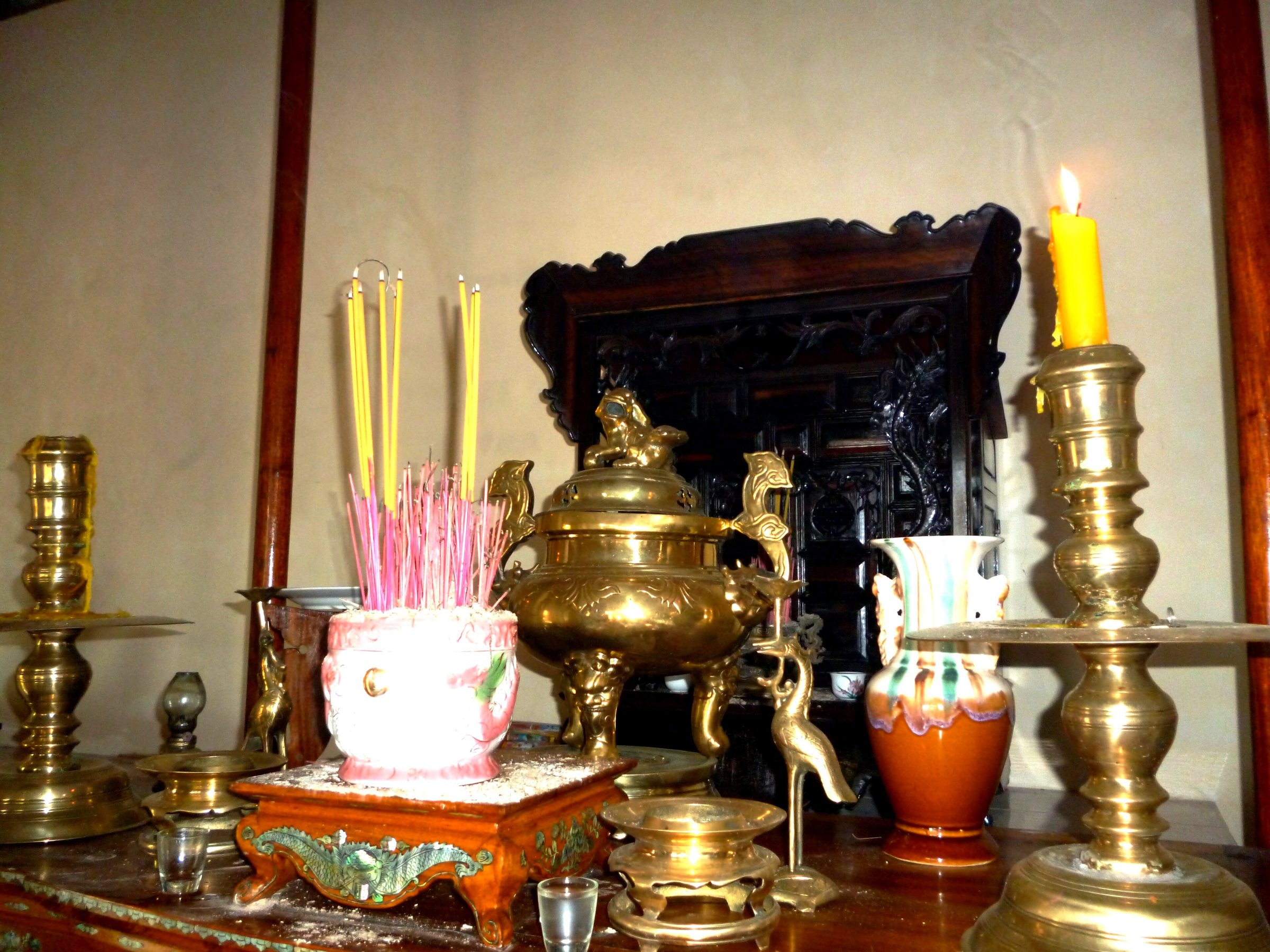
Etiquette and customsPhép lịch sự
Vietnam has a rich and layered set of social expectations shaped by Confucian ideas about hierarchy, community and face. Most Vietnamese people are forgiving of foreigners who make genuine efforts, but some situations — religious sites, minority villages, Tet visits — carry expectations that are worth understanding in advance.
Greetings and the pronoun system
Vietnamese has no neutral word for 'you' or 'I'. Every address requires selecting from a set of pronouns that signal the speaker's age and relationship to the other person. A younger person speaking to an older woman uses con (I) and bà (you); an older man speaking to a young man might use anh or chú. Foreigners are not expected to master this system, but being aware that it exists helps explain why Vietnamese speakers sometimes seem to be naming people rather than addressing them.
A light bow or nod accompanies greetings in most contexts. Handshakes are common in business settings, particularly with men. Physical contact between strangers in public is limited; hugging on first meeting is unusual. Addressing someone by their first name alone, without a title or pronoun, can read as abrupt or rude.
Temples, pagodas and religious sites
Shoes are removed before entering most pagodas, temples, and many private homes. Watch for a row of shoes at the entrance; this is the clearest signal. Socks may be worn. Some communal houses and minority dwellings follow the same rule.
Dress conservatively at religious sites: shoulders and knees covered is the standard expectation for both men and women. Some sites keep sarongs or wraps available for those who arrive underdressed, but this is not universal. Loud conversation and laughter inside a pagoda or temple is considered disrespectful. Photography is often tolerated in the grounds but restricted inside the main hall; look for signs or follow local behaviour. Do not touch statues, offerings or altar items.
When burning incense, hold the sticks with both hands at chest height and bow briefly before placing them. Waving incense smoke toward yourself is considered auspicious, not rude.
Chopstick manners and dining
A few chopstick practices carry strong negative associations. Sticking chopsticks vertically into a bowl of rice resembles incense sticks at a funeral altar and is considered inauspicious. Passing food directly from chopstick to chopstick echoes a funeral rite and is similarly avoided. Pointing at people with chopsticks is rude in the same way pointing with a finger is rude.
Meals are generally communal; dishes are shared from the centre of the table. It is polite to serve others before yourself, particularly older guests. Finishing every grain of rice in your bowl signals you have eaten enough; leaving a small amount can indicate satisfaction in some regional traditions, though this varies.
Slurping noodles or soup is not considered impolite. Eating with the bowl raised close to the mouth is normal. Refusing food repeatedly when pressed can cause offence; a small token acceptance is often the smoother response.
Drinking customs and toasts
Bia hơi culture — fresh draught beer, consumed at low plastic tables on the pavement — is central to social life in the north in particular. Toasting is common: một, hai, ba, dô (one, two, three, cheers) is the standard northern toast. Clinking glasses is expected; hold your glass slightly lower than that of an elder or senior guest as a sign of respect.
Refusing alcohol entirely is socially easier for women than for men, where persistent pressure to drink is common in some group settings. Claiming a health reason is a generally accepted deflection. Drinking substantially more than one's host without reciprocating toasts can read as poor manners.
Tea is served before and after meals in many homes and traditional tea houses. Accepting a cup when offered, even if you do not drink it, is courteous.
Face and public disagreement
'Face' — the maintenance of dignity and reputation in front of others — is a significant factor in Vietnamese social and professional life. Causing someone to lose face by criticising, correcting or contradicting them publicly creates lasting discomfort. This applies to arguments in shops or restaurants as much as in business negotiations.
Direct refusals are often softened into ambiguous responses. 'Yes' can mean 'I hear you' rather than agreement; an apparent agreement that is never followed through may signal reluctance that was not expressed directly. Shouting, showing visible anger, or pursuing a dispute loudly in public is likely to harden positions rather than resolve them, and to embarrass bystanders.
In business contexts, hierarchy shapes communication significantly; disagreeing with a senior person in front of their colleagues is particularly sensitive. These dynamics are discussed in more detail on the business culture page.
Photographing people
Asking permission before photographing individuals — rather than pointing a camera at them without acknowledgement — is the baseline expectation, as it would be in most countries. In practice, many Vietnamese people in tourist areas are accustomed to cameras and unbothered; others are not.
The question is more pointed in ethnic-minority villages, particularly in the northwest and central highlands. Some communities have expressed discomfort with being treated as photographic subjects, and the ethics of tourism photography of minority peoples remains actively debated. There is no settled rule, but approaching with a greeting, not photographing ceremonies or private moments without clear assent, and not making photography the transactional basis of an interaction are starting points that most observers would accept.
Payment for photographs is sometimes requested; this is a matter of negotiation. Photography restrictions at military installations, border zones and some government buildings are formal rather than customary and should be observed.
Gifts and Tet visits
Gifts in Vietnam are often not opened immediately in front of the giver; setting them aside to open later avoids any visible reaction becoming awkward. Wrapping matters: red and gold are associated with luck; black and white with mourning. Clocks and handkerchiefs carry negative associations in some contexts, as they are linked to funerals. Fruit, sweets, tea and alcohol are common and unambiguous choices.
Tet — the Lunar New Year, usually falling in late January or February — is the most significant period for social visits. Visiting a household on the first day of Tet carries particular weight; the first visitor of the year is thought to influence the family's fortune. Hosts may quietly prefer the first visitor to be someone considered lucky (generally someone older, married, and in good health). This is a sensitive area and not one where an explicit conversation will necessarily happen; uncertainty about whether a first-day visit is welcome is not unreasonable.
Bringing an even number of gifts is generally preferred. Lì xì — small amounts of money given in red envelopes — are given to children and sometimes unmarried young adults during Tet. The amount matters less than the gesture; the envelope should be new or clean.
Also known as / see also
참조 페이지
출처 목록
- Vietnam National Authority of Tourism — VNAT 접근됨 29 August 2026
Supports: carried over from the first build - Lịch sự — Wikipedia (Vietnamese) (CC BY-SA 4.0) 접근됨 29 August 2026
Supports: carried over from the first build
Current 마지막 확인: 29 August 2026. Rules, fares and prices change — check the official source before acting on anything here. Report a mistake.
Picture credits (1)
Ban thờ họ ở nhà thờ họ Trần ở Cát Sơn, ngày 02 tháng 02 năm 2013, Phương Huy, CC BY-SA 4.0, Wikimedia Commons