The Imperial City
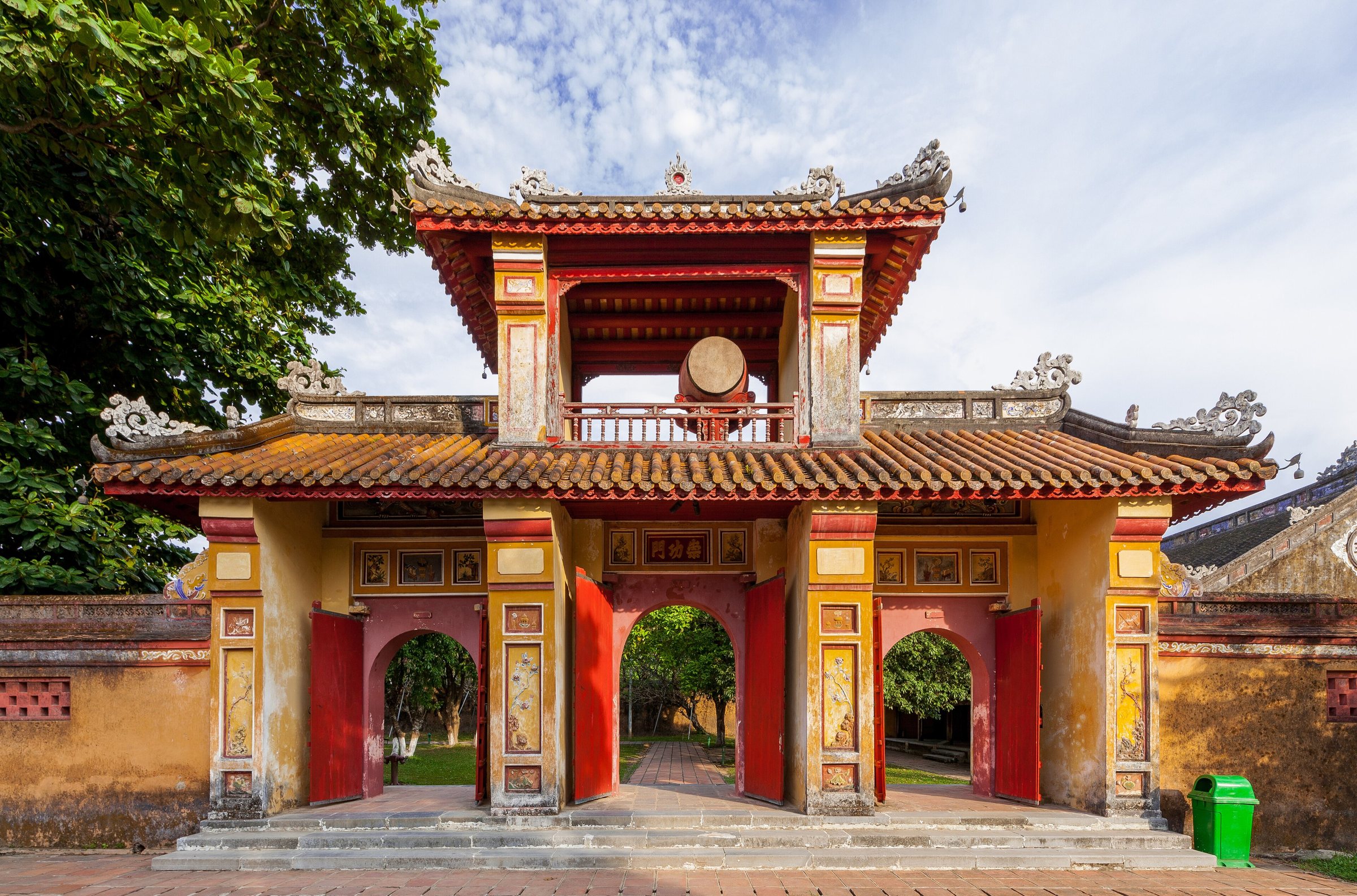
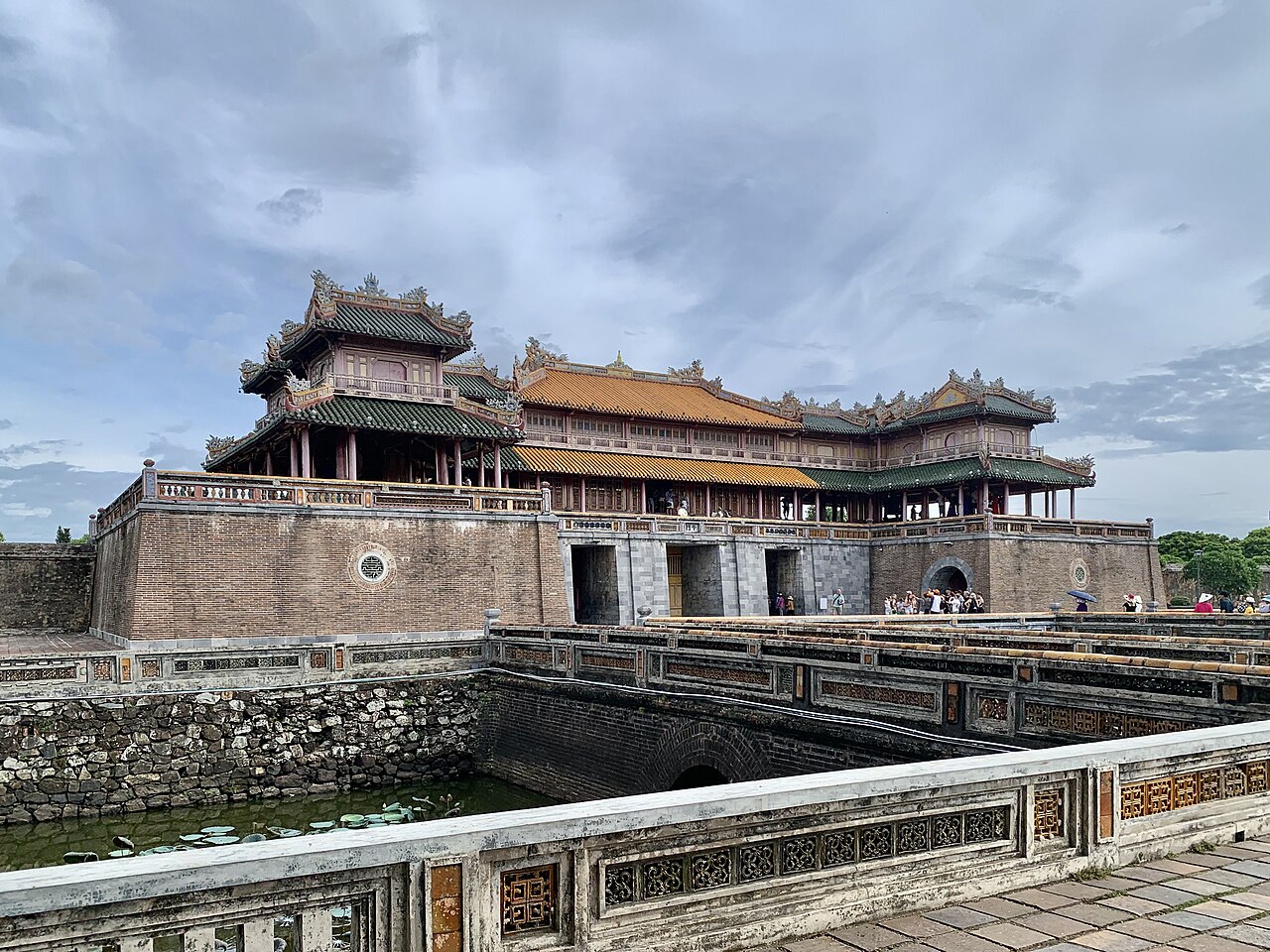
Hue's citadel complex, known in Vietnamese as the Đại Nội or Imperial City, was modelled on Beijing's Forbidden City and built from 1804 onwards under Emperor Gia Long. The full complex consists of three concentric walled enclosures: the Kinh Thành (Capital City), the Hoàng Thành (Imperial City) and the innermost Tử Cấm Thành (Forbidden Purple City), reserved for the emperor and his household.
Significant portions were destroyed during the 1968 Tet Offensive, when Hue became the site of prolonged urban fighting lasting 25 days. The Ngọ Môn (Noon Gate), the Thai Hoa Palace of Supreme Harmony and several pavilions survived or have been substantially restored; parts of the Forbidden Purple City remain ruined. UNESCO-supported restoration work has continued in phases since the 1990s and is ongoing, meaning some structures may be under scaffolding at any given time.
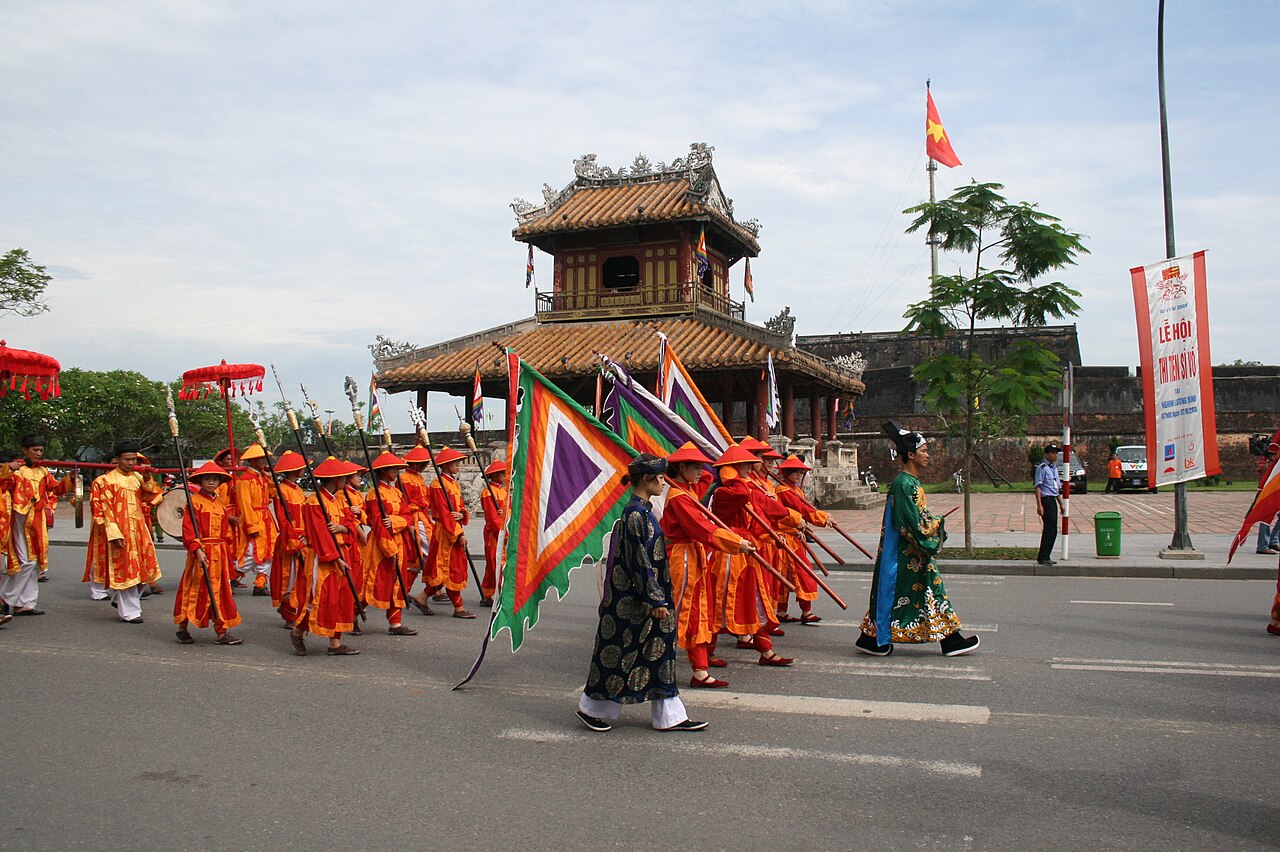
The flag tower outside the main gate, flying a large national flag, is one of the most recognisable landmarks in the city. Central Vietnamese cuisine originated in the royal kitchens here, and that heritage shapes what is served across the city today.
Royal Tombs
Seven Nguyen emperors are buried in tomb complexes scattered across the forested hills south-west of the city. Each reflects the personality and reign of its occupant and functions as a self-contained ceremonial landscape combining temples, ponds, pavilions and the burial mound itself.
- Lăng Minh Mạng (Emperor Minh Mang, r. 1820–1841): considered the most classically proportioned of the tombs, set within a symmetrical garden of lakes and stone bridges on a central axis leading to the burial mound.
- Lăng Tự Đức (Emperor Tu Duc, r. 1847–1883): the largest complex, built during the emperor's lifetime and used by him as a retreat; it includes a lake, pavilions and the stele house containing Tu Duc's self-composed epitaph, one of the longest in Vietnam.
- Lăng Khải Định (Emperor Khai Dinh, r. 1916–1925): architecturally the most unusual, blending Vietnamese, French and Chinese elements; the interior of the main hall is encrusted with mosaic work made from glass and porcelain fragments.
The tombs are spread across a wide area and are most conveniently visited by motorbike or hired vehicle. Boat trips on the Perfume River can be combined with tomb visits.
Thien Mu Pagoda and the Perfume River
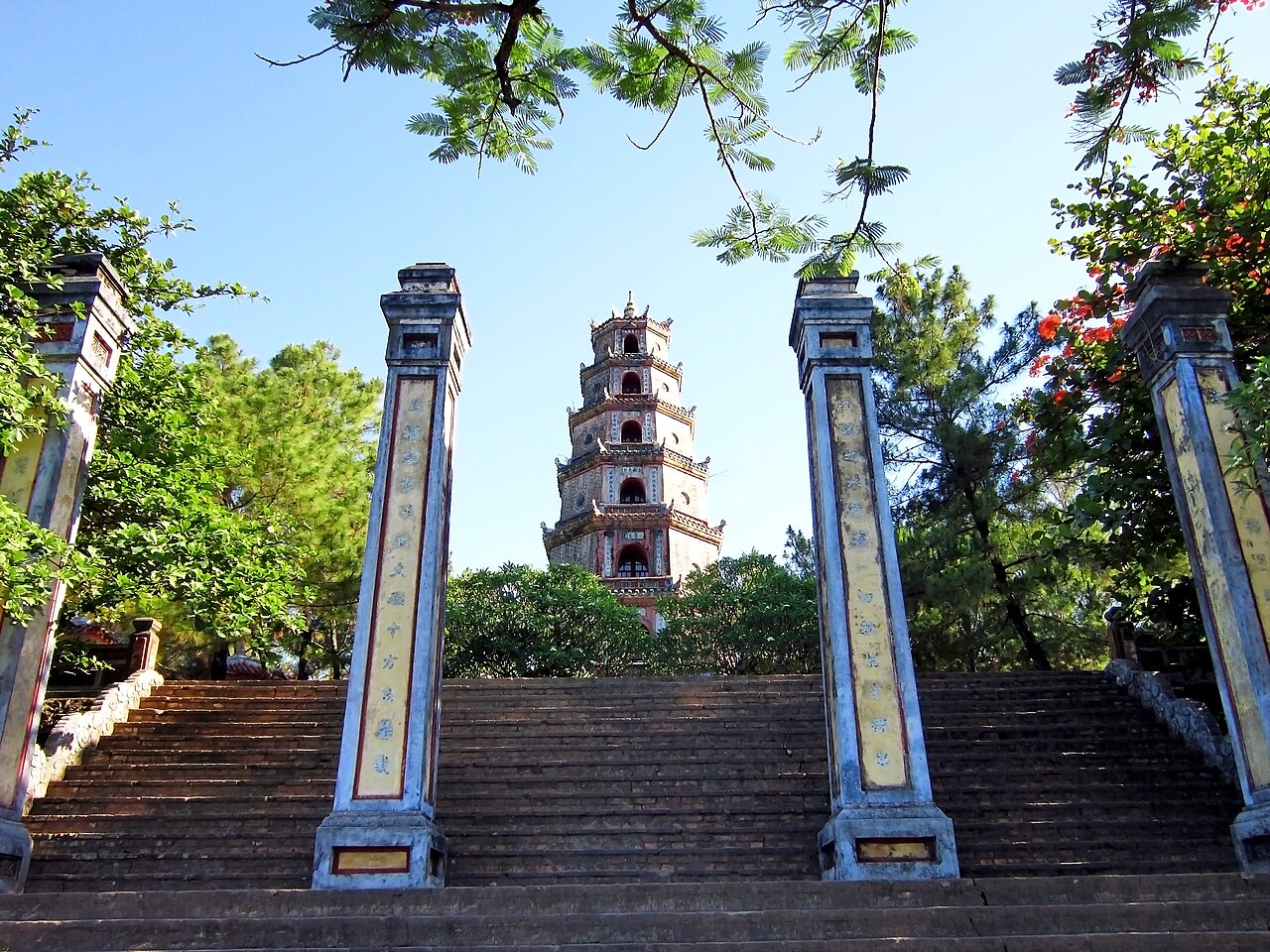
Chùa Thiên Mụ (Heavenly Lady Pagoda) stands on a low hill overlooking the Perfume River about four kilometres west of the citadel. Its seven-storey octagonal tower, the Phước Duyên Tower, built in 1844 under Emperor Thiệu Trị, has become an informal symbol of Hue. The pagoda remains an active place of worship and houses a preserved Austin car — the vehicle in which the monk Thích Quảng Đức travelled to Saigon before his self-immolation in 1963.
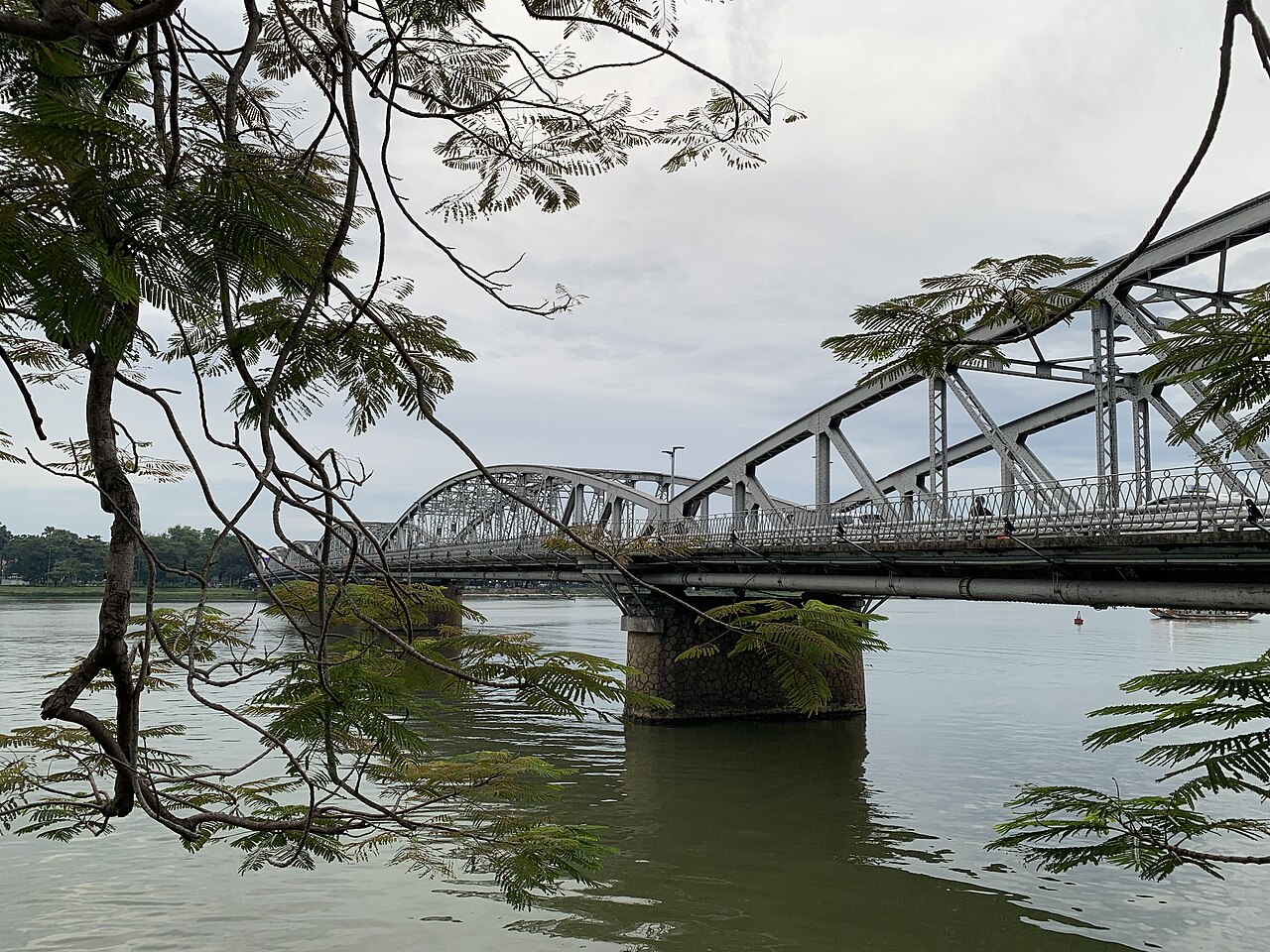
The Sông Hương (Perfume River) takes its name from the wildflowers said to scent its headwaters in the hills above the city. Traditional rồng (dragon) boats, lacquered and carved at the prow, carry passengers along the river and are a widely used way to reach Thien Mu, the royal tombs and the villages of the surrounding countryside. Organised excursions typically include stops for traditional music performances.
The river divides the modern commercial city on its southern bank from the citadel quarter to the north.
Food
Hue is regarded within Vietnam as having one of the country's most distinct and demanding culinary traditions, shaped by centuries of royal court cooking that prized visual presentation, variety of small dishes and the use of fermented shrimp paste (mắm ruốc). The food tends to be spicier and more complex than the cooking of either Hanoi or Ho Chi Minh City.
Key dishes associated with the city include:
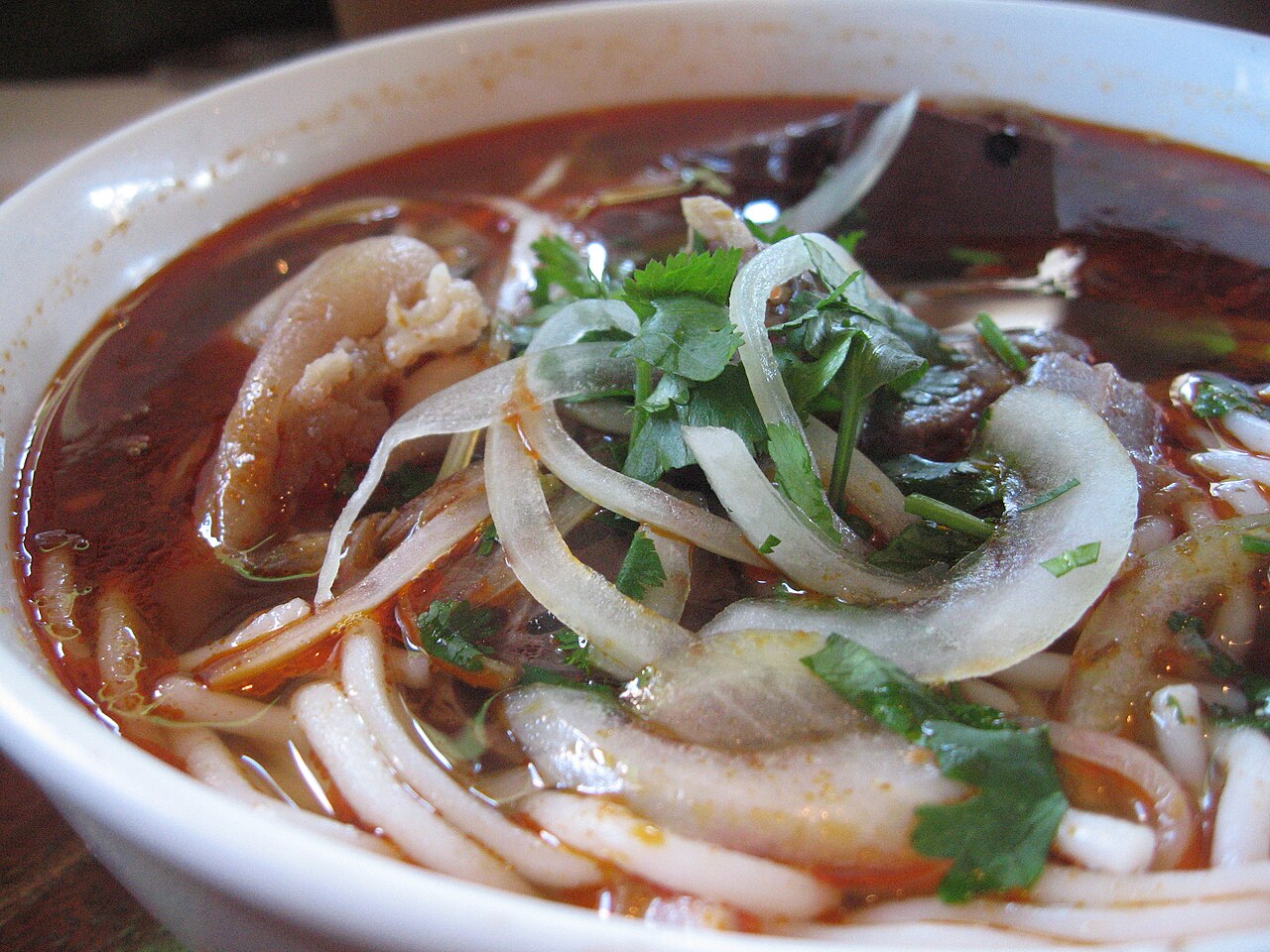
- Bún bò Huế: a lemongrass-flavoured beef and pork noodle soup with a distinctly spiced, ruddy broth. See the dedicated bún bò Huế page for detail.
- Bánh bèo, bánh nậm and bánh lọc: small steamed or wrapped rice-flour preparations associated with royal snacking culture. See Hue royal snacks.
- Cơm hến: rice with tiny river clams, herbs, crackling and fermented shrimp paste, typically eaten at breakfast.
- Bánh khoái: a smaller, crispier local version of the savoury filled rice-flour pancake found elsewhere in central Vietnam.
Hue also has a well-established tradition of vegetarian cooking tied to its large Buddhist community, with entirely plant-based versions of many classic dishes widely available, particularly around pagodas and on lunar calendar days.
Day Trips: DMZ and Hai Van Pass
Hue is commonly used as a base for visiting the former Demilitarised Zone (DMZ) that divided North and South Vietnam at the 17th parallel from 1954 until reunification in 1975. Key sites along what is now the Quảng Trị area include the Vinh Moc tunnel complex — where a coastal village relocated underground during the American War — the Ben Hai River and the former Khe Sanh Combat Base. Most travellers join organised day tours, as the sites are spread across a wide rural area with limited public transport links.
To the south, the Hải Vân Pass crosses a spur of the Trường Sơn range at around 500 metres, forming the climatic boundary between the cooler, wetter north-central region and the drier south. The road over the pass, now bypassed by a tunnel for most traffic, connects Hue to Đà Nẵng and offers extensive views along the coastline on clear days. The pass is a frequent stop on motorbike journeys between the two cities. Bạch Mã National Park, also within day-trip range, preserves montane forest at similar elevations.
Climate and When to Visit
Hue's climate follows a pattern distinct from most of Vietnam. The city experiences its driest and most temperate conditions between February and April, when temperatures climb gradually from the low-to-mid twenties into the low thirties and rainfall is at its lowest. May through August is hot, with maximum temperatures regularly reaching the low-to-mid thirties, and humidity is high.
The defining feature of Hue's climate is its wet season, which runs from September to December — later and more intense than in most of the country. October and November see the heaviest rainfall by a considerable margin, driven by north-easterly winds that push moisture against the mountain barrier inland. Flooding in the old city is not uncommon in these months. December and January remain relatively cool and wet.
Travellers sensitive to heat and rain should treat February to April as the most reliable window. July and August are busy with domestic tourism. See when to go: weather by region for a broader comparison.
Getting There and Getting Around
Hue does not have scheduled commercial airline service at present; the nearest airport with regular domestic and international connections is Đà Nẵng International Airport (DAD), approximately 100 kilometres to the south. Road and rail transfers between Đà Nẵng and Hue cross the Hải Vân Pass or pass through the tunnel beneath it.
The Reunification Express connects Hue to Hanoi, Đà Nẵng, and Ho Chi Minh City; the Hue railway station is on the south bank of the Perfume River within the city. Open-tour buses also serve the Hue–Đà Nẵng–Hội An corridor and are widely used by independent travellers.
Within the city and for royal tomb visits, the most common options are hired motorbike (self-drive or with a driver), bicycle and metered taxi or ride-hailing apps. Dragon boats are the traditional means of river travel. The tombs, Thien Mu Pagoda and several villages are reachable by a combination of river and road.
For practical preparation, see pages on the Vietnam e-visa, SIM cards and eSIMs, money and ATMs and safety and common scams.
Iklim per bulan
Rata-rata jangka panjang, bukan prakiraan. Periode referensi: 2015–2024. Nguồn: ERA5 reanalysis (Copernicus) via the Open-Meteo archive API.
Show the numbers
| Bulan | Suhu tertinggi °C | Rendah °C | Curah hujan (mm) | Hari hujan | Humidity % |
|---|---|---|---|---|---|
| January | 23.7 | 18.6 | 161 | 16 | 87 |
| February | 24.9 | 18.9 | 105 | 12 | 87 |
| March | 28.2 | 21.5 | 66 | 9 | 86 |
| April | 31.0 | 23.7 | 112 | 8 | 82 |
| May | 32.8 | 25.5 | 166 | 18 | 80 |
| June | 34.5 | 26.3 | 126 | 15 | 73 |
| July | 33.3 | 26.0 | 176 | 18 | 75 |
| August | 33.5 | 26.0 | 155 | 18 | 75 |
| September | 31.0 | 24.9 | 321 | 23 | 84 |
| October | 28.0 | 23.3 | 572 | 25 | 87 |
| November | 26.7 | 22.2 | 439 | 23 | 88 |
| December | 23.9 | 19.9 | 384 | 23 | 87 |
Practical notes
Places within Hue
Where it is
Also known as / see also
Di sekitar
Dirujuk oleh
Các nguồn
- ERA5 climate normals — Copernicus / Open-Meteo (CC BY 4.0) đã truy cập 30 August 2026
Supports: monthly temperature and rainfall normals, and elevation - Hue (Q36399) — Wikidata (CC0 1.0) đã truy cập 30 August 2026
Supports: coordinates, area, population - Hue — Wikipedia (CC BY-SA 4.0) đã truy cập 30 August 2026
Supports: background
Current Terakhir diverifikasi: 31 August 2026. Rules, fares and prices change — check the official source before acting on anything here. Report a mistake.
Picture credits (8)
Gate in Imperial City, Huế (III), This Photo was taken by Supanut Arunoprayote . Feel free to use any of my images, but…, CC BY 4.0, Wikimedia Commons · Bun Bo Hue 1, SauceSupreme, CC BY 2.0, Wikimedia Commons · Festival Huế 2008-3, Lưu Ly, Public domain, Wikimedia Commons · BV TW Huế 2025, Duong Minh Hang, CC0, Wikimedia Commons · Chùa Thiên Mụ ở Huế, Bùi Thụy Đào Nguyên, CC BY-SA 3.0, Wikimedia Commons · Chainwit., CC BY 4.0, Wikimedia Commons · Across Đông Ba river, Huế (27112858137), Sketyl none, CC BY 2.0, Wikimedia Commons · Huế (2024) - Meridian Gate - Ngọ Môn (Hoàng thành Huế) - img 02, Chainwit., CC BY 4.0, Wikimedia Commons