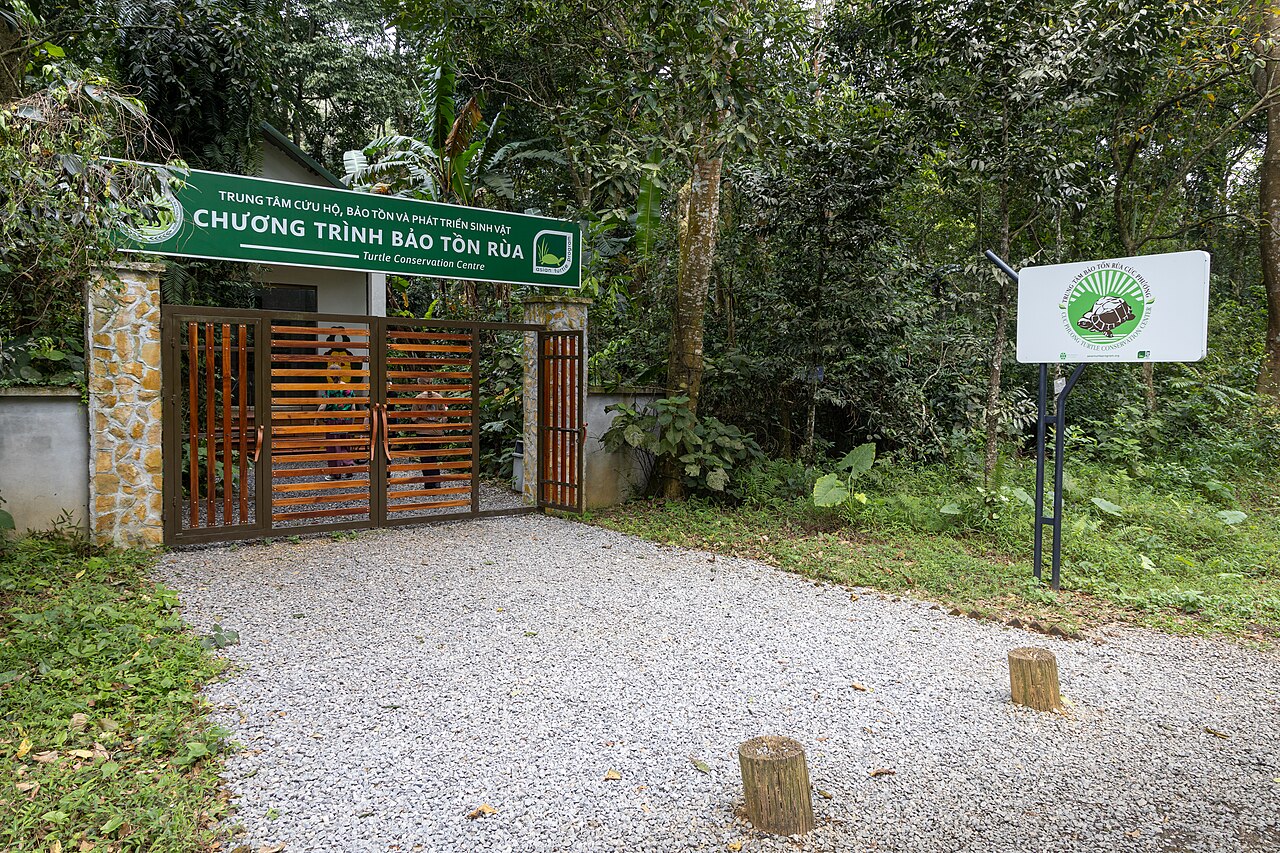
Established in 1962, Cuc Phuong National Park occupies a forested limestone massif on the southern edge of the Red River Delta, administratively part of Ninh Binh. It was the first national park declared in Vietnam and remains one of the most biodiverse, sheltering endangered primates, rare turtles, ancient trees and several hundred butterfly species.
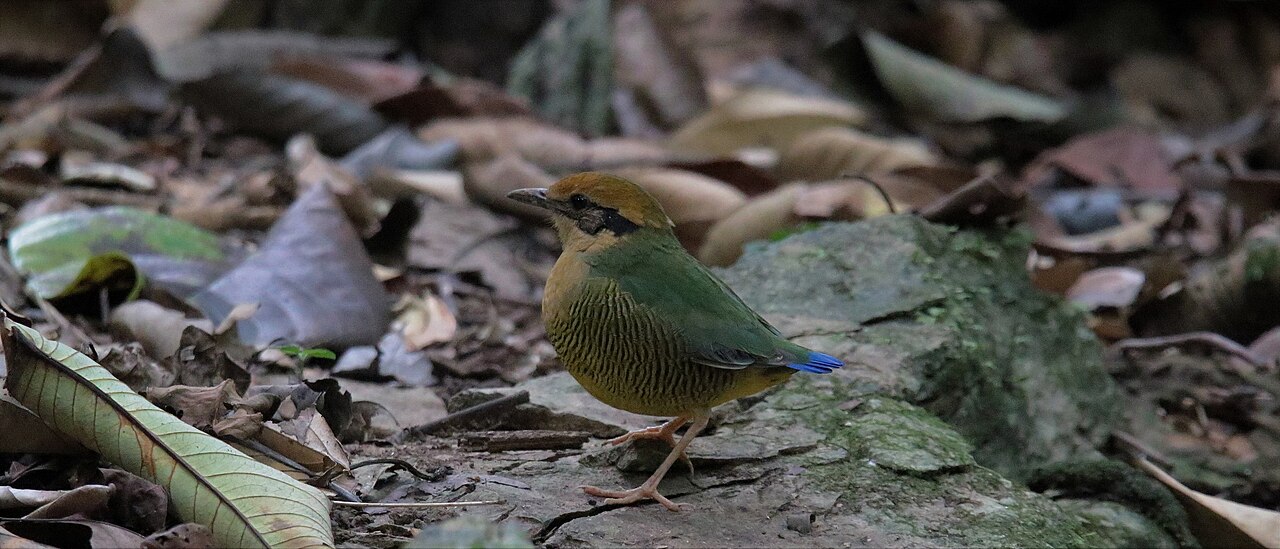
What the park is known for
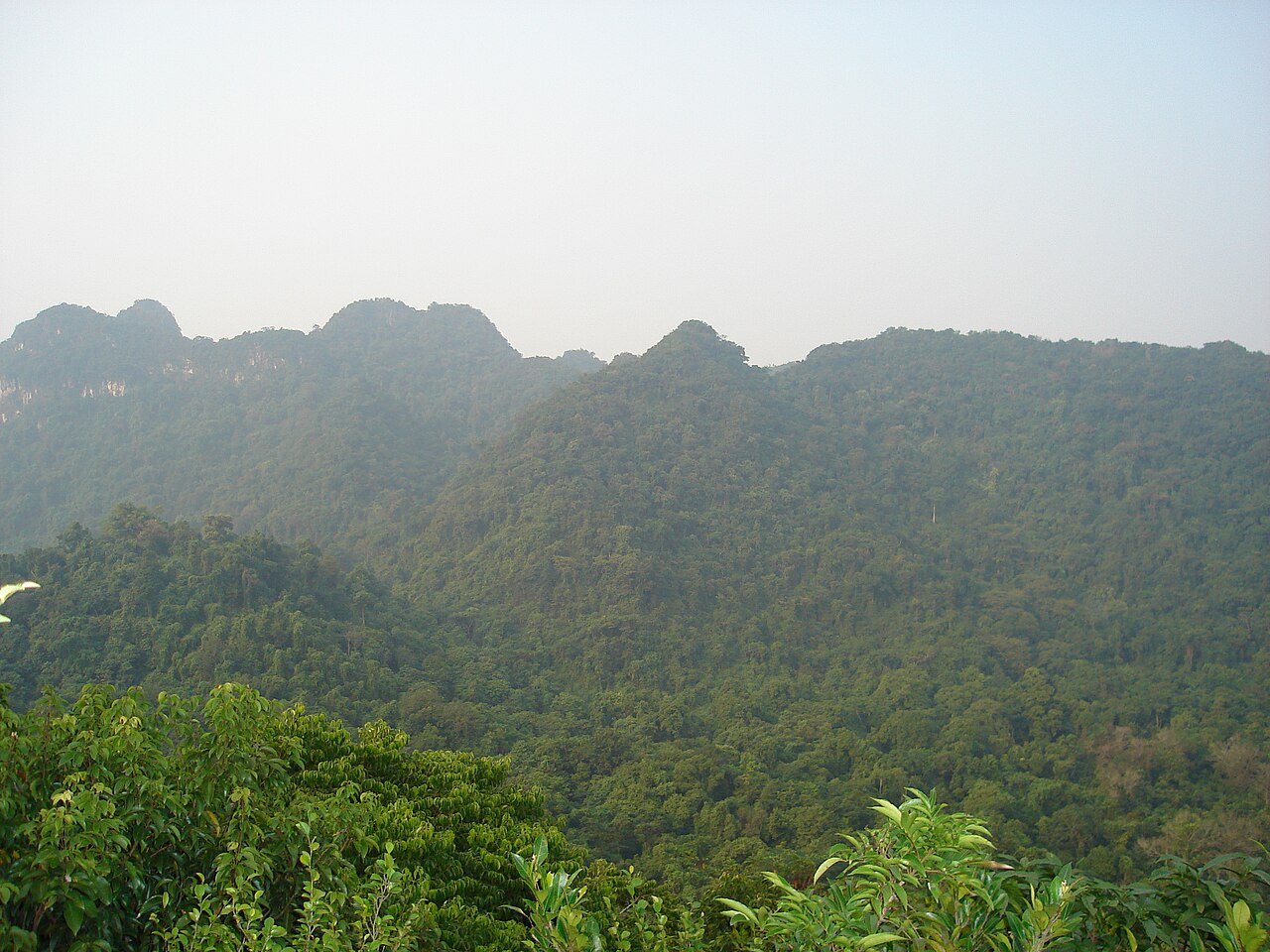
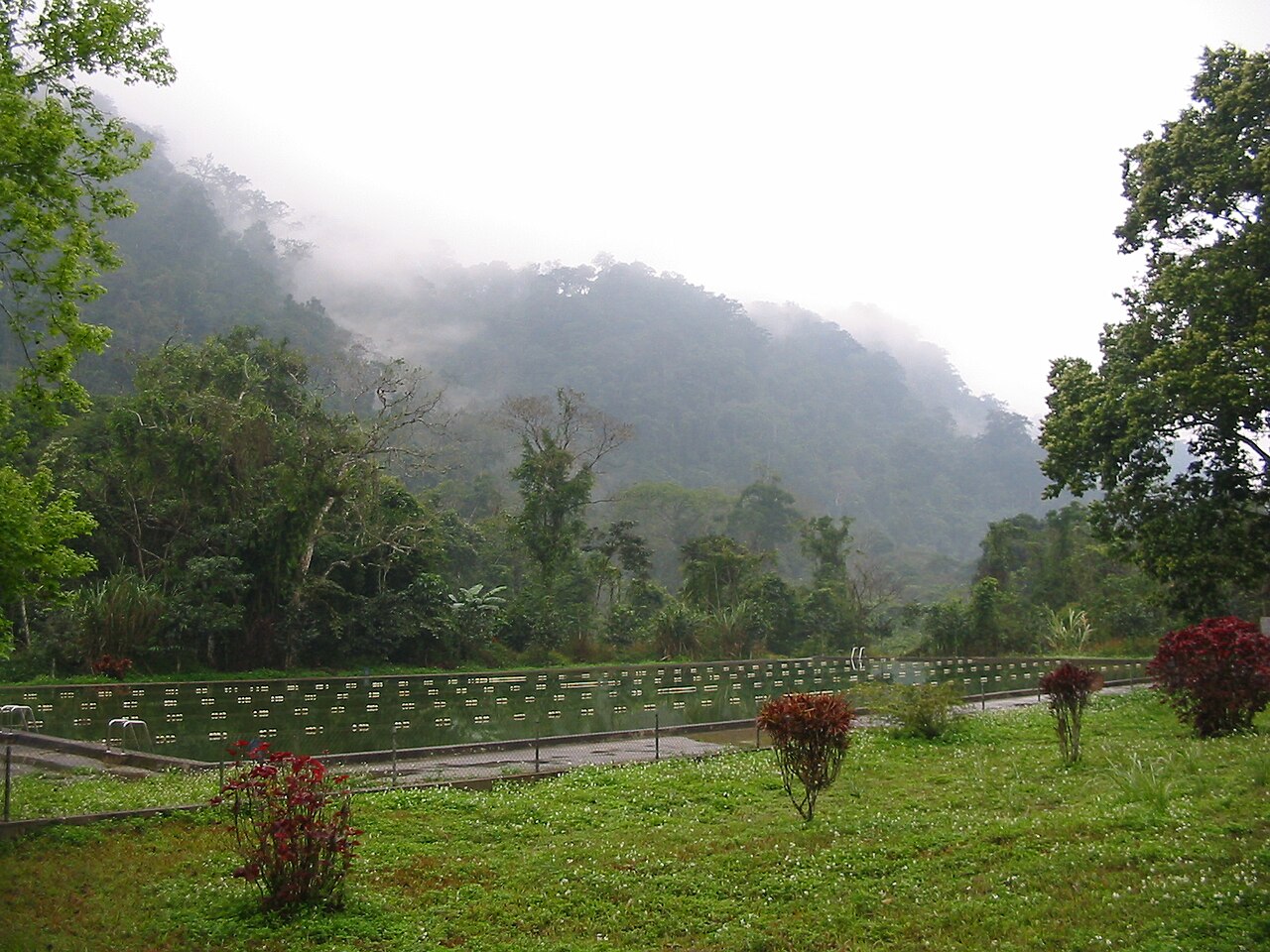
Cuc Phuong's reputation rests on three things that distinguish it from other protected areas in northern Vietnam: its conservation centres, its ancient trees and its role as the country's founding national park. The forest is primary limestone tropical forest, unusually intact for lowland Vietnam, and the canopy closes densely enough that the interior remains noticeably cooler and darker than the surrounding plains.
The park spans roughly 22,000 hectares and sits at the junction of three provinces — Ninh Binh, Thanh Hoa and Hoa Binh — though it is administered from the Ninh Binh side. Several ethnic Muong communities live within or adjacent to the park boundary, and their presence shapes the landscape at the margins of the reserve.
Endangered Primate Rescue Centre and Turtle Conservation Centre
The Endangered Primate Rescue Centre, established in the 1990s with German support, holds one of Southeast Asia's most significant collections of threatened primates, including several gibbon species, langurs and loris. Animals arrive as confiscations from the illegal wildlife trade; the aim is rehabilitation and, where possible, release. Visitors can observe enclosures from designated walkways. The centre has contributed to captive breeding programmes for species whose wild populations are critically small.
Separately, the Turtle Conservation Centre works with freshwater and land turtles, many of which are among the most trafficked reptiles in Asia. Both centres operate within the park's core zone and charge an entry fee. Neither is a zoo in the conventional sense: the emphasis is on conservation rather than display, and the conditions reflect that priority.
Ancient trees and cave trails
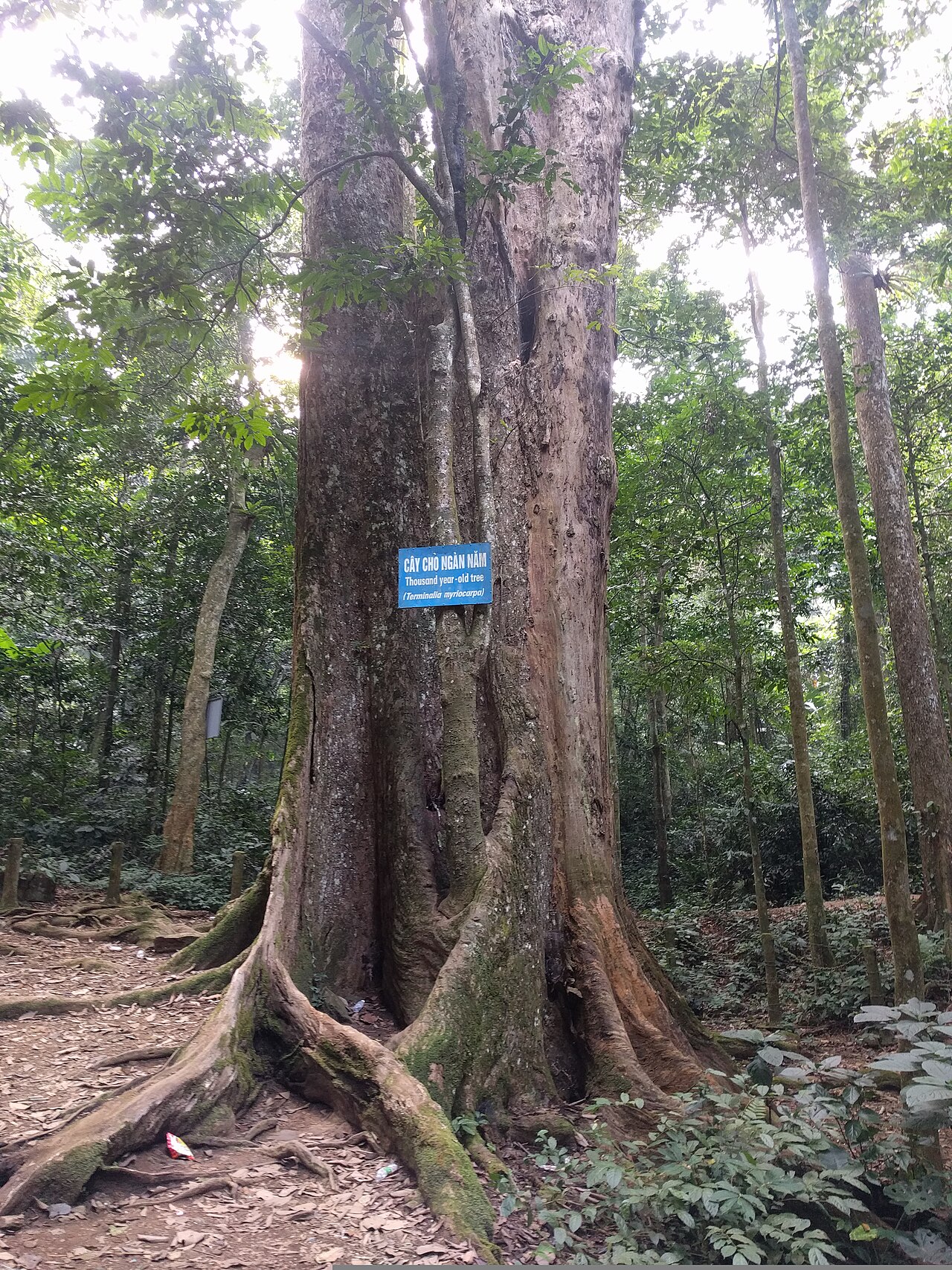
Among the park's most visited natural features is a thousand-year-old tree — a Terminalia of exceptional girth — reached by a forest trail from the park centre. The walk passes through dense canopy and crosses small streams; the scale of the tree relative to the surrounding forest is the draw rather than any formal monument around it.
Several cave systems penetrate the limestone hills. Hang Doi (Bat Cave) and Dong Nguoi Xua (Cave of Prehistoric Man) are the most frequently visited; the latter contains prehistoric artefacts and burial remains, though the question of public access to specific chambers is subject to periodic review and visitors should confirm current arrangements at the park gate. Trail distances and conditions vary by season, and the park provides maps at the visitor centre.
Butterfly season
Between approximately late April and mid-May, Cuc Phuong sees a butterfly emergence that is unusual in scale. Hundreds of species are present in the park year-round, but in this short window certain species emerge in very large numbers, particularly along the road through the park's core. The phenomenon is tied to temperature and humidity conditions at the end of the dry season and the start of the southwest monsoon transition. It is one of the few events of this kind that is reliably observable at a fixed location in Vietnam.
The butterfly peak overlaps with the end of the cooler dry season, which is otherwise the main visitor period. See When to go: weather by region for broader seasonal context.
When to go
The dry season from November to April is generally considered the better period for visiting. Trails are passable, leeches are fewer and the forest is more navigable. April and early May add the butterfly spectacle but also mark the onset of higher humidity.
The wet season from May to October brings heavy rain, leeches on most forest trails, and some track closures. The forest is at its most lush and wildlife activity shifts, but conditions are more demanding for casual walkers. The park remains open year-round.
Staying inside the park
Accommodation is available within the park, operated by the park authority. Options include guesthouses near the main visitor centre and bungalows deeper in the forest, closer to the ancient tree trail. Staying overnight allows early-morning walks before day visitors arrive, which improves the chance of observing wildlife. Booking in advance is advisable during the November-to-April peak and essential around the butterfly season in late April.
There is a restaurant at the park centre. Facilities deeper in the park are basic. Visitors should carry cash, as card payment infrastructure in remote park accommodation is unreliable; see Money, ATMs and cards for general guidance.
Getting there and away
The park entrance is roughly 45 km west of Ninh Binh city, making Ninh Binh the standard base for visitors arriving from the south or from Hanoi by rail or road. From Hanoi the journey is around 120 km; most visitors hire a car or take a motorbike, as public transport to the park gate is limited and involves changes. Organised day tours from Hanoi and Ninh Binh are common.
The park is also within reasonable distance of Mai Chau and Pu Luong Nature Reserve to the west, which some itineraries combine into a single loop. The nearby limestone scenery of Ninh Binh and Tam Coc is frequently visited on the same trip. Foreign nationals should confirm current visa requirements via the Vietnam e-visa page before travel, as conditions are subject to change by decree.
各月气候
长期平均值,非预测数据。 参考周期: 2015–2024. 来源: ERA5 reanalysis (Copernicus) via the Open-Meteo archive API.
Show the numbers
| 月份 | 最高气温 °C | 最低气温 °C | 降雨量(毫米) | 降雨天数 | Humidity % |
|---|---|---|---|---|---|
| January | 19.4 | 13.1 | 81 | 13 | 83 |
| February | 20.8 | 14.0 | 49 | 11 | 83 |
| March | 24.4 | 17.7 | 75 | 13 | 87 |
| April | 28.0 | 20.2 | 114 | 13 | 85 |
| May | 30.6 | 23.1 | 223 | 18 | 84 |
| June | 32.2 | 24.7 | 198 | 17 | 82 |
| July | 31.2 | 24.3 | 348 | 22 | 85 |
| August | 30.4 | 24.0 | 389 | 24 | 88 |
| September | 29.0 | 22.9 | 322 | 22 | 88 |
| October | 26.3 | 20.1 | 229 | 15 | 83 |
| November | 24.2 | 17.6 | 71 | 10 | 81 |
| December | 19.7 | 13.1 | 41 | 8 | 77 |
Practical notes
Where it is
Also known as / see also
附近
被以下页面引用
来源
- ERA5 climate normals — Copernicus / Open-Meteo (CC BY 4.0) 访问于 30 August 2026
Supports: monthly temperature and rainfall normals, and elevation - Vietnam Administration of Forestry — MARD 访问于 29 August 2026
Supports: carried over from the first build - Cúc Phương National Park — Wikipedia (CC BY-SA 4.0) 访问于 29 August 2026
Supports: carried over from the first build
Current 最后核实: 29 August 2026. Rules, fares and prices change — check the official source before acting on anything here. Report a mistake.
Picture credits (5)
Superbass, CC BY-SA 4.0, Wikimedia Commons · Đuôi cụt bụng vằn, Khoitran1957, CC BY-SA 4.0, Wikimedia Commons · Thousand year old tree in Cuc Phuong National Park, Vietnam, TomFitzhenry, CC BY-SA 4.0, Wikimedia Commons · Cúc phương1, Gió Đông, CC BY-SA 3.0, Wikimedia Commons · Cuc.Phuong.National.Park, No machine-readable author provided. Ravikiran r assumed (based on copyright claims)., Public domain, Wikimedia Commons