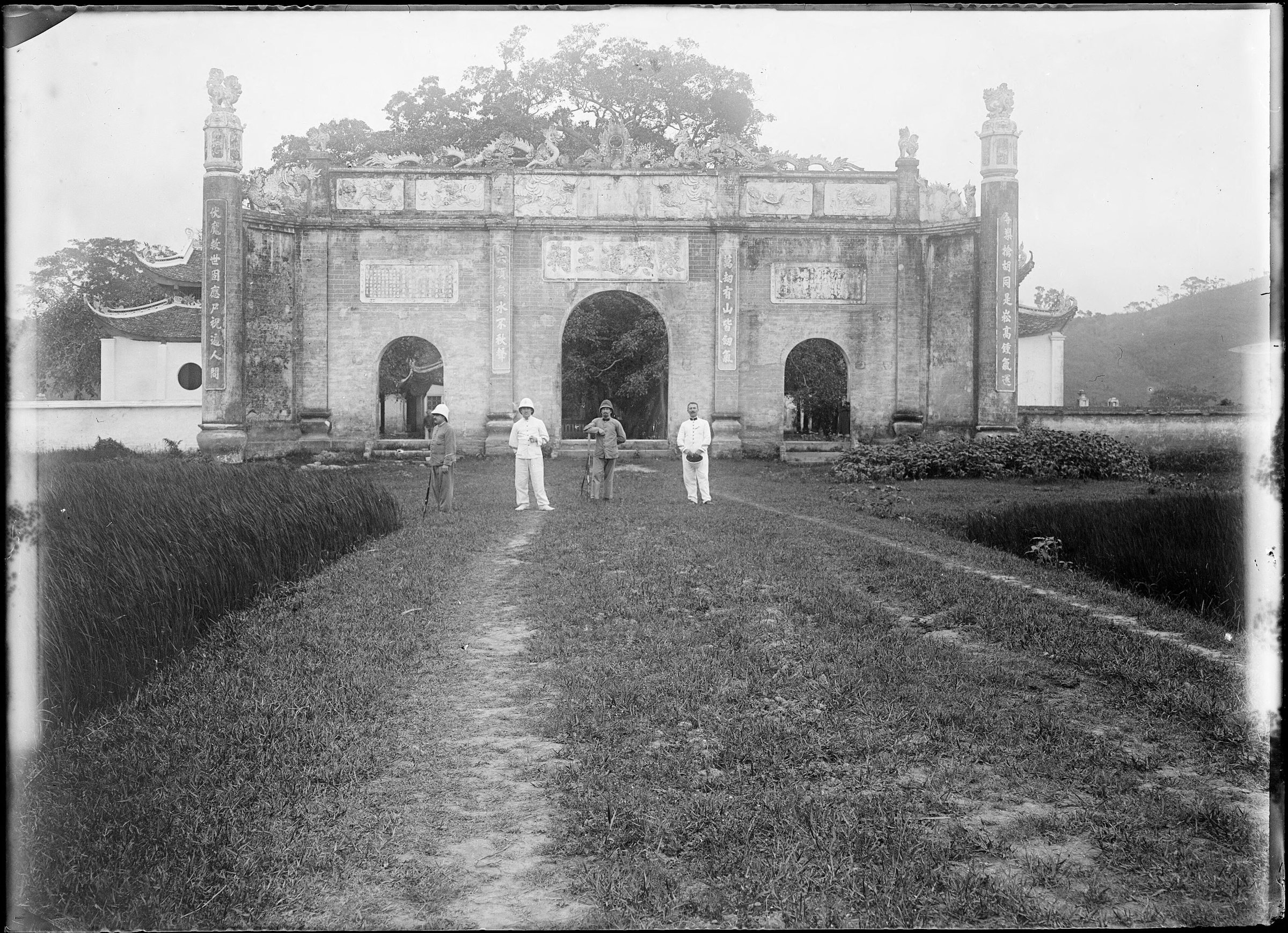
Côn Sơn and Kiếp Bạc form a paired pilgrimage and heritage destination in what was formerly Hai Duong province, now part of Hai Phong after the administrative reorganisation of July 2025. The two sites are several kilometres apart but are treated as a single cultural unit, drawing visitors for their historical associations, their forest settings and two major festival seasons each year.
Kiep Bac: temple to Tran Hung Dao
Kiếp Bạc temple stands on a bend of the Luc Dau river, surrounded by low hills, and is dedicated to Trần Hưng Đạo, the thirteenth-century general who led Vietnamese forces against Mongol invasions. He is one of the most venerated figures in Vietnamese history, regarded not only as a military commander but also as a spiritual protector, and many Vietnamese visit the temple to seek his intercession as much as to mark the historical occasion.
The main sanctuary contains statues of Trần Hưng Đạo and members of his family. The site's layout — water on one side, hills behind — conforms to classical geomantic principles, and the setting has changed relatively little in character, though the structures themselves have been restored over the centuries. The surrounding area is associated with the encampments from which he directed the defence of the Đại Việt kingdom.
Con Son: pagoda and Nguyen Trai's retreat
Côn Sơn is a forested hill site containing a pagoda, several sets of stone steps rising through pine trees, and a series of shrines. It is associated above all with Nguyễn Trãi, the fifteenth-century poet, strategist and scholar who retreated here in later life. Nguyễn Trãi is considered one of the foundational figures of Vietnamese literature and political thought, and a stone said to mark where he sat and composed poetry is preserved on the hillside.
The pagoda itself — Thiên Tư Phúc Tự — predates Nguyễn Trãi's connection to the site and has been in use since at least the fourteenth century. A temple to Nguyễn Trãi stands within the complex. The wooded landscape and relative quiet of the site differ noticeably in atmosphere from the more crowded riverside setting of Kiếp Bạc, giving the two sites distinct characters despite their close historical relationship.
Festival seasons
The two sites have separate but structurally similar festival periods, both following the lunar calendar. Côn Sơn holds its main festival in the first lunar month, broadly coinciding with the post-Tết period in late January or February by the Gregorian calendar, though the exact dates shift from year to year. Kiếp Bạc's principal festival falls in the eighth lunar month, typically September or October.
During these periods the sites receive very large numbers of pilgrims and tourists. Processions, ritual offerings, traditional music and ceremonies take place over several days. Outside the festival windows the sites are quieter and easier to move around, though weekends year-round bring significant domestic visitor numbers given the proximity to Hanoi and Hai Phong. Those with an interest in the architecture and landscape rather than the ceremonial events may find the off-peak periods preferable. For broader seasonal guidance, see When to go: weather by region.
Administrative note: Hai Duong merger
Until 1 July 2025, Côn Sơn and Kiếp Bạc were located in Hai Duong province. Following Vietnam's nationwide consolidation of its 63 provinces into 34, Hai Duong was merged into Hai Phong, and the sites are now administered under that city-province. The question of how local management structures, ticketing arrangements and heritage responsibilities will settle in practice after the merger is not yet fully resolved, and visitors should verify current arrangements on arrival or through official sources.
The physical sites, the festivals and the historical significance of both places are unaffected by the administrative change.
Getting there and away
The sites lie roughly 70 kilometres east of Hanoi and about 40 kilometres west of central Hai Phong, placing them within day-trip range of both cities. Road connections via national highways are the standard approach; there is no railway station directly serving either site. Organised day tours from Hanoi are common during festival seasons. Independent travellers typically hire a car, motorbike or use a combination of bus and local transport.
The two sites are several kilometres apart from each other and not easily walked between, so onward transport between Côn Sơn and Kiếp Bạc requires a vehicle. During festival periods, road and parking congestion around both sites can be considerable. For practical matters including payment, see Money, ATMs and cards. Entry fees apply at both sites.
Practical notes
Most international visitors to this part of northern Vietnam enter on a tourist visa or the Vietnamese e-visa scheme. For current visa requirements and eligibility, the official authority is the Vietnamese immigration service; see also Vietnam e-visa for a general overview, noting that rules can change by decree. Mobile connectivity across the region is generally reliable; SIM cards and eSIMs covers options for staying connected. On general safety considerations, Safety and common scams applies to the region as to Vietnam broadly.
Dress at both sites is expected to be modest, as both are active places of worship as well as heritage monuments. The hillside at Côn Sơn involves stone steps and can be slippery after rain.
월별 기후
장기 평균값이며 예보가 아닙니다. 기준 기간: 2015–2024. 출처: ERA5 reanalysis (Copernicus) via the Open-Meteo archive API.
Show the numbers
| 월 | 최고 기온 °C | 최저 기온(°C) | 강수량(mm) | 강수일수 | Humidity % |
|---|---|---|---|---|---|
| January | 20.7 | 14.0 | 61 | 10 | 77 |
| February | 22.1 | 15.2 | 42 | 9 | 77 |
| March | 25.4 | 18.7 | 65 | 13 | 82 |
| April | 28.7 | 21.6 | 98 | 13 | 81 |
| May | 31.3 | 24.8 | 211 | 18 | 82 |
| June | 33.1 | 26.7 | 249 | 20 | 80 |
| July | 32.5 | 26.4 | 280 | 22 | 82 |
| August | 31.5 | 25.8 | 405 | 26 | 86 |
| September | 30.7 | 24.8 | 313 | 22 | 85 |
| October | 28.2 | 21.7 | 160 | 13 | 77 |
| November | 26.0 | 19.0 | 56 | 9 | 76 |
| December | 21.3 | 14.3 | 31 | 7 | 70 |
Where it is
Also known as / see also
주변
참조 페이지
출처 목록
- ERA5 climate normals — Copernicus / Open-Meteo (CC BY 4.0) 접근됨 30 August 2026
Supports: monthly temperature and rainfall normals, and elevation - Vietnam National Authority of Tourism — VNAT 접근됨 29 August 2026
Supports: the rules and definitions on this page
Current 마지막 확인: 29 August 2026. Rules, fares and prices change — check the official source before acting on anything here. Report a mistake.
Picture credits (1)
Kiếp Bạc temple in 1904, André Salles, Public domain, Wikimedia Commons