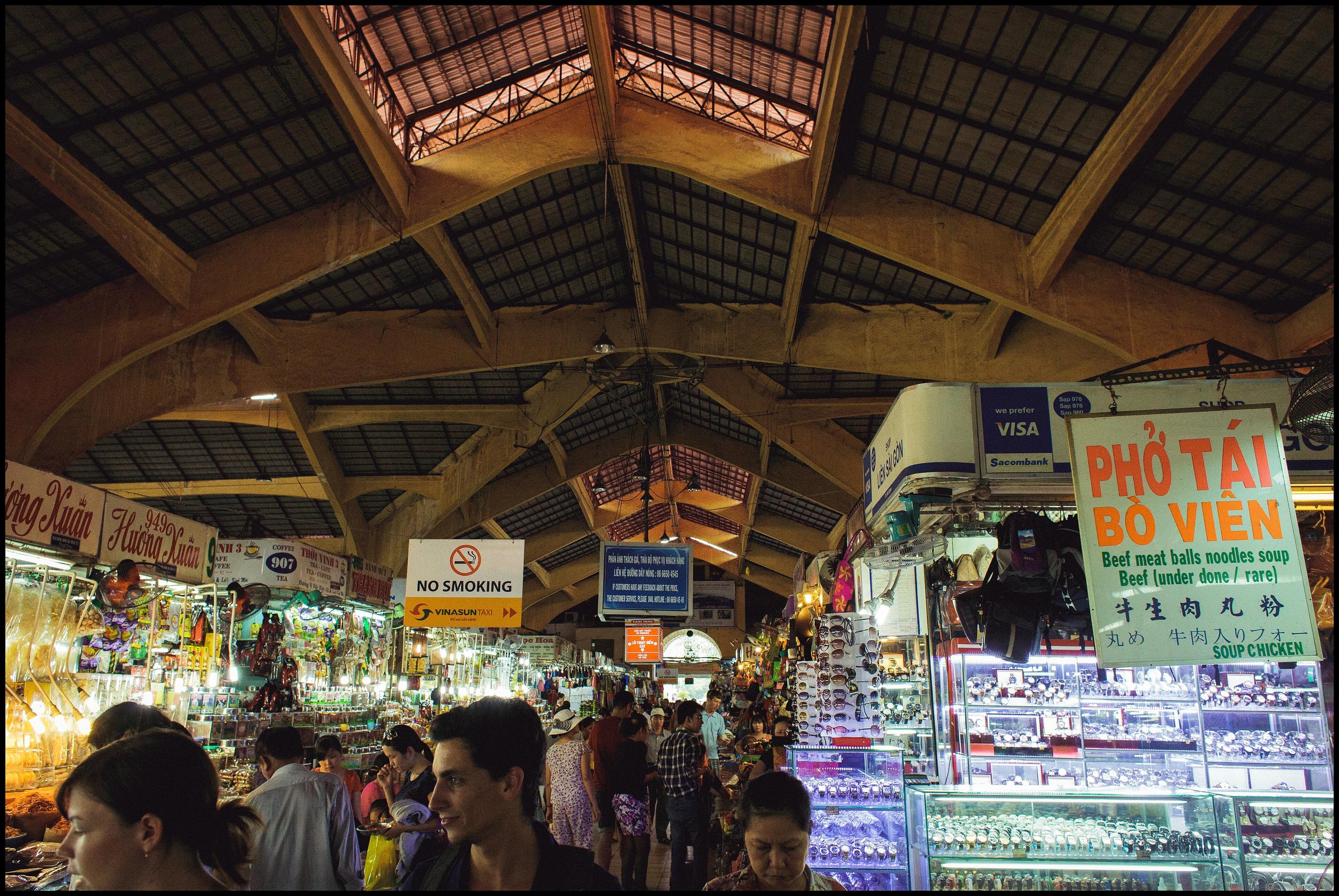
Cost of living in Ho Chi Minh CityChi phí sống ở TP.HCM
Overview and budget levels
Ho Chi Minh City is the most expensive city in Vietnam for most categories of spending, though it remains considerably cheaper than Bangkok, Kuala Lumpur or Singapore. Costs divide usefully into three broad levels.
- Tight budget: A single person renting a modest room or small studio in an outer area, eating almost entirely at street stalls and local restaurants, using motorbike taxis and public buses, and avoiding international services can live on a relatively modest monthly sum. This profile suits long-term backpackers and younger Vietnamese professionals.
- Mid-range: A furnished one-bedroom apartment in a mid-tier district, a mix of local and Western dining, a motorbike or regular ride-hailing use, and occasional gym or co-working membership. This is the most common profile among younger expatriates and remote workers.
- Comfortable expatriate: A two- or three-bedroom serviced apartment or villa in District 2 or Thao Dien, international schooling for children, private health insurance, regular dining at international restaurants, and a car or driver. This profile carries costs that can rival mid-tier European cities.
Prices vary by season, negotiation and the pace of local inflation, which has been notable in the rental market since 2022.
Rent by neighbourhood
Rental prices differ substantially across the city's neighbourhoods. Following the July 2025 administrative merger, district labels remain in everyday use even though the district tier no longer exists formally; landlords and property listings continue to use them.
- District 1: The historic commercial core. Serviced apartments and higher-end condominiums dominate the expatriate rental stock. Prices are the highest in the city. Small studios exist but are scarce and compete with short-term rental demand.
- District 3: Adjacent to District 1, with a denser local character and a mix of older French-era houses, narrow-alley rooms and newer condominiums. Generally somewhat cheaper than District 1 for comparable space.
- Binh Thanh: A large, varied district north of District 1. Vinhomes Central Park and several other large-scale condo projects push the top end of rents up, while local housing in its inner lanes remains among the more affordable options close to the centre.
- Thao Dien (within the former District 2 area): The primary expatriate enclave on the east bank of the Saigon River. Villas, townhouses and large apartments with international facilities. Rents are high, and the area hosts the densest concentration of international schools, Western supermarkets and foreign restaurants.
- Phu Nhuan: A compact, central district popular with Vietnamese professionals and some expatriates who prefer a quieter local atmosphere. Rents are moderate relative to Districts 1 and 3.
All rents are typically quoted in US dollars for furnished expatriate-grade units, and in Vietnamese dong for local-standard rooms. Prices vary by season and landlord.
Utilities, internet and phone
Electricity in Ho Chi Minh City is supplied by EVN (Electricity of Vietnam) at a tiered rate: the more you consume, the higher the marginal rate per kilowatt-hour. Air conditioning dominates electricity bills in a city that rarely drops below 25 °C even at night. A household running air conditioning in multiple rooms through the dry season will pay considerably more than one using fans. Prices vary by consumption tier and season.
Water bills are low by international standards for typical household consumption. Building management fees in condominiums and serviced apartments add a further monthly cost that varies widely by development.
Fixed-line fibre broadband is widely available and reliable in built-up areas, supplied by Viettel, VNPT, FPT and others. Speeds of 100 Mbps and above are standard at the residential level. Mobile data on Vietnamese SIM cards is inexpensive and 4G coverage is near-universal across the urban area; 5G is available in parts of the city centre.
International television packages and streaming services are available, though content libraries differ from home-country versions.
Food and eating out
Food costs are highly variable depending on where and how you eat. The gap between local and international dining in Ho Chi Minh City is wide.
- Street food and local restaurants (quan): A bowl of pho, a plate of com tam (broken rice with grilled pork), or a banh mi from a pavement stall represent the cheapest eating in the city. Prices vary by stall and neighbourhood.
- Mid-range Vietnamese and Asian restaurants: Air-conditioned interiors, table service, beer and soft drinks. Popular with local middle-class diners and expatriates. Prices vary by area.
- Western and international restaurants: Concentrated in Districts 1, 3 and Thao Dien. Pricing often approaches or matches European levels, particularly at established venues with imported ingredients.
- Supermarkets and cooking at home: Local wet markets such as Ben Thanh or Thi Nghe offer fresh produce at low prices. VinMart, Co.op Mart and Lotte Mart stock local goods affordably. Imported products from Western supermarkets such as Annam Gourmet or the shelves of Emart carry significant premiums.
Coffee culture is central to daily life. Local ca phe sua da (iced milk coffee) costs a fraction of a drink at a chain such as Highlands Coffee or The Coffee House, which in turn costs less than at international chains or specialty roasters.
Transport
Getting around Ho Chi Minh City involves a choice between motorbike, ride-hailing, taxi, bus and—increasingly—the new metro line.
- Ride-hailing: Grab dominates for both cars and motorbike taxis (Grab Bike). Be (a Vietnamese competitor) also operates. Fares fluctuate with demand and distance; prices vary by time of day and surge conditions.
- Own motorbike: The most common choice for residents. Purchase prices for a used semi-automatic or automatic scooter vary widely by age and model. Running costs (fuel, parking, occasional servicing) are low. An international driving licence endorsed for motorcycles, or a Vietnamese licence, is required under Vietnamese law.
- Metro Line 1: The Bến Thành–Suối Tiên line opened in late 2024, running from the city centre to the far northeast. It is the first metro line in the city and fares are set by the city authority. Further lines are under construction or in planning.
- Bus: An extensive public bus network covers most of the urban area. Fares are low and fixed. Air-conditioned buses operate on major routes. Reliability and frequency vary by route.
- Car ownership or rental: Traffic congestion is severe, parking is expensive in central areas, and many expatriates opt for ride-hailing rather than owning a car. Those who do own cars often employ a driver.
International schools and childcare
Ho Chi Minh City has the largest concentration of international schools in Vietnam, clustered particularly around Thao Dien and the surrounding area. Institutions offering British, American, Australian, International Baccalaureate and other curricula include the British Vietnamese International School (BVIS), the International School Ho Chi Minh City (ISHCMC), Renaissance International School, Saigon South International School (SSIS) and several others.
Tuition fees at international schools are among the largest single costs for expatriate families with children. Annual fees vary considerably between schools and year groups. Application registration fees, capital levies and activity fees add to the headline tuition figure. Places at well-regarded schools can be limited and waiting lists exist.
Vietnamese public schooling is free but conducted entirely in Vietnamese and follows the national curriculum; it is used by very few expatriate families. A number of semi-international or bilingual private Vietnamese schools occupy a middle ground in terms of fees and curriculum.
Childcare and kindergarten options range from local crèches at low cost to international nurseries with fees approaching those of primary schooling.
Health insurance and how Ho Chi Minh City compares with Hanoi and Da Nang
Health insurance: Expatriates typically purchase international private medical insurance rather than relying on the Vietnamese public health system, though the latter is accessible and used by many long-term residents for routine care. Major international hospitals in the city—FV Hospital, Vinmec, Hanh Phuc and the Franco-Vietnamese Hospital among them—charge rates closer to international norms, making out-of-pocket costs significant without coverage. Insurance premiums vary by age, pre-existing conditions, coverage level and insurer.
Comparison with Hanoi: Ho Chi Minh City is generally more expensive than Hanoi for rent at equivalent expatriate-grade levels, for international dining, and for international schooling. Street food and local costs are broadly comparable. The lifestyle in Ho Chi Minh City is often described as faster-paced and more commercially oriented.
Comparison with Da Nang: Da Nang is noticeably cheaper than Ho Chi Minh City across most categories, including rent, international dining and international schooling—though the range and quality of international schools is considerably narrower. Da Nang attracts remote workers partly on this basis, though its international infrastructure is more limited.
All comparisons are directional; individual spending patterns vary widely and prices change over time.
Where it is
Also known as / see also
Được tham chiếu bởi
Các nguồn
- General Statistics Office of Vietnam — GSO đã truy cập 3 September 2026
Supports: the rules and definitions on this page
This server cannot reach the domain; the link was not confirmed from here. - Vietnam country data — World Bank đã truy cập 31 August 2026
Supports: the rules and definitions on this page
This server cannot reach the domain; the link was not confirmed from here.
Ageing Đã xác minh lần cuối: 31 August 2026. Rules, fares and prices change — check the official source before acting on anything here. Report a mistake.
Picture credits (1)
Bến Thành Market (14628132293), Erwin Verbruggen from Amsterdam, The Netherlands, CC BY-SA 2.0, Wikimedia Commons