Reunification and Doi MoiĐổi Mới
Reunification, 1975–1976
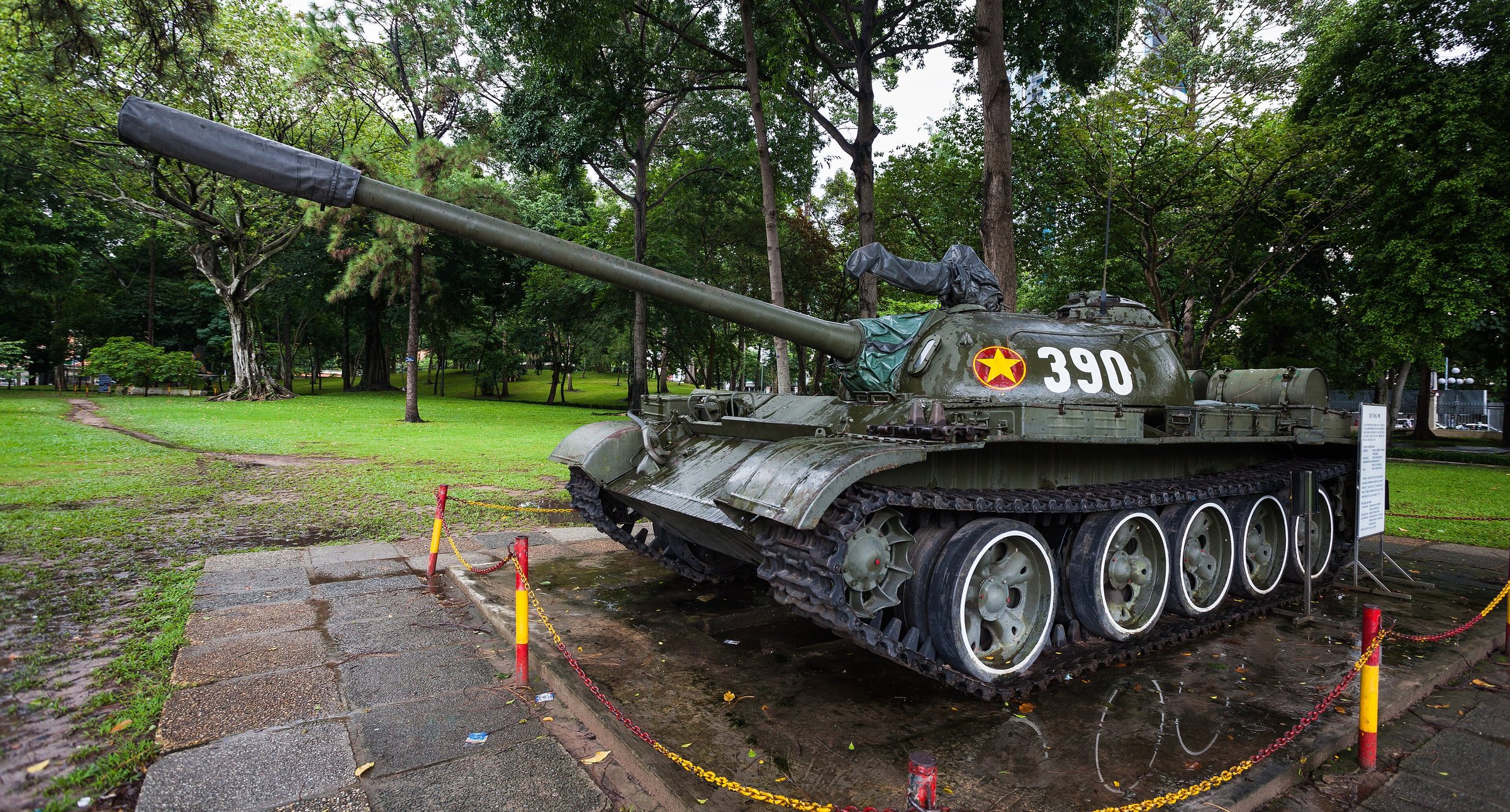
The fall of Saigon on 30 April 1975 ended the Vietnam War and left the country under the control of the communist north. Formal reunification followed on 2 July 1976, when the Socialist Republic of Vietnam was proclaimed with Hanoi as its capital. The southern city of Saigon was renamed Hồ Chí Minh City in honour of the late northern leader. Reunification was a political achievement decades in the making, but it did not bring immediate stability or prosperity. The new government faced the task of integrating two societies that had been organised on fundamentally different economic and ideological lines for more than twenty years, and it did so in the context of international isolation, war damage, and deep internal suspicion of the south's population.
The Subsidy Era and Its Hardships
From 1976 to 1986 Vietnam operated a Soviet-style centrally planned economy, a period Vietnamese commonly call thời bao cấp, the subsidy era. Agricultural collectivisation was extended to the south, disrupting rice production in the Mekong Delta, one of the world's most productive rice-growing regions. State enterprises were inefficient, consumer goods were rationed through a coupon system, and shortages of food and basic materials were widespread. Inflation was severe through much of the period. The government's attempt to forcibly unify economic life alienated significant parts of the southern population and contributed to a humanitarian crisis that unfolded on the country's coastlines.
The Boat People
Between the late 1970s and the early 1990s, an estimated one to two million Vietnamese fled the country by sea. These refugees, widely known as the boat people, came in significant numbers from Vietnam's ethnic Chinese community as well as from former south Vietnamese military personnel and others who feared reprisals or saw no future under the new order. Journeys across the South China Sea and the Gulf of Thailand were dangerous; vessels were overcrowded and frequently targeted by pirates operating in Thai waters. Many thousands died at sea. Those who survived arrived in camps in Malaysia, Hong Kong, the Philippines, Indonesia, and Thailand. The crisis produced one of the largest refugee movements in postwar Asia and left a lasting Vietnamese diaspora across North America, Western Europe, and Australia.
Border Wars: Cambodia and China
Vietnam's difficulties in this period were compounded by armed conflict on two fronts. To the west, the Khmer Rouge regime in Cambodia, aligned with China and hostile to Vietnam, carried out cross-border raids and massacres in Vietnamese border villages from 1977 onwards. Vietnam invaded Cambodia in December 1978 and overthrew the Khmer Rouge government in January 1979, installing a pro-Hanoi administration. Vietnamese troops remained in Cambodia until 1989, a presence that drew widespread international condemnation and tightened economic sanctions. To the north, China launched a punitive invasion across the Vietnamese border in February 1979, in retaliation for Vietnam's intervention in Cambodia and for the treatment of ethnic Chinese in Vietnam. Fighting was intense along a broad front from Móng Cái to Lào Cai. China withdrew after about a month, but low-level border skirmishes continued through much of the 1980s. Both conflicts deepened Vietnam's international isolation and placed severe strain on state resources.
Đổi Mới: The Reform Programme from 1986
By the mid-1980s the failures of central planning were impossible to ignore. At the Sixth National Congress of the Communist Party of Vietnam in December 1986, the leadership adopted a package of reforms they called Đổi Mới, meaning renovation or renewal. The core changes dismantled agricultural collectives, allowing households to farm land on long-term leases and sell surplus produce on open markets. Price controls were progressively lifted, private enterprise was legalised, and foreign investment was invited. The state retained ownership of strategic industries and the party retained political control, a combination sometimes described as a socialist-oriented market economy. The reforms were not a single event but a process that accelerated through the late 1980s and 1990s as reformers within the party gained ground over conservatives. Rice production recovered rapidly; Vietnam moved from importing rice to becoming one of the world's largest rice exporters within a few years of the reforms beginning.
Opening Up: Normalisation and WTO Accession
International reintegration followed the domestic reforms gradually. The United States lifted its trade embargo in 1994 and normalised diplomatic relations with Vietnam in 1995, the same year Vietnam joined the Association of Southeast Asian Nations (ASEAN). Bilateral trade agreements with the United States and the European Union progressively lowered barriers to Vietnamese exports. Vietnam joined the World Trade Organisation in January 2007 after eleven years of negotiations, committing to further liberalisation of its trade and investment rules. WTO membership accelerated the inflow of foreign direct investment and tied Vietnam more firmly into global supply chains.
Transformation into a Manufacturing Economy
From the 1990s onwards, and with gathering speed after 2000, Vietnam attracted large volumes of foreign manufacturing investment, drawn by a young and growing workforce, relatively low labour costs, improving infrastructure, and political stability under single-party rule. Export-oriented industries grew rapidly: garments and footwear were early drivers, followed by electronics assembly. Samsung established major facilities in Bắc Ninh and Thái Nguyên that came to account for a substantial share of the company's global smartphone output, making Vietnam one of the world's significant electronics exporters. Other multinationals in technology, footwear, and consumer goods followed. The country's economic profile shifted markedly away from agriculture, though the agricultural sector, including aquaculture and coffee cultivation in the Central Highlands, remained a significant export earner. The pace and character of this transformation continue to be subjects of debate: questions about labour conditions, environmental costs, income distribution, and the degree to which domestic Vietnamese firms have benefited remain contested.
Where it is
Also known as / see also
被以下页面引用
来源
- Vietnam National Museum of History — Bảo tàng Lịch sử quốc gia 访问于 31 August 2026
Supports: the rules and definitions on this page - Đổi Mới — Wikipedia (CC BY-SA 4.0) 访问于 31 August 2026
Supports: background - Đổi Mới — Wikipedia (Vietnamese) (CC BY-SA 4.0) 访问于 31 August 2026
Supports: background, Vietnamese edition
Current 最后核实: 31 August 2026. Rules, fares and prices change — check the official source before acting on anything here. Report a mistake.
Picture credits (1)
Palacio de la Reunificación, Ciudad Ho Chi Minh, Vietnam, 2013-08-14, DD 06, Diego Delso, CC BY-SA 3.0, Wikimedia Commons