The Nguyen dynastyNhà Nguyễn
Founding and unification under Gia Long
The Nguyen dynasty was founded by Nguyen Phuc Anh, who took the reign name Gia Long after defeating the Tay Son rulers and reunifying Vietnam in 1802. The country he consolidated stretched from the Chinese border in the north to the Ca Mau Peninsula in the south — a configuration broadly recognisable as modern Vietnam.
Gia Long had spent years in exile and armed resistance, at times receiving support from French missionary Pigneau de Behaine and a small number of French volunteers. Once on the throne, he adopted a conservative Confucian model of governance, modelled partly on the Qing court in Beijing, and chose Hue, in the centre of the country, as his imperial capital rather than either Hanoi or Saigon.
The dynasty he established named itself Nguyen, after the clan that had governed the southern lords (chúa Nguyễn) since the seventeenth century, tracing a lineage distinct from the earlier Le dynasty lords who had dominated the north.
Building the imperial capital at Hue
Construction of the Hue Citadel began in 1804 and drew on both Vietnamese and French military engineering principles. The complex follows a concentric plan: an outer fortified wall encloses the Imperial City (Hoàng Thành), which in turn contains the Forbidden Purple City (Tử Cấm Thành), the emperor's private quarters.
The Ngo Mon gate, throne halls, ceremonial courtyards, and a network of canals were completed largely during the reigns of Gia Long and his successor Minh Mang (r. 1820–1841). Minh Mang also standardised the administrative divisions of the country and was notably hostile to Catholic missionaries, issuing edicts that restricted their activities.
Beyond the citadel, successive emperors commissioned elaborate royal tombs in the hills south and west of the city. Each tomb complex combines a stele pavilion, a temple for worship, ornamental ponds, and a burial mound, and each reflects the personal aesthetic of the emperor it commemorates. The tombs of Minh Mang, Tu Duc, and Khai Dinh are the most visited today.
Loss of sovereignty and the French protectorate
French military pressure on Vietnam intensified from the 1850s. Saigon fell to French forces in 1859, and by 1867 France controlled the six provinces of Cochinchina as a colony. Emperor Tu Duc (r. 1848–1883) presided over this territorial erosion, caught between internal dissent — including the Cao Bai rebellion — and an adversary with overwhelming naval firepower.
After Tu Duc's death in 1883, a succession crisis weakened the court further. The Treaty of Hue (1883, also called the Harmand Treaty) and the subsequent Patenôtre Treaty of 1884 established French protectorates over Annam (central Vietnam) and Tonkin (the north). Cochinchina was already a colony. The emperor remained on the throne as a ceremonial figure, but real power passed to the French Resident Superior.
For the full political and administrative framework that followed, see French Indochina.
The later emperors under French rule
Between 1883 and 1926 the French manipulated imperial succession repeatedly, deposing emperors deemed uncooperative. Ham Nghi was deposed and exiled to Algeria in 1888 after he issued the Cần Vương edict calling for resistance to France. Thanh Thai was removed in 1907, and Duy Tan — who had quietly supported a 1916 uprising — was sent to Réunion.
The longest-reigning emperor of the French period, Khai Dinh (r. 1916–1925), is associated with the tomb that most visibly blends European and Vietnamese decorative styles, its interior encrusted with mosaic made from porcelain and glass. His reign coincided with growing nationalist sentiment and he was criticised by figures such as Phan Chu Trinh for collaborating with the colonial administration.
Bao Dai, Khai Dinh's son, was educated in France and ascended the throne in 1926. He attempted modest modernising reforms in the 1930s but operated within strict French constraints. The question of how much agency the later Nguyen emperors possessed remains contested among historians.
Bao Dai's abdication and the end of the dynasty
The events of 1945 brought the dynasty to a close in rapid succession. Japan, which had occupied Vietnam while leaving French administrators nominally in place, staged a coup against the French administration in March 1945 and encouraged Bao Dai to declare independence under Japanese auspices. He proclaimed the Empire of Vietnam in April, though it was a short-lived arrangement with little real power.
Following Japan's surrender in August 1945, Ho Chi Minh's Viet Minh movement launched the August Revolution and established control in Hanoi. Facing the collapse of the Japanese framework and the Viet Minh's rapid advance, Bao Dai issued his abdication proclamation on 25 August 1945 in Hue, handing a ceremonial sword and seal to Viet Minh representatives. His statement included the often-quoted phrase preferring to be a citizen of a free country than the emperor of an enslaved one, though the precise wording is reproduced differently across sources.
Bao Dai subsequently served briefly as a Viet Minh adviser before leaving the country. He later became head of state of the French-backed State of Vietnam (1949–1955), though by then the dynasty itself was finished.
Physical legacy in Hue
The most concentrated material legacy of the Nguyen dynasty is in Hue, where the citadel complex, royal temples, and imperial tombs together form a UNESCO World Heritage Site inscribed in 1993. The site suffered significant damage during the 1968 Tet Offensive, when fighting inside the citadel lasted nearly a month, and further deterioration through decades of limited conservation funding.
Ongoing restoration work — undertaken by Vietnamese authorities with international technical support — has stabilised several major structures. The state of individual buildings varies considerably: some throne halls have been substantially rebuilt, while sections of the outer walls and the Forbidden Purple City remain partially ruined.
Beyond the citadel, Nguyen-period artefacts, court costumes, ceramics, and documents are held in the Hue Museum of Royal Antiquities, housed in the Long An Palace. The royal tombs at Minh Mang, Tu Duc, and Khai Dinh remain accessible as distinct sites scattered across the wooded hills surrounding the city.
Hue's broader urban character — its walled neighbourhoods, garden houses, and cuisine rooted in imperial court cooking — is also widely attributed to the Nguyen period, though the relationship between dynasty and local culture is layered rather than direct.
Also known as / see also
参照元
出典
- Vietnam National Museum of History — Bảo tàng Lịch sử quốc gia アクセス日 31 August 2026
Supports: the rules and definitions on this page - Nhà Nguyễn — Wikipedia (Vietnamese) (CC BY-SA 4.0) アクセス日 31 August 2026
Supports: background, Vietnamese edition
Current 最終確認: 31 August 2026. Rules, fares and prices change — check the official source before acting on anything here. Report a mistake.
Picture credits (4)
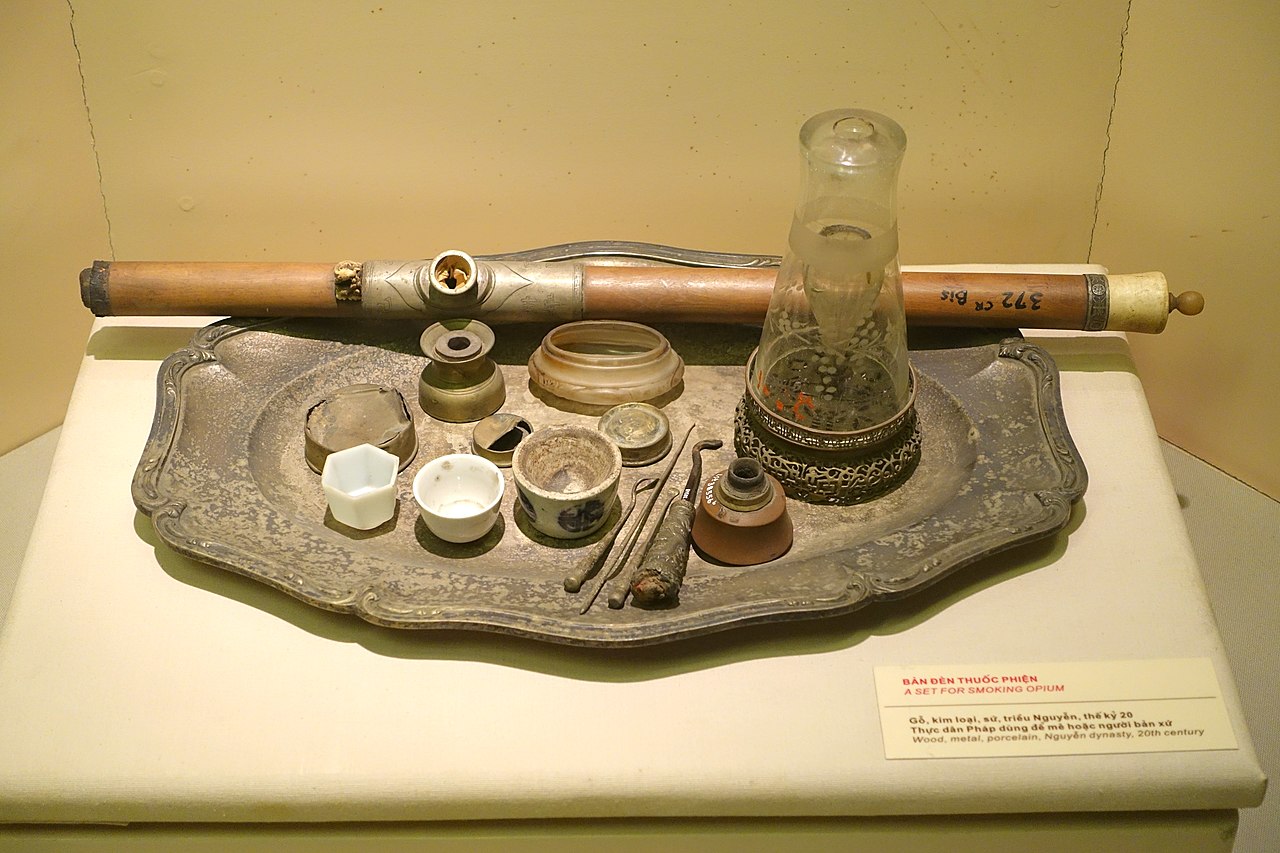
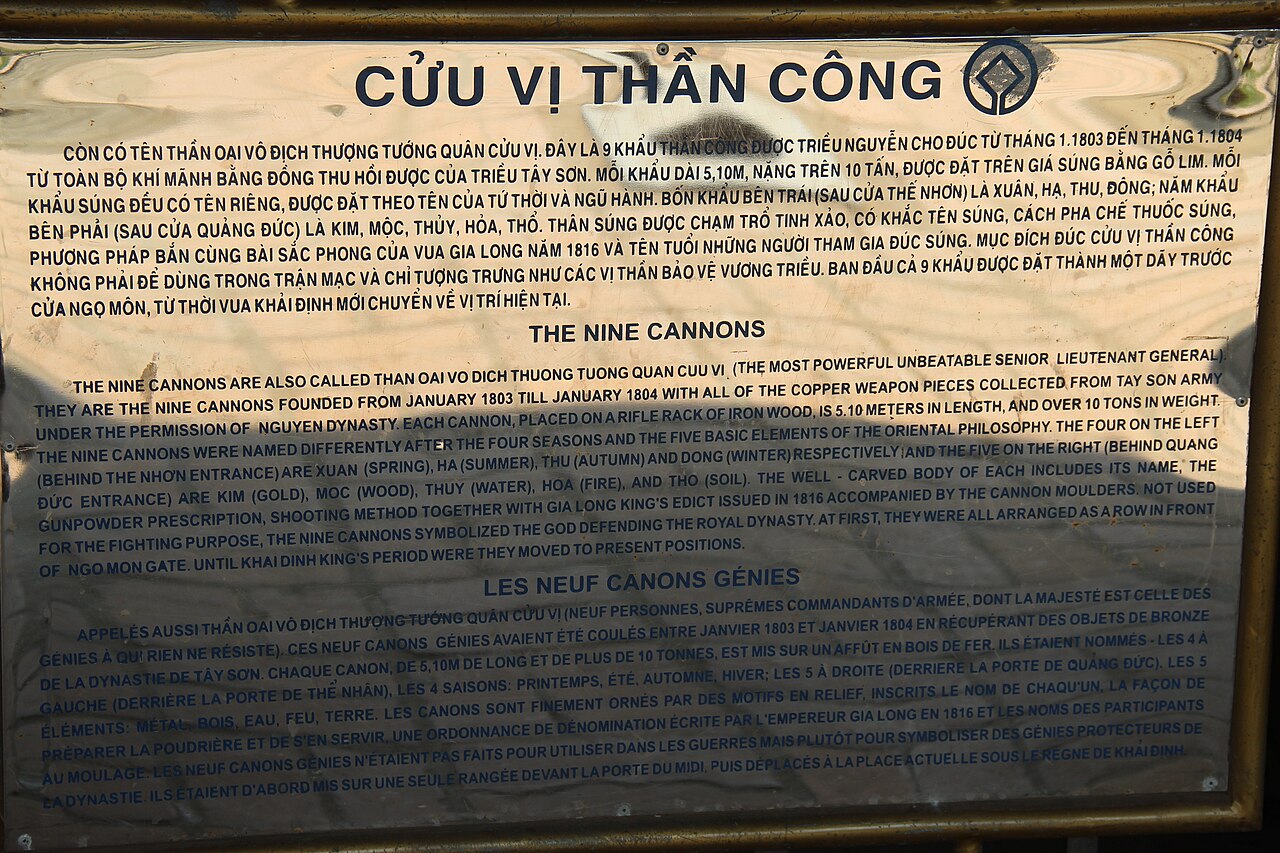
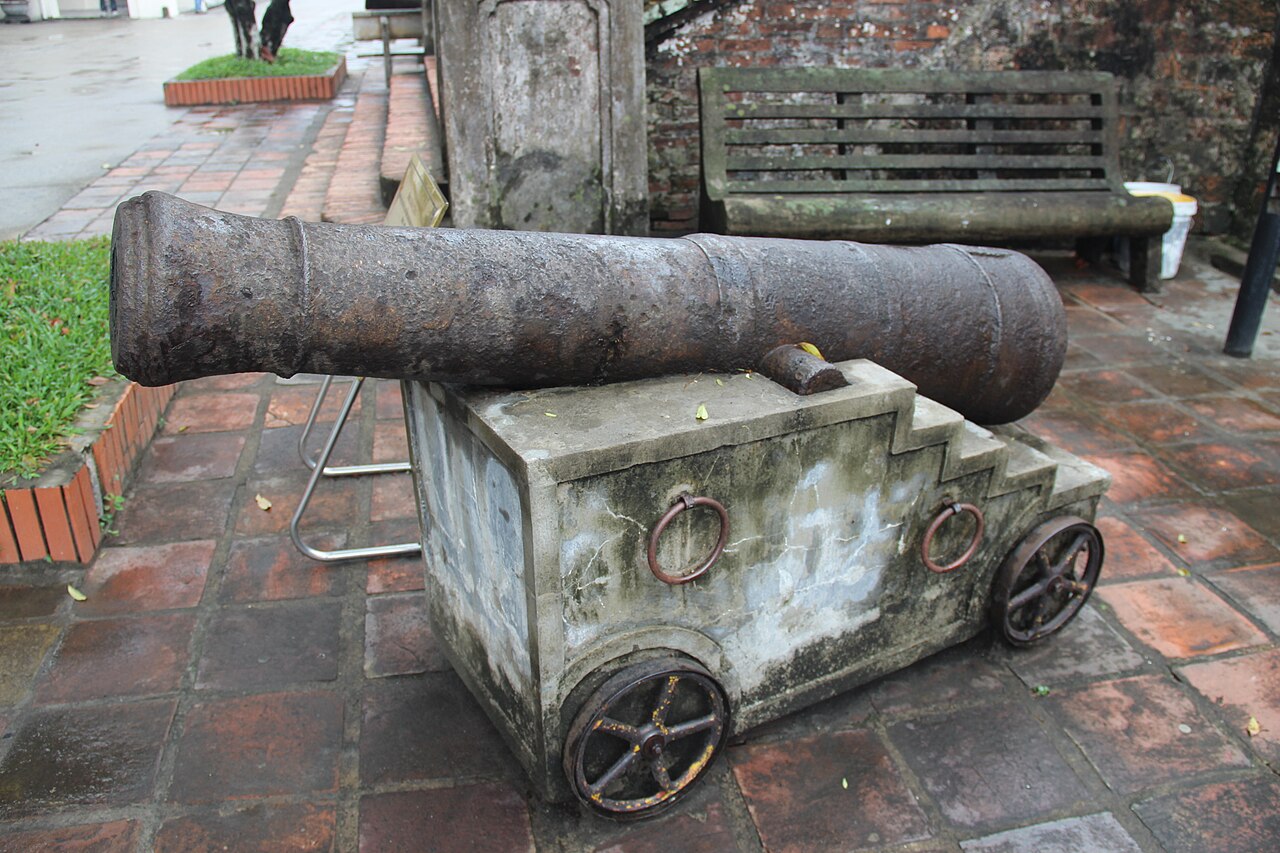
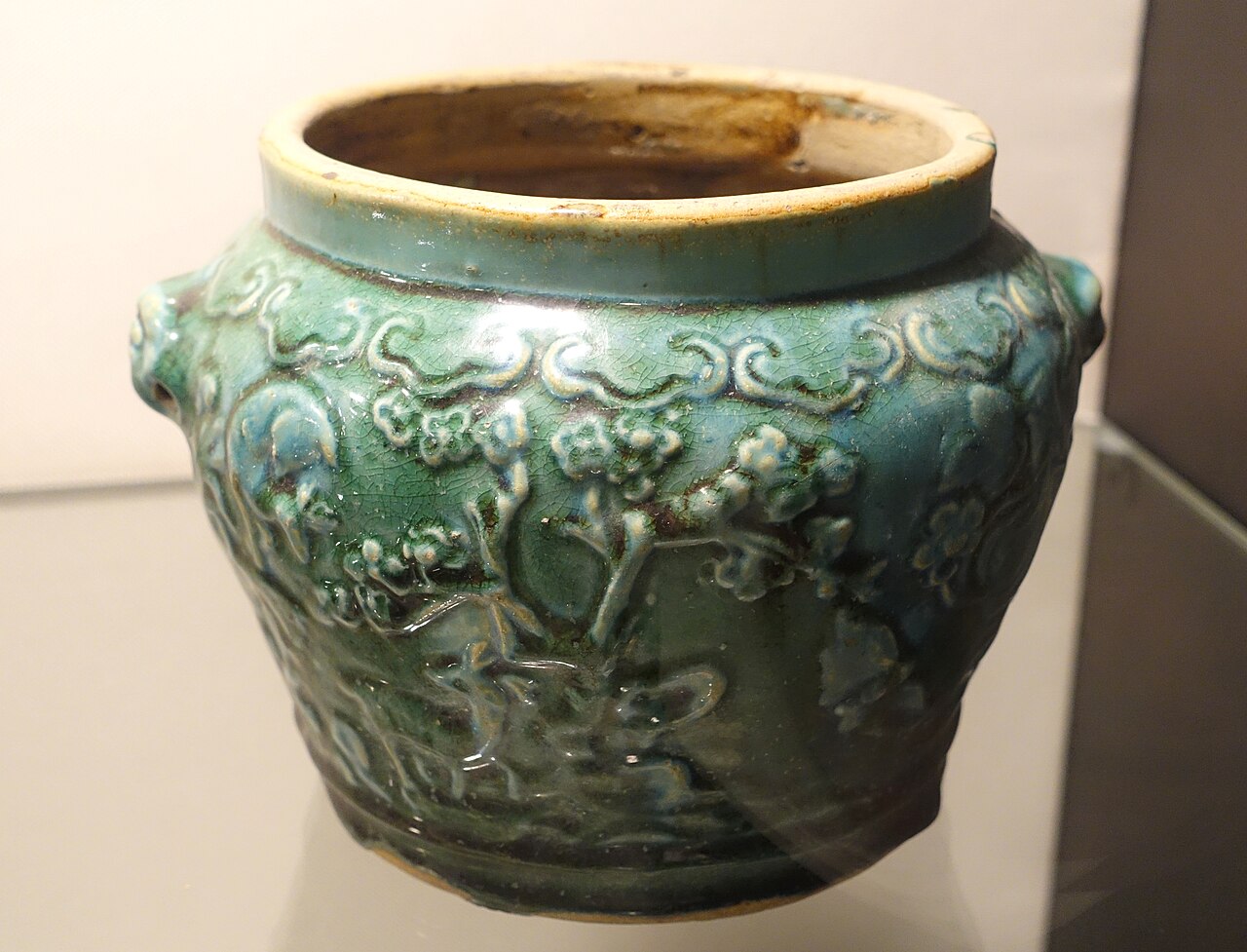
A set for smoking opium, Nguyen dynasty, 20th century, wood, metal, porcelain - National Museum of Vietnamese History - Hanoi, Vietnam -…, Daderot, CC0, Wikimedia Commons · Nguyen Dynasty Forbidden City The Nine Cannons (15436867222), Gary Todd from Xinzheng, China, CC0, Wikimedia Commons · Nguyen Dynasty Iron Cannon, 19th Century (9735304614), Gary Todd from Xinzheng, China, CC0, Wikimedia Commons · Rice container, Bien Hoa ceramic, green glaze - Nguyen dynasty, 19th century AD - Vietnam National Museum of Fine Arts - Hanoi, Vietnam -…, Daderot, CC0, Wikimedia Commons