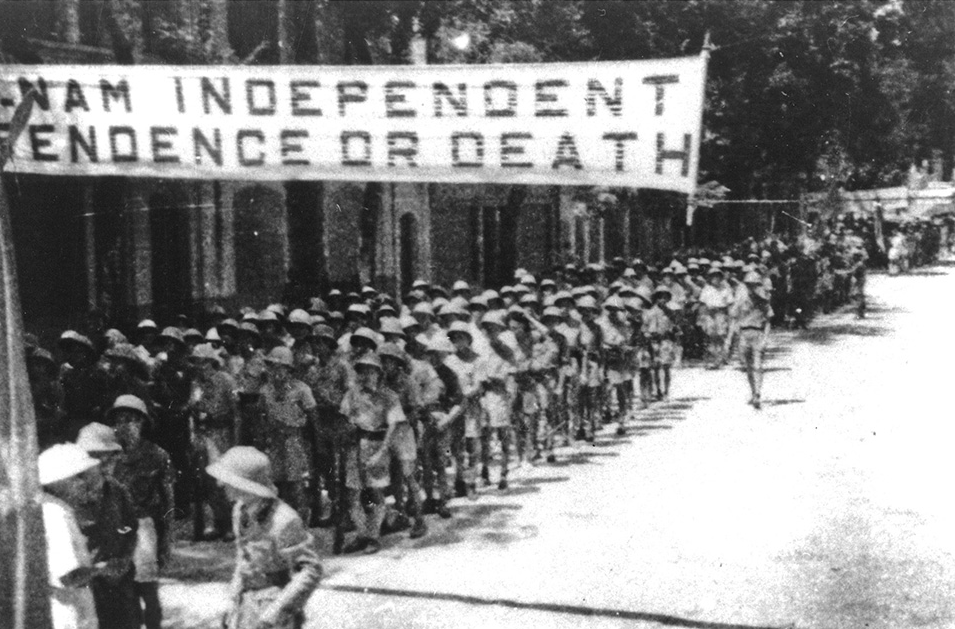
The August Revolution and independenceCách mạng Tháng Tám
Background: Japanese occupation and colonial crisis
Vietnam had been part of French Indochina since the late nineteenth century, but the fall of France to Nazi Germany in 1940 fundamentally weakened French authority in the region. Imperial Japan, expanding across Asia, pressured the French colonial administration into allowing Japanese military bases and troop movements through Indochina from September 1940 onwards. For much of the occupation, French colonial officials continued to administer the territory under Japanese supervision — an uneasy dual authority that lasted until March 1945.
On 9 March 1945, Japanese forces launched a sudden coup de force (coup de grâce in French colonial records), disarming and imprisoning French troops and administrators across Indochina in a single night. Emperor Bảo Đại, the last Nguyễn dynasty ruler, was kept in place as a nominal head of a Japanese-backed Vietnamese state. The coup destroyed what remained of French authority and created a power vacuum that the Viet Minh would move quickly to fill.
The 1945 famine
Between late 1944 and mid-1945, northern Vietnam experienced a catastrophic famine known in Vietnamese as nạn đói năm Ất Dậu. Estimates of the death toll range widely, from around 400,000 to two million people, with most historians centring figures around one to two million dead in the northern regions. The causes were multiple and debated: Japanese requisitioning of rice for military use and forced cultivation of jute and other industrial crops reduced food stocks; French colonial export policies had already left limited reserves; and poor harvests compounded the crisis.
The famine was politically significant beyond its human cost. It delegitimised both Japanese and French authority simultaneously, and the Viet Minh organised relief efforts and granary seizures in affected areas, building grassroots support in the countryside. For many Vietnamese who lived through 1945, the famine and the revolution are inseparable memories. The famine is commemorated at several points in Hanoi, and its scale is a subject of ongoing historical research.
The Viet Minh and the seizure of power
The Việt Minh — short for Việt Nam Độc Lập Đồng Minh Hội, the League for the Independence of Vietnam — was founded in 1941 under the leadership of Hồ Chí Minh and the Indochinese Communist Party. Operating from bases in the mountains of northern Vietnam, particularly around Cao Bằng and Tuyên Quang, the organisation built a political and military network capable of acting nationally when the moment arrived.
Japan's surrender to the Allies on 15 August 1945 following the atomic bombings of Hiroshima and Nagasaki removed the dominant power from the equation almost overnight. The Viet Minh had anticipated this and moved with striking speed. Between 14 and 28 August — the period now called the August Revolution (Cách mạng Tháng Tám) — Viet Minh forces and mass demonstrations took control of Hanoi, Huế, Saigon and dozens of towns and provinces with relatively little armed resistance. Emperor Bảo Đại abdicated on 25 August in Huế, handing a ceremonial sword and seal to Viet Minh representatives, symbolically ending the Nguyễn dynasty.
2 September 1945: Ba Đình Square
On 2 September 1945, Hồ Chí Minh stood before a crowd estimated at hundreds of thousands of people in Ba Đình Square in central Hanoi and read aloud the Vietnamese Declaration of Independence. The speech opened by quoting the American Declaration of Independence of 1776 and the French Declaration of the Rights of Man and of the Citizen, a rhetorical choice aimed partly at the Allied powers whose support Hồ Chí Minh hoped to secure. He then declared the founding of the Việt Nam Dân chủ Cộng hòa — the Democratic Republic of Vietnam.
Ba Đình Square remains one of the most politically significant sites in Vietnam. The Hồ Chí Minh Mausoleum, completed in 1975, stands on the western edge of the square and contains Hồ Chí Minh's embalmed body. The Presidential Palace, used by French governors-general before 1945, is nearby. The One Pillar Pagoda and the Hồ Chí Minh Museum are within walking distance. The square itself is used for state ceremonies and is closely managed; access conditions vary and are subject to change.
Other connected sites
Several locations around Vietnam are directly linked to the events of 1945. Tân Trào, a village in what is now Tuyên Quang province, served as the Viet Minh's main wartime base and the site of the National Congress held in mid-August 1945 that formally authorised the general uprising. A banyan tree under which Hồ Chí Minh reportedly addressed troops is preserved there and is a pilgrimage site for Vietnamese visitors.
In Huế, the Imperial Citadel was the setting for Bảo Đại's abdication ceremony on 25 August. The Ngọ Môn Gate, the main southern entrance to the citadel, is where the handover took place. In Hà Nội, the Bắc Bộ Phủ (the former residence of the French Governor-General of Tonkin, now a government guesthouse) was seized by the Viet Minh on 19 August — a date marked annually as the anniversary of the Hanoi uprising. The Hỏa Lò Prison, built by the French and used to hold political prisoners throughout the colonial period, also dates from this era.
Aftermath and contested interpretations
Independence proved short-lived in practice. French forces, backed by British troops who had been tasked with accepting the Japanese surrender south of the 16th parallel, returned to Saigon in September 1945 and began reasserting control over southern Vietnam almost immediately. Negotiations between the French government and Hồ Chí Minh's administration continued into 1946 but broke down, leading to the outbreak of full-scale war in December 1946. That conflict is covered in detail on the page about the First Indochina War and Diện Biên Phủ.
The August Revolution is celebrated in the official historiography of the Socialist Republic of Vietnam as the founding moment of the modern state. Outside Vietnam, historians debate the degree of popular participation versus Viet Minh organisation, the role of the famine in radicalising the population, and what alternative political outcomes might have been possible in the chaotic weeks after Japan's surrender. The events of 1945 remain central to how Vietnam understands its modern identity.
Also known as / see also
Được tham chiếu bởi
Các nguồn
- Vietnam National Museum of History — Bảo tàng Lịch sử quốc gia đã truy cập 31 August 2026
Supports: the rules and definitions on this page - Cách mạng Tháng Tám — Wikipedia (Vietnamese) (CC BY-SA 4.0) đã truy cập 31 August 2026
Supports: background, Vietnamese edition
Current Đã xác minh lần cuối: 31 August 2026. Rules, fares and prices change — check the official source before acting on anything here. Report a mistake.
Picture credits (1)
OSS ( Office of Strategic Services ), US Army personnel., Public domain, Wikimedia Commons