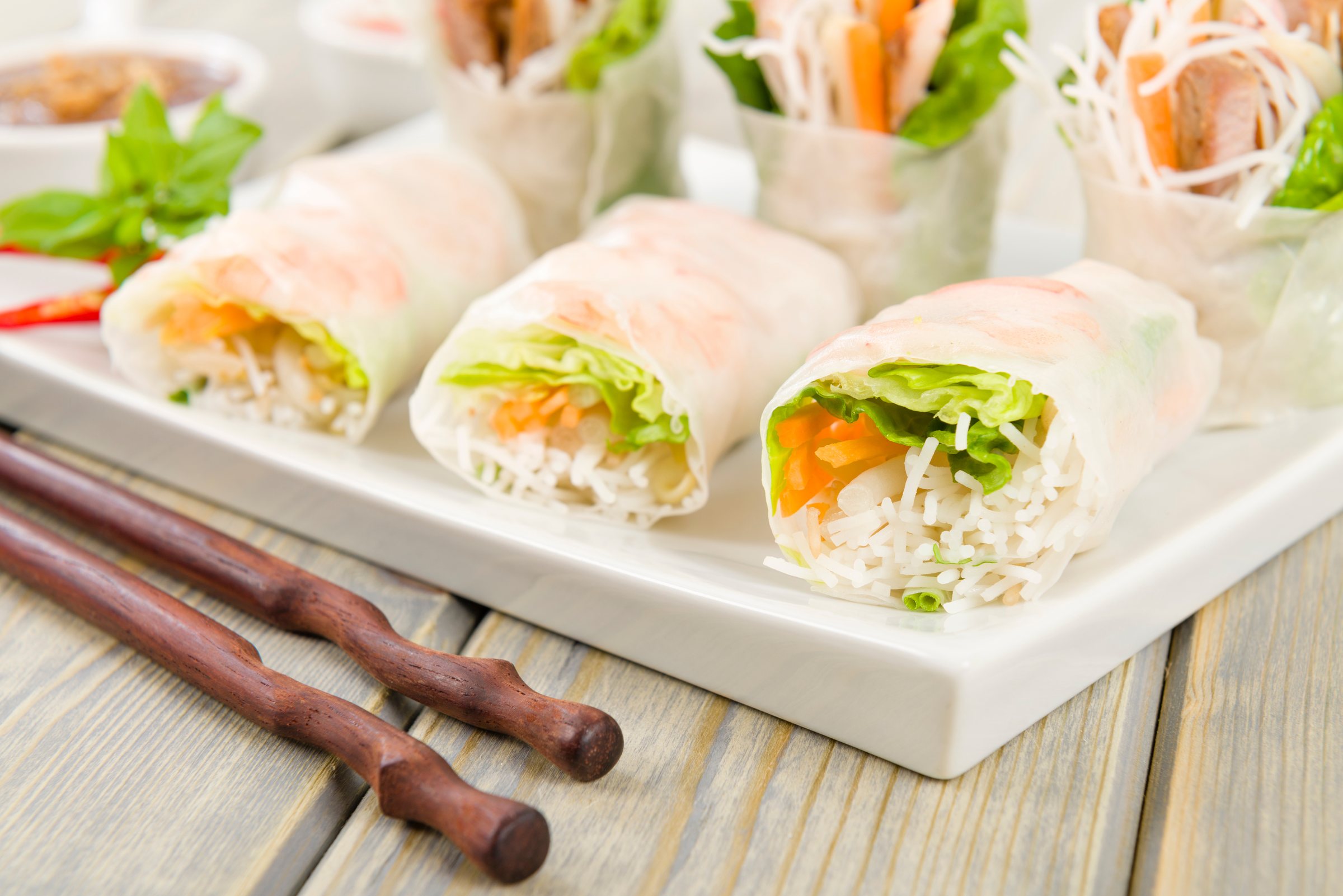
Fresh spring rollsGỏi cuốn
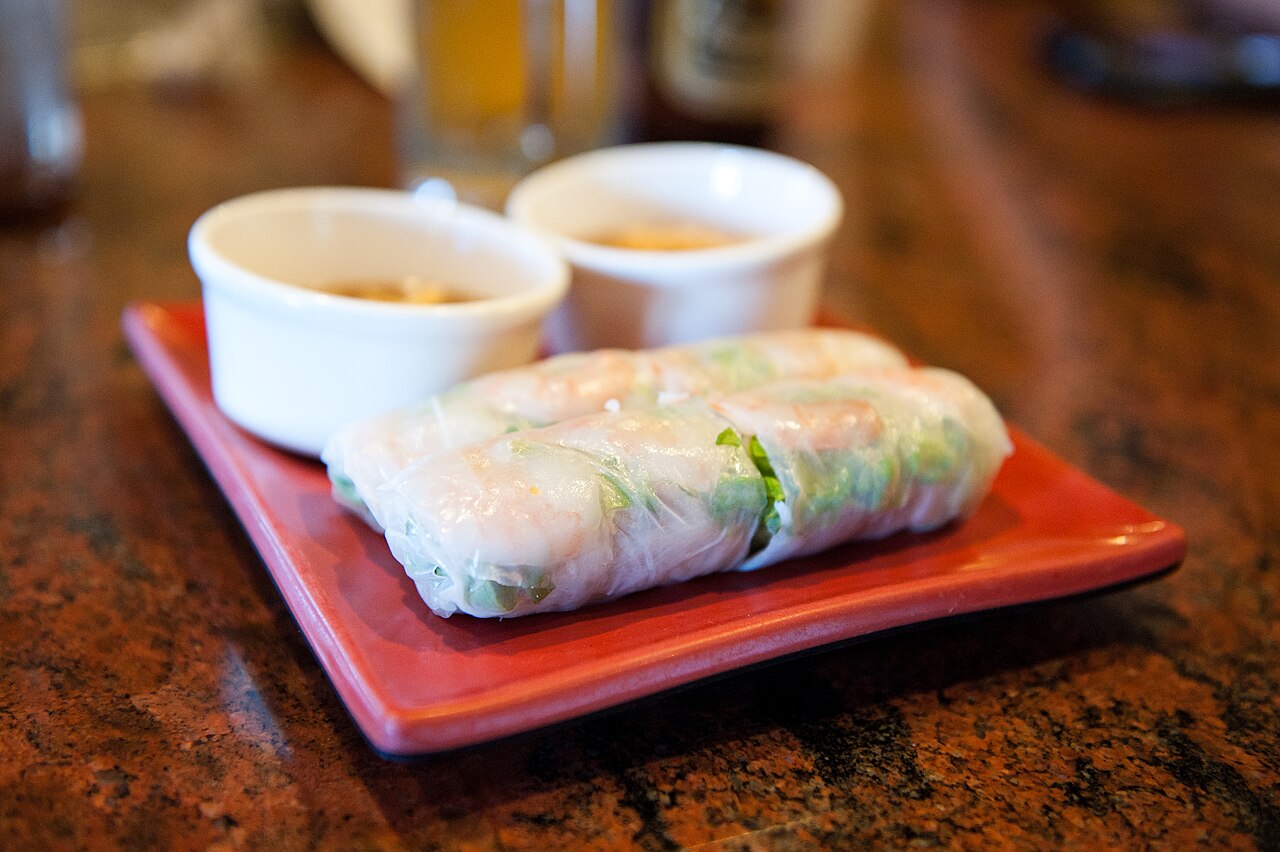
What gỏi cuốn are
Gỏi cuốn — often called fresh spring rolls in English — are rolls made by wrapping fillings in a softened sheet of dried rice paper (bánh tráng). Unlike nem rán (fried spring rolls, sometimes called chả giò in the south), gỏi cuốn are never cooked after assembly. They are served at room temperature, which keeps the wrapper soft and translucent and the herbs inside visibly green. The name breaks down as gỏi (salad or mixed dish) and cuốn (rolled), pointing to their character as something closer to a hand-held salad than a cooked snack. They are strongly associated with Southern Vietnamese cuisine and with everyday eating in and around Ho Chi Minh City, though they are now common across the country.
Standard fillings
The most common version contains boiled prawns, thin slices of boiled pork belly, rice vermicelli (bún), lettuce or mustard greens, and a generous quantity of fresh herbs. Mint (rau húng lủi) is nearly universal; Vietnamese perilla (tía tô) and garlic chives appear frequently. A few chive stems are often left protruding from one end for visual effect. The prawn is typically split lengthways and placed against the wrapper so the pink-and-white curve shows through the translucent rice paper. Some versions include cucumber batons or bean sprouts for additional texture. Proportions vary considerably between cooks and regions, and no single combination is definitive.
Dipping sauces
Two dipping sauces appear alongside gỏi cuốn, and which one is offered can signal regional background. In the south, a thick sauce based on hoisin (tương hoisin) blended with peanut paste or crushed roasted peanuts is standard. It is sweet, rich and opaque. In the centre and north, nước chấm — the thin, clear sauce of fish sauce, lime juice, sugar, water, garlic and chilli — is more common. Some establishments serve both. Neither is universally considered the correct accompaniment; the choice is a matter of convention and personal preference. A small dish of crushed peanuts for scattering is often provided alongside the peanut-hoisin version.
Rolling technique
Rice-paper sheets are sold dry and must be briefly wetted before use. The standard method is to pass each sheet through a shallow bowl or tray of warm water for a few seconds until it becomes pliable but not fully soft — it will continue to soften after removal. The sheet is laid flat, fillings are arranged in a strip across the lower third, the bottom edge is folded up, the sides are folded in, and the roll is then completed by rolling away from the cook. Overfilling is the most common difficulty: a tightly sealed roll requires less filling than most beginners expect. Rolls should be consumed shortly after assembly, as the wrapper continues to absorb moisture and can become sticky or tear if left too long.
Vegetarian versions
Vegetarian gỏi cuốn replace prawn and pork with combinations of firm tofu, mushrooms (often wood-ear or shiitake), julienned carrot, cucumber and additional herbs. The structure of the roll remains the same. The accompanying sauce requires adjustment: hoisin is inherently plant-based, but nước chấm relies on fish sauce (nước mắm), which is replaced in vegetarian versions with soy sauce or a fermented mushroom-based sauce to approximate the saline depth. Vegetarian gỏi cuốn are widely available at Buddhist vegetarian restaurants (quán chay), where they appear on the menu under the same name or as gỏi cuốn chay.
Comes from
참조 페이지
출처 목록
- Vietnam National Authority of Tourism — VNAT 접근됨 29 August 2026
Supports: the rules and definitions on this page - Gỏi cuốn — Wikipedia (CC BY-SA 4.0) 접근됨 31 August 2026
Supports: background - Gỏi cuốn — Wikipedia (Vietnamese) (CC BY-SA 4.0) 접근됨 31 August 2026
Supports: background, Vietnamese edition
Current 마지막 확인: 31 August 2026. Rules, fares and prices change — check the official source before acting on anything here. Report a mistake.
Picture credits (2)
Photo: paul_brighton / Adobe Stock, asset 49182063 · JOH 8495 - Pho Kim Long Restaurant, star5112, CC BY-SA 2.0, Wikimedia Commons