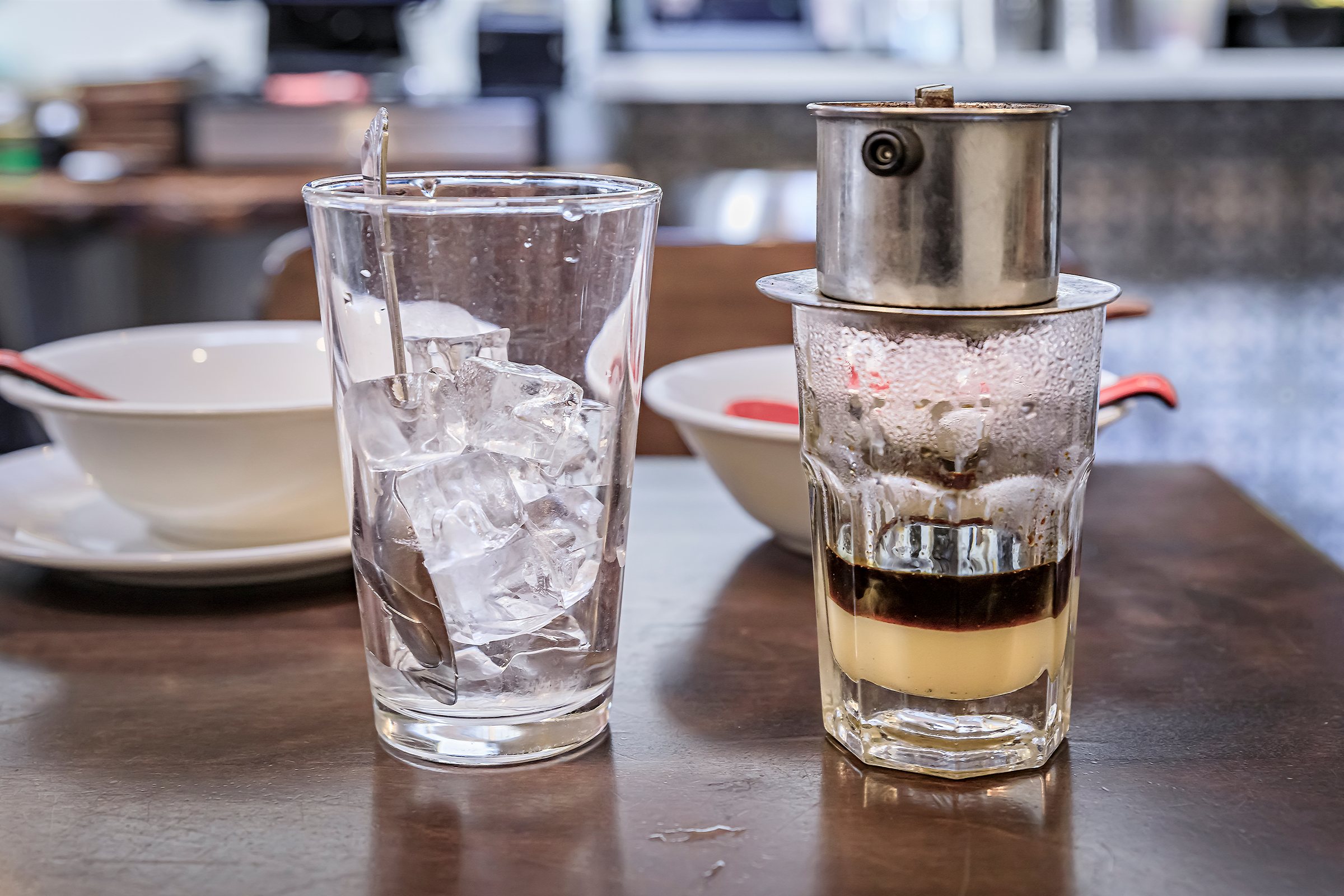
Vietnamese iced coffeeCà phê sữa đá
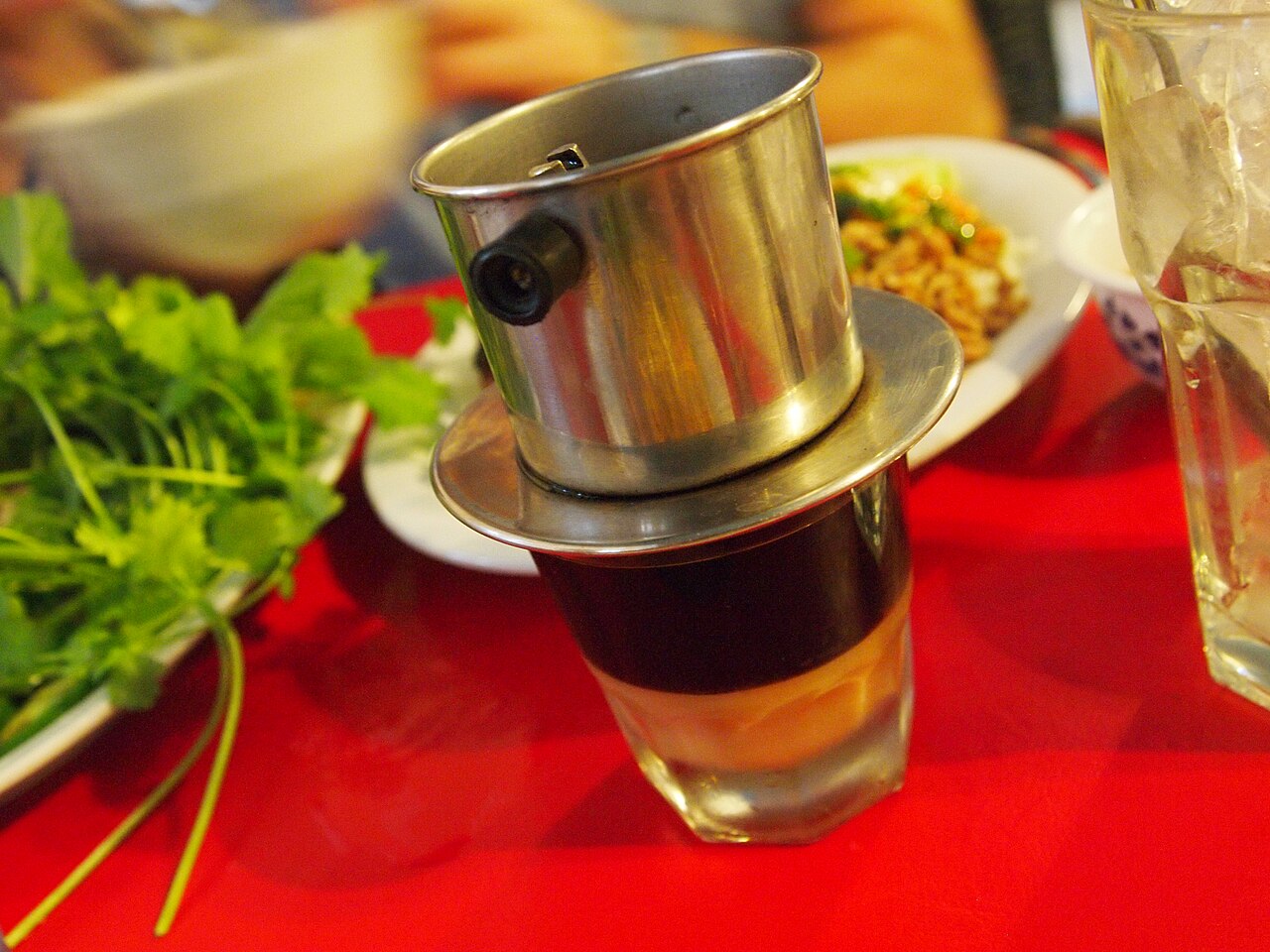
What it is
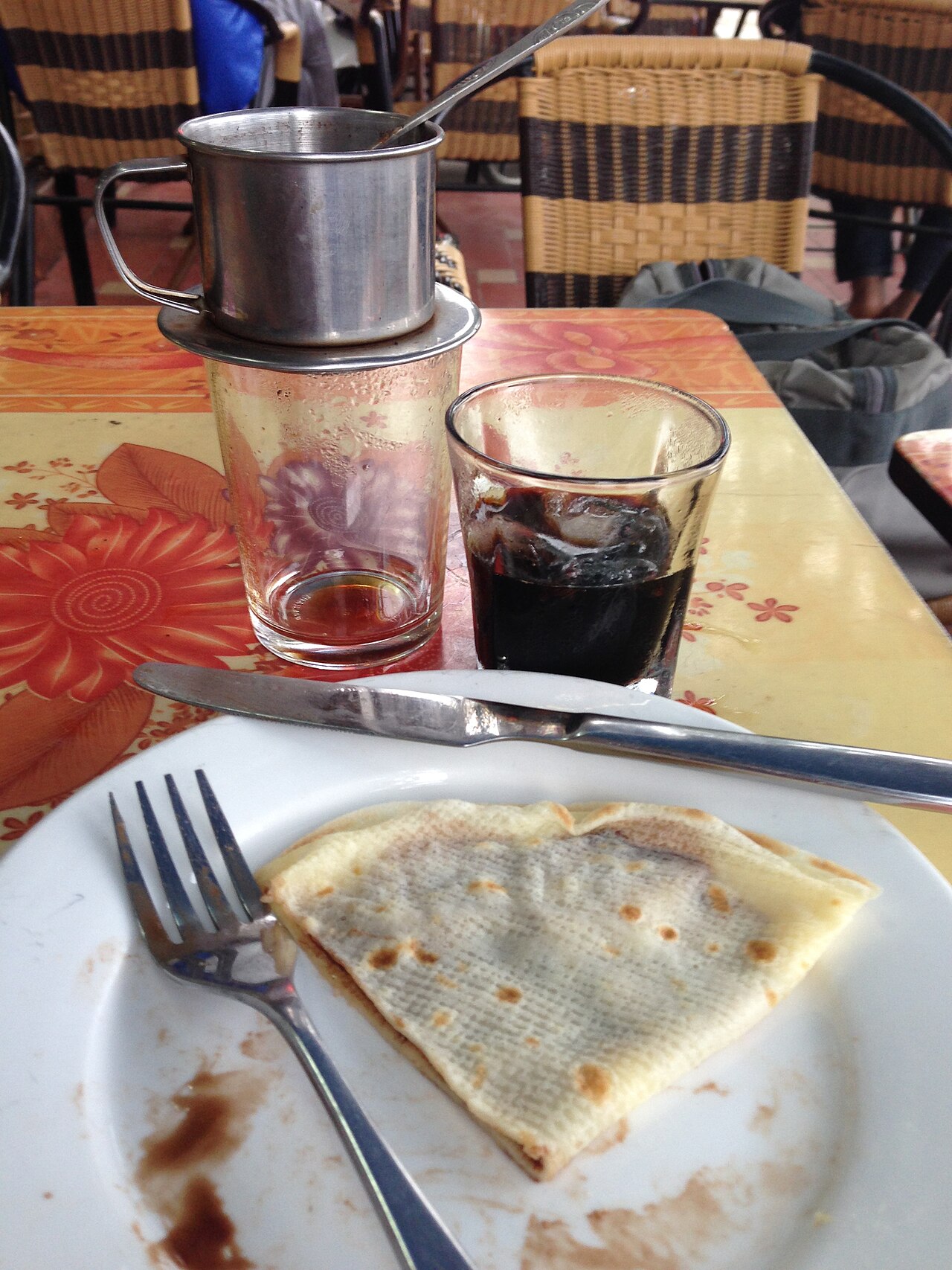
Cà phê sữa đá — literally milk coffee with ice — is brewed to order using a phin, a small stainless-steel drip filter that sits directly on the glass. Ground coffee is tamped loosely inside, hot water is added, and the brew drips through over three to five minutes. The result is concentrated and heavy-bodied. A layer of sweetened condensed milk waits at the bottom of the glass; ice is added last, and the drinker stirs everything together before drinking.
The drink is served cold (đá) or hot (nóng), and with or without milk. Understanding four words covers most ordering situations: nóng (hot), đá (iced), đen (black, no milk) and sữa (with condensed milk). A typical order might be cà phê sữa đá or, for black iced coffee, cà phê đen đá.
Robusta and why Vietnam grows it
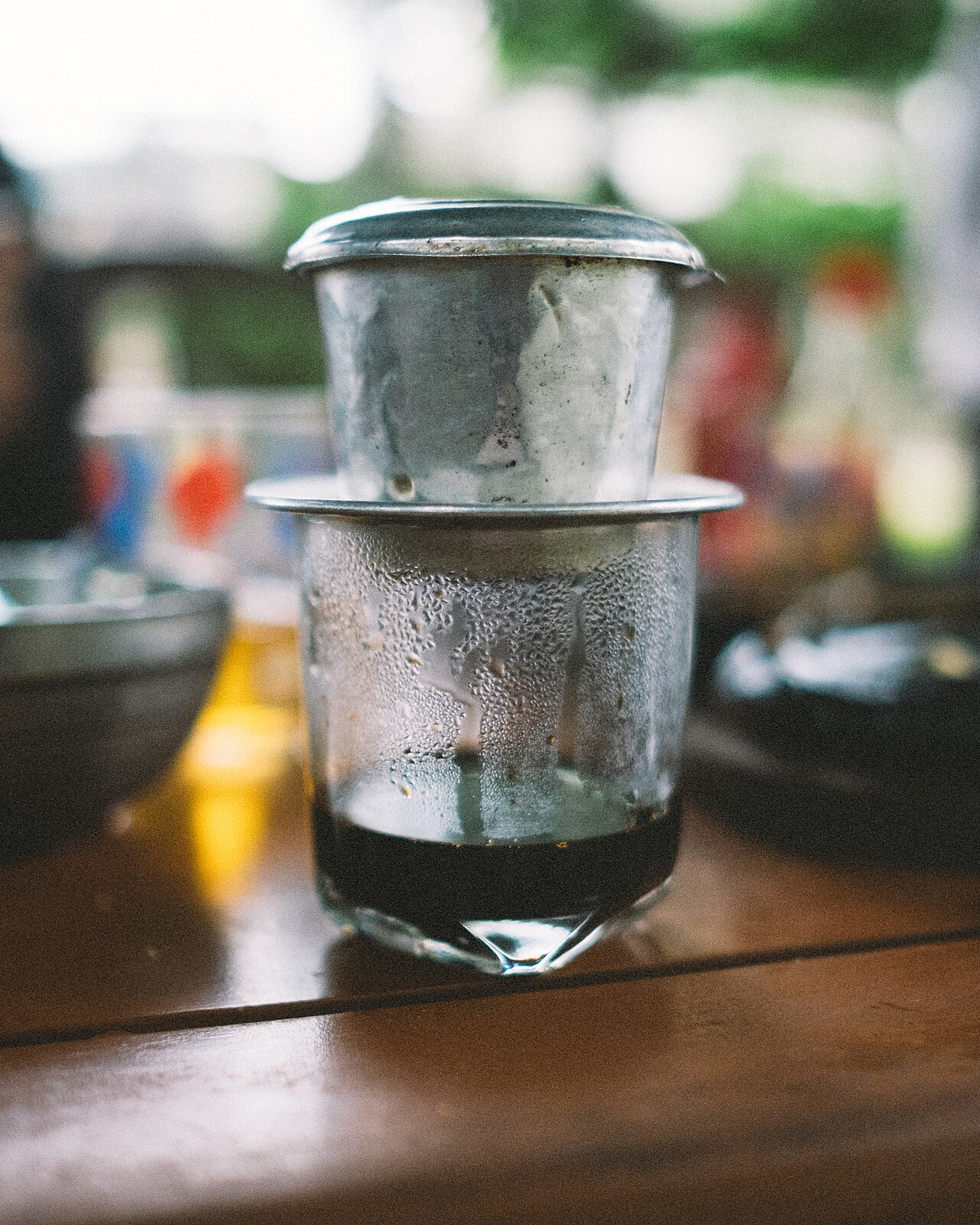
Vietnam is the world's second largest coffee producer by volume, behind Brazil, and grows predominantly robusta (Coffea canephora). Robusta thrives in the red basalt soils and moderate altitude of the Central Highlands — particularly around Buôn Ma Thuột in Đắk Lắk — where the climate is cooler than the lowland tropics but not cold enough to stress the plant. Robusta tolerates humidity and disease better than arabica and yields more fruit per hectare.
The variety has roughly twice the caffeine content of arabica and a pronounced bitterness with low acidity. This intensity suits the phin method, which extracts a small volume of very strong coffee rather than a large diluted cup. Arabica is grown in smaller quantities in higher-altitude areas such as the hills around Đà Lạt, and blended robusta-arabica products exist, but robusta defines the national cup.
The phin filter
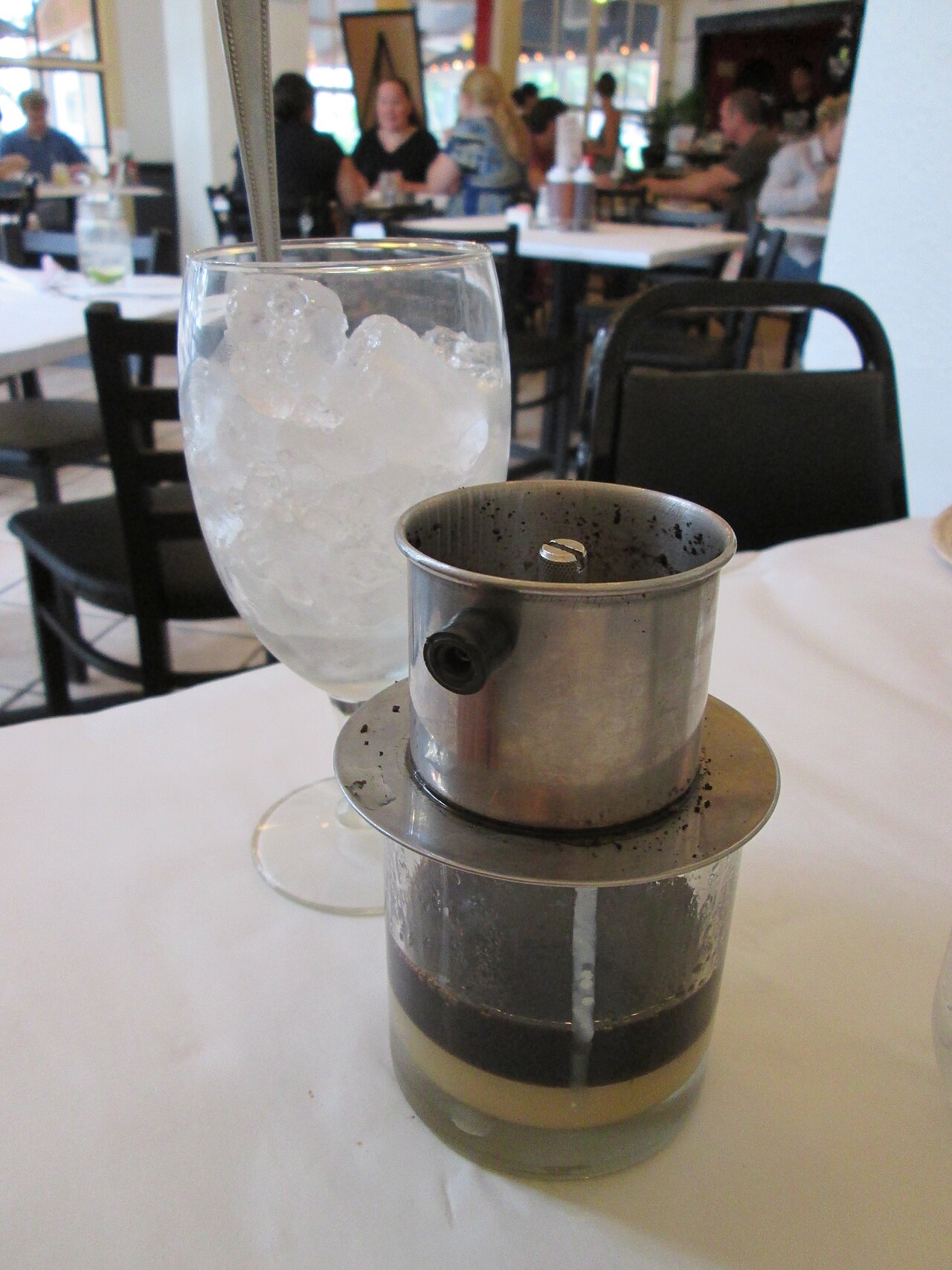
The phin arrived in Vietnam during the French colonial period, adapted from European drip-brewing principles into a portable, individual-serving device. It consists of four parts: a perforated base plate that rests on the rim of a glass or cup, a brewing chamber, a gravity press plate that sits on top of the grounds, and a lid that doubles as a drip tray when inverted.
Technique matters more than the device itself. The grind is coarser than espresso but finer than most pour-over methods. Too fine and the water stalls; too coarse and the brew runs thin. The press plate is placed lightly on the grounds — not firmly tamped — to slow the flow to a steady drip. A full brew takes three to five minutes. The phin requires no electricity and no paper filter, which contributes to its continued dominance in a country where street-side preparation remains the norm.
Condensed milk and its role
Fresh dairy milk was scarce and difficult to preserve in Vietnam's climate before modern refrigeration. Sweetened condensed milk, shelf-stable in its tin, became the practical substitute during the colonial era and has remained inseparable from the drink ever since. Brands such as Ông Thọ (Longevity) are closely associated with the drink and are recognised by name by most Vietnamese drinkers.
Condensed milk performs two functions simultaneously: it sweetens and it lightens the intensity of robusta. The ratio of milk to coffee varies by region and by individual vendor. Southern-style coffee, particularly in Ho Chi Minh City, tends to be sweeter and milkier than northern preparations, where the coffee is often stronger and the milk proportion smaller.
Street stools versus café chains
The dominant setting for cà phê sữa đá remains the small street-side stall: a low table, plastic stools, a single vendor, and a menu of perhaps three or four items. These stalls open early — many serve the pre-work crowd before sunrise — and prices are set by neighbourhood custom rather than printed menus. In Ho Chi Minh City and Hà Nội, pavement cafés with this format operate in nearly every residential alley.
From the 2010s onward, domestic café chains expanded rapidly. Highlands Coffee, The Coffee House and Phúc Long serve cà phê sữa đá alongside blended drinks and food, with air conditioning, wi-fi and table service. Their coffee is typically machine-brewed rather than phin-brewed, and recipes are standardised. A separate tier of specialty coffee shops has emerged in larger cities, using arabica, calibrated grinders and trained baristas, though these remain a minority segment. All three formats coexist without one displacing the others.
Regional and ingredient variations
Beyond the standard preparation, several recognised variants exist. Cà phê trứng (egg coffee), associated with Hà Nội and credited to the Giảng family café, replaces condensed milk with a whipped mixture of egg yolk, sugar and condensed milk beaten to a foam. Cà phê dừa uses coconut milk or coconut cream. Bạc xỉu, common in southern Vietnam, is a much milkier version with a small amount of coffee — closer to a coffee-flavoured milk than a milk coffee — and is often the preferred choice of those who find cà phê sữa đá too intense.
Salt coffee (cà phê muối), which adds a small quantity of salted cream, became widely discussed in the 2020s and is particularly associated with Huế. The addition moderates bitterness through a well-documented sensory mechanism rather than through sweetness alone.
Where it is
Also known as / see also
Comes from
被以下页面引用
来源
- Vietnam National Authority of Tourism — VNAT 访问于 29 August 2026
Supports: the rules and definitions on this page - Vietnamese iced coffee — Wikipedia (CC BY-SA 4.0) 访问于 31 August 2026
Supports: background - Cà phê sữa đá — Wikipedia (Vietnamese) (CC BY-SA 4.0) 访问于 31 August 2026
Supports: background, Vietnamese edition
Current 最后核实: 31 August 2026. Rules, fares and prices change — check the official source before acting on anything here. Report a mistake.
Picture credits (5)
Photo: SvetlanaSF / Adobe Stock, asset 552374101 · Danh's Garden, Shreveport, LA - Vietnamese Coffee, Shreveport-Bossier Convention and Tourist Bureau, CC BY 2.0, Wikimedia Commons · Vietnamese iced coffee - Jan 31, 2018, Vinnie Cartabiano, CC BY 2.0, Wikimedia Commons · Vietnamese Iced Coffee Ba Chi Canteen, Infrogmation of New Orleans, CC BY 2.0, Wikimedia Commons · Vietnamese iced coffee and a crepe, Lào Cai, Vietnam - 20131027, Smuconlaw, CC BY-SA 4.0, Wikimedia Commons