Bun chaBún chả
What the dish is
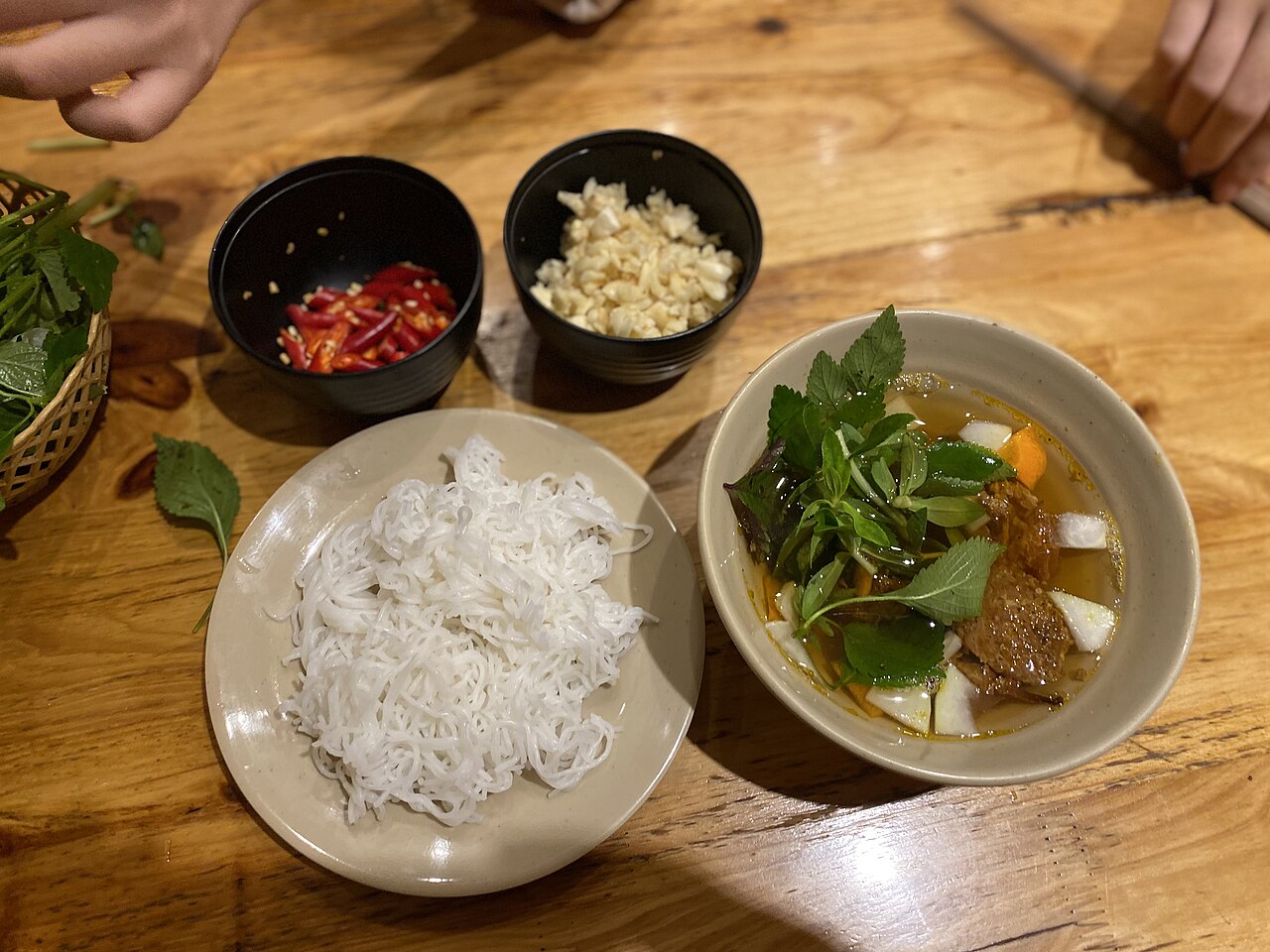
Bún chả centres on two cuts of pork cooked over charcoal: chả viên, small patties of minced pork seasoned with fish sauce, sugar and shallots, and chả miếng, slices of pork belly that have been marinated and grilled in the same way. Both are served submerged in a bowl of nước chấm pha — a diluted dipping broth made from fish sauce, rice vinegar or lime juice, sugar, water, garlic and chilli. The broth is served warm rather than cold, which distinguishes it clearly from many other Vietnamese dipping sauces. Thin rice vermicelli (bún) arrive separately, dry and at room temperature, on a plate or in a basket alongside a generous pile of fresh herbs, typically perilla, mint, lettuce and bean sprouts.
How it is eaten
The diner takes a small bundle of noodles and lowers them into the broth bowl with chopsticks, then adds torn herbs and, if desired, a piece of the chilli or garlic floating in the broth. Each mouthful combines a strand of noodle, a piece of pork and a sip of broth. There is no single correct ratio; the balance is adjusted bite by bite. The noodles are never pre-mixed into the broth — the bowl retains its distinct pork, broth and garnish components throughout the meal. Extra broth is commonly requested at Hanoi restaurants and is usually brought without charge, though prices for the meal vary by season and establishment.
The lunchtime convention
In Hanoi, bún chả is strongly associated with midday. Many dedicated bún chả restaurants open around late morning and close once the day's pork is sold, often before mid-afternoon. Eating bún chả at dinner is unusual in the city, though not impossible. This pattern is partly practical: charcoal grilling is labour-intensive and smoke-producing, and the dish is considered heavy enough to anchor a main midday meal. Visitors arriving after early afternoon frequently find that a given stall has sold out entirely.
Nem cua bể
The conventional side order with bún chả is nem cua bể, fried spring rolls filled with crab meat, minced pork, glass noodles and wood-ear mushroom, wrapped in rice paper and deep-fried until crisp. They are dipped directly into the same broth bowl as the pork. Nem cua bể are considered part of a complete bún chả order in Hanoi rather than an optional extra, and most restaurants include them on the standard set. The crab content varies considerably between establishments; lower-cost versions may use very little actual crab.
Differences from bún thịt nướng
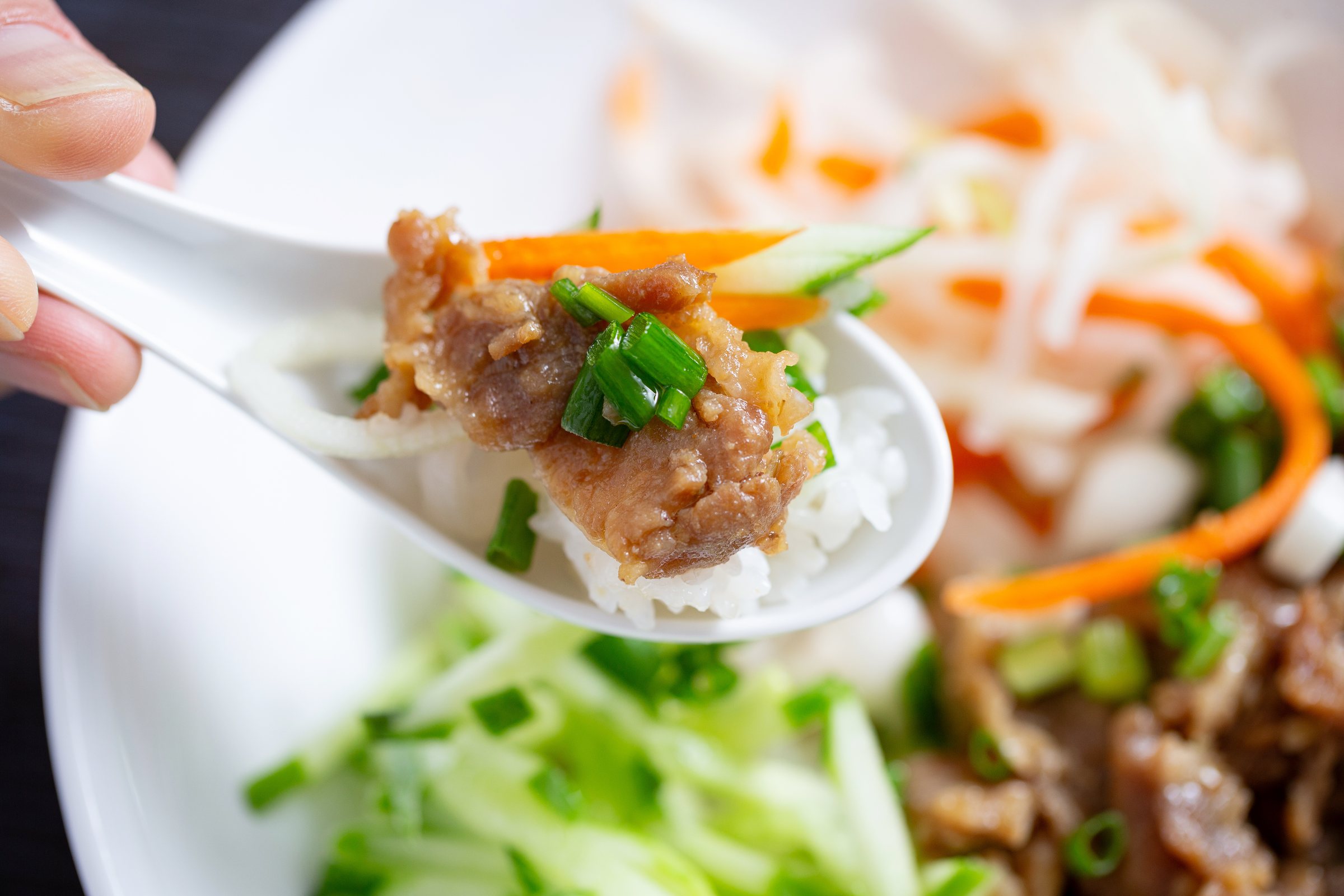
Bún thịt nướng, common across southern Vietnam, is sometimes described as a related dish, but the construction differs in important ways. In bún thịt nướng, the grilled pork — typically thin slices rather than patties — is placed directly on top of a bowl or plate of cold noodles with shredded vegetables, pickled daikon and carrot, crushed roasted peanuts and fresh herbs. The dipping sauce (nước chấm) is served on the side, not as a warm broth in which the pork sits. The overall texture and temperature of the dish are therefore quite different: bún thịt nướng is closer to a room-temperature salad, whereas bún chả is built around a warm broth bowl. The grilling technique — charcoal — is similar, but the seasoning profiles reflect broader differences between northern Vietnamese cuisine and southern Vietnamese cooking.
Origins and identity
Bún chả is documented in writing about Hanoi food from the early twentieth century, and the food writer Vũ Bằng described the smell of bún chả grills on Hanoi streets in his 1960 essay collection Miếng ngon Hà Nội (Delicious Foods of Hanoi). The dish is widely regarded as specific to Hanoi in a way that few Vietnamese dishes are — its preparation and serving conventions are stable enough across the city that it functions as a marker of northern culinary identity. Versions served outside Hanoi, including in Ho Chi Minh City, often adapt the broth sweetness or substitute different herbs, and Hanoi residents tend to regard these as approximations rather than equivalents.
Comes from
Referenciado por
Fuentes
- Vietnam National Authority of Tourism — VNAT consultado 29 August 2026
Supports: the rules and definitions on this page - Bun cha — Wikipedia (CC BY-SA 4.0) consultado 31 August 2026
Supports: background - Bún chả — Wikipedia (Vietnamese) (CC BY-SA 4.0) consultado 31 August 2026
Supports: background, Vietnamese edition
Current Última verificación: 31 August 2026. Rules, fares and prices change — check the official source before acting on anything here. Report a mistake.
Picture credits (5)
Photo: mnimage / Adobe Stock, asset 1957922196 · Bún chả with chili peppers and fresh garlic, Kiraface, CC BY-SA 4.0, Wikimedia Commons · Bun cha ca nha trang, Nguyen Thi Quynh Tram, CC BY 3.0, Wikimedia Commons · Bun cha ca rau can, Nguyen Thi Quynh Tram, CC BY 3.0, Wikimedia Commons · Bún chả hành, ng17th5n2022 (1), Phương Huy, CC0, Wikimedia Commons