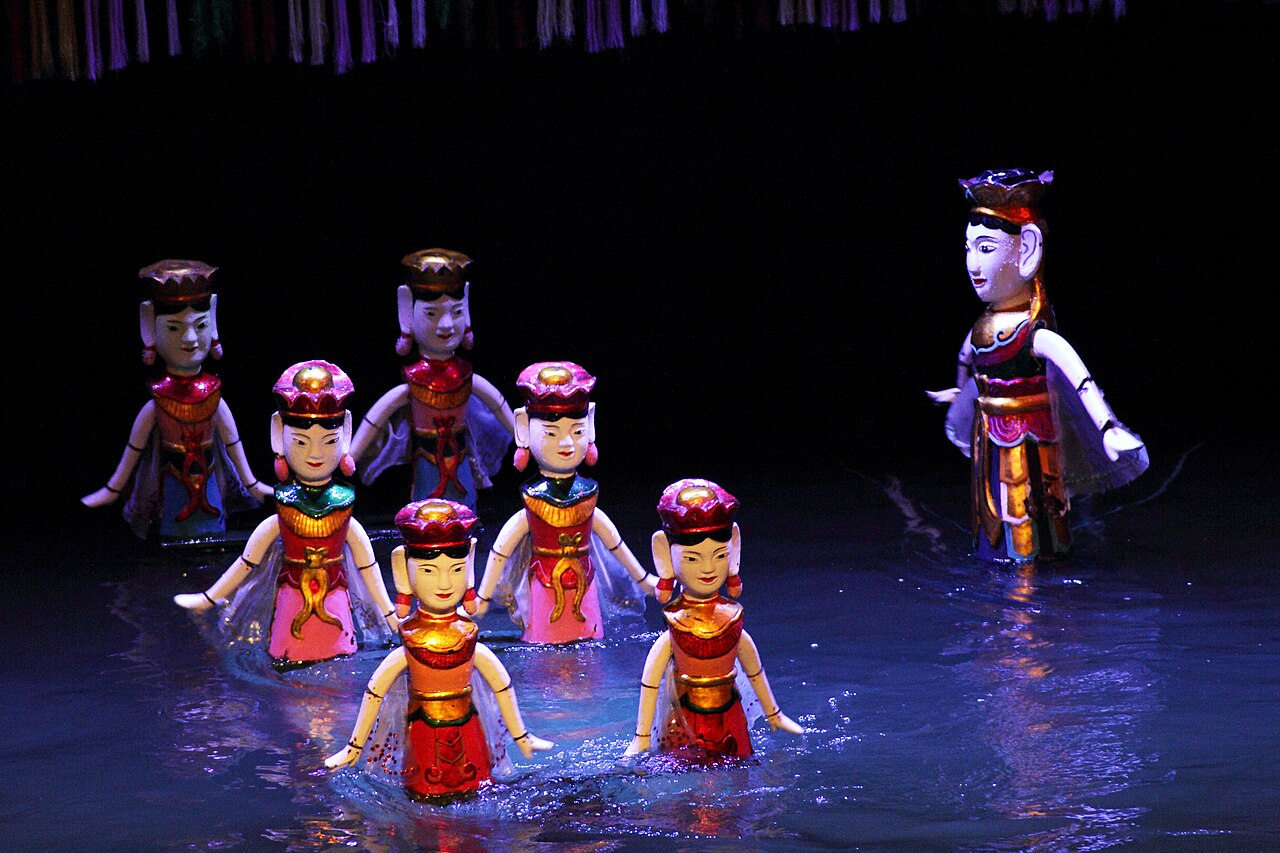
Water puppetryMúa rối nước
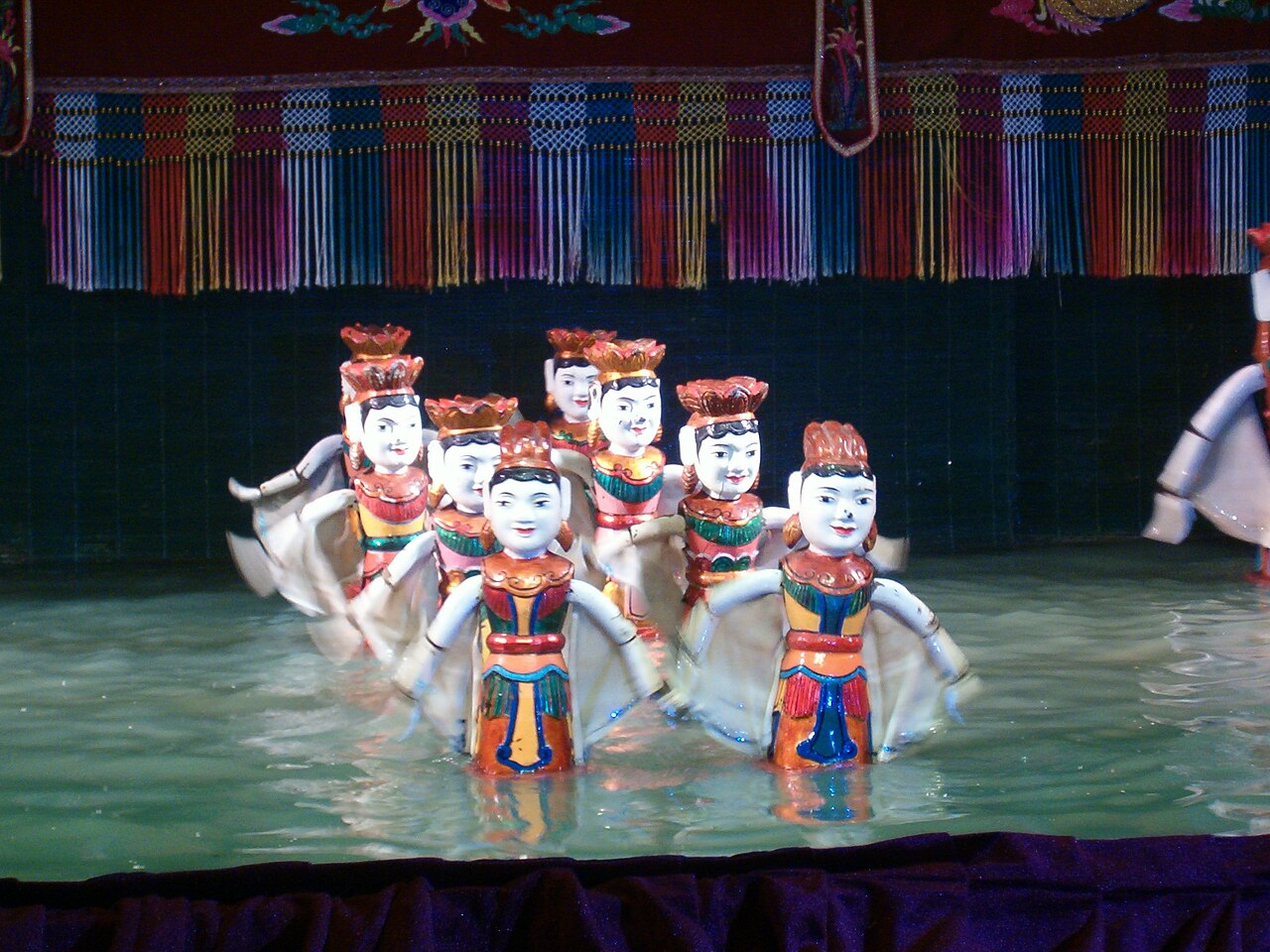
Origins in the Red River Delta
Water puppetry — múa rối nước, literally 'dancing puppets on water' — developed in the villages of the Red River Delta, likely during the Lý dynasty (1009–1225). The earliest known written reference appears in a 1121 stone stele describing a royal celebration.
The form grew directly from the landscape. Flooded rice paddies and communal ponds were the original stages. Village festivals, harvests and the lunar new year provided the occasions. Because the technique required a body of water and a hidden operating space, it remained closely tied to the delta region for centuries, rarely spreading in its traditional form to the drier central and southern parts of the country.
Troupes were historically organised at the village level, with techniques passed down within families or tight-knit guilds. Some villages in Nam Định province still maintain these hereditary troupes alongside the professional theatre companies that emerged in the twentieth century.
How the puppeteers work
The stage is a waist-deep pool of water — traditionally a pond, now a purpose-built tank in urban theatres. A painted pavilion structure, styled after a communal house (đình), stands at the rear and serves as both backdrop and screen. Puppeteers stand behind this screen, fully concealed, with their lower bodies submerged.
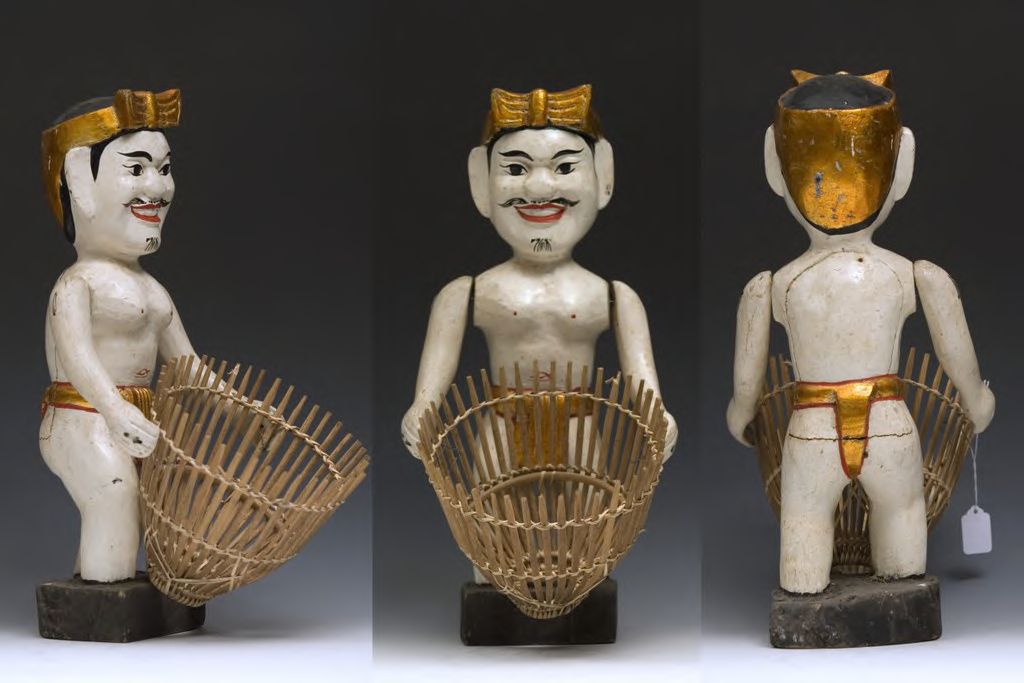
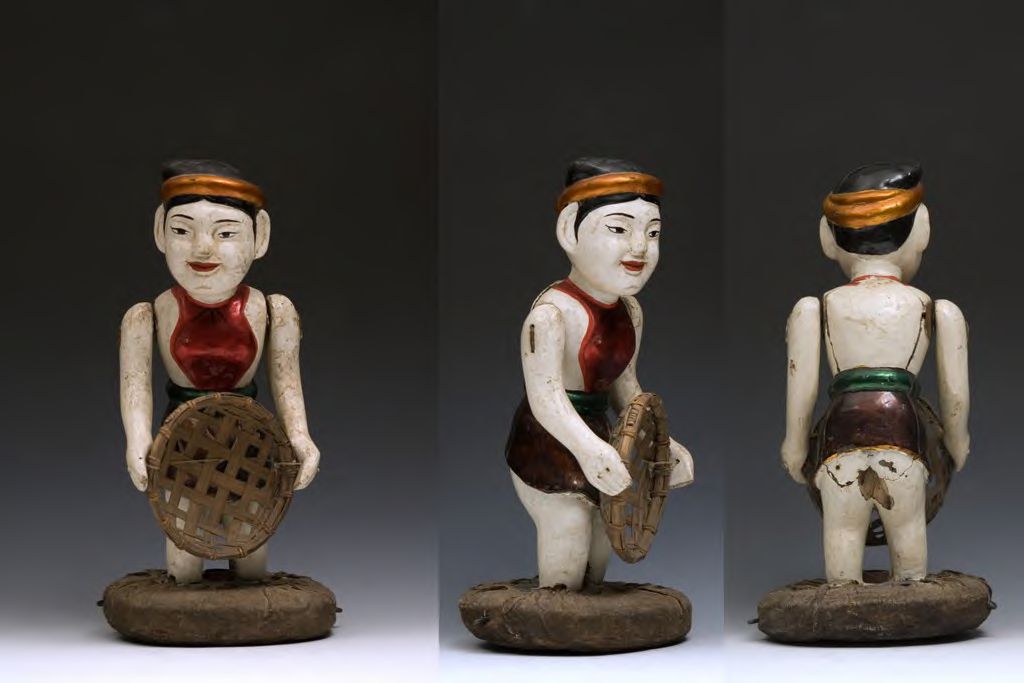
Each puppet is carved from fig wood (gỗ sung), which resists waterlogging and is light enough to be manoeuvred with precision. The figures are lacquered in bright colours and sealed against water damage. A puppet may weigh several kilograms and last for decades if maintained properly.
Control is achieved through a system of rods, strings and levers submerged beneath the surface. The exact mechanisms are closely guarded; individual troupes developed distinct technical solutions for particular movements such as fish swimming, dragons spitting fire and the iconic farmer ploughing with a buffalo. More complex figures require two or three puppeteers working in coordination.
Stories and characters
Traditional performances draw on a shared repertoire of short scenes rather than single long narratives. Common subjects include rice farming, fishing, duck herding, the legend of the restored sword (Sự tích Hồ Gươm) in which King Lê Lợi returns a magical blade to a golden tortoise, and the story of the Tứ linh — the four sacred animals of Vietnamese cosmology: the dragon, unicorn, tortoise and phoenix.
The character of Chú Tễu, a rotund, grinning peasant figure, appears in many programmes as a master of ceremonies and comic narrator. He is one of the most recognisable figures in Vietnamese folk performance and often interacts directly with the audience.
Scenes depicting daily agricultural life — sowing seed, catching fish, celebrating the harvest — reflect the art form's village origins and remain central to most programmes, sitting alongside mythological episodes.
Music and the live ensemble
Performances are accompanied by a live ensemble positioned on stage beside the pool, fully visible to the audience. The musicians play a repertoire drawn from northern Vietnamese folk and ceremonial traditions.
Instruments typically include the đàn bầu (monochord zither), đàn tranh (sixteen-string zither), trống (drums), mõ (wooden percussion block), sáo trúc (bamboo flute) and cymbals. Vocals may be delivered in the style of chèo, the northern folk opera tradition, with performers singing commentary or dialogue for the puppet characters.
The music cues the puppeteers as well as the audience; particular melodic phrases signal specific puppet actions. Timing between musicians and hidden operators is therefore a rehearsed and precise relationship rather than improvisation.
Theatres in Hanoi and Ho Chi Minh City
The Thăng Long Water Puppet Theatre on Đinh Tiên Hoàng Street, beside Hoàn Kiếm Lake in central Hanoi, is the most frequently visited venue. It stages multiple performances daily and presents a programme covering most of the canonical scenes. The setting beside the lake reinforces the historical association between the art form and open water.
The Vietnam Puppet Theatre (Nhà hát Múa rối Việt Nam), also in Hanoi, functions as the national company and stages both water puppetry and conventional rod-puppet performances.
In Ho Chi Minh City, the Golden Dragon Water Puppet Theatre on Nguyễn Thị Minh Khai Street stages regular evening performances aimed at a mixed local and international audience. Programmes there tend to be somewhat shorter than those in Hanoi.
Booking in advance is advisable for all three venues during peak travel periods, as seating capacity is limited by the pool-stage format.
Preservation and current status
UNESCO inscribed water puppetry on its list of Intangible Cultural Heritage in Need of Urgent Safeguarding in 2010, citing the loss of village-based transmission as the primary risk. The professional theatre companies in Hanoi and Ho Chi Minh City have sustained the form commercially, but some researchers argue that the village-festival context — in which the performance was embedded in communal ritual — has largely disappeared.
Training programmes at the Vietnam Puppet Theatre aim to recruit and develop new puppeteers, though the physical demands of sustained work in cold or murky water limit the pool of candidates. Technique varies between troupes, and some aspects of mechanism design remain deliberately unpublished.
Contemporary practitioners have experimented with new storylines, including scenes addressing environmental themes, while retaining the traditional music and puppet vocabulary. How far such extensions alter the form's character is a matter of ongoing discussion among performers and scholars.
Where it is
Also known as / see also
Referenciado por
Fuentes
- Vietnam National Authority of Tourism — VNAT consultado 29 August 2026
Supports: the rules and definitions on this page - Water puppetry — Wikipedia (CC BY-SA 4.0) consultado 31 August 2026
Supports: background - Múa rối nước — Wikipedia (Vietnamese) (CC BY-SA 4.0) consultado 31 August 2026
Supports: background, Vietnamese edition
Current Última verificación: 31 August 2026. Rules, fares and prices change — check the official source before acting on anything here. Report a mistake.
Picture credits (4)
Water puppetry (9693994184), 嘉銘 詹, CC BY-SA 2.0, Wikimedia Commons · Puppettheatre, user:She, Public domain, Wikimedia Commons · Water puppet holding Basket 0237 - DPLA - c525915740a1149a820fdb45af32b84c, File URL IIIF manifest Catalog record, Public domain, Wikimedia Commons · Water puppet holding basket 0238 - DPLA - 00cfc011af47cb2d721f832ba3b4b193, File URL IIIF manifest Catalog record, Public domain, Wikimedia Commons