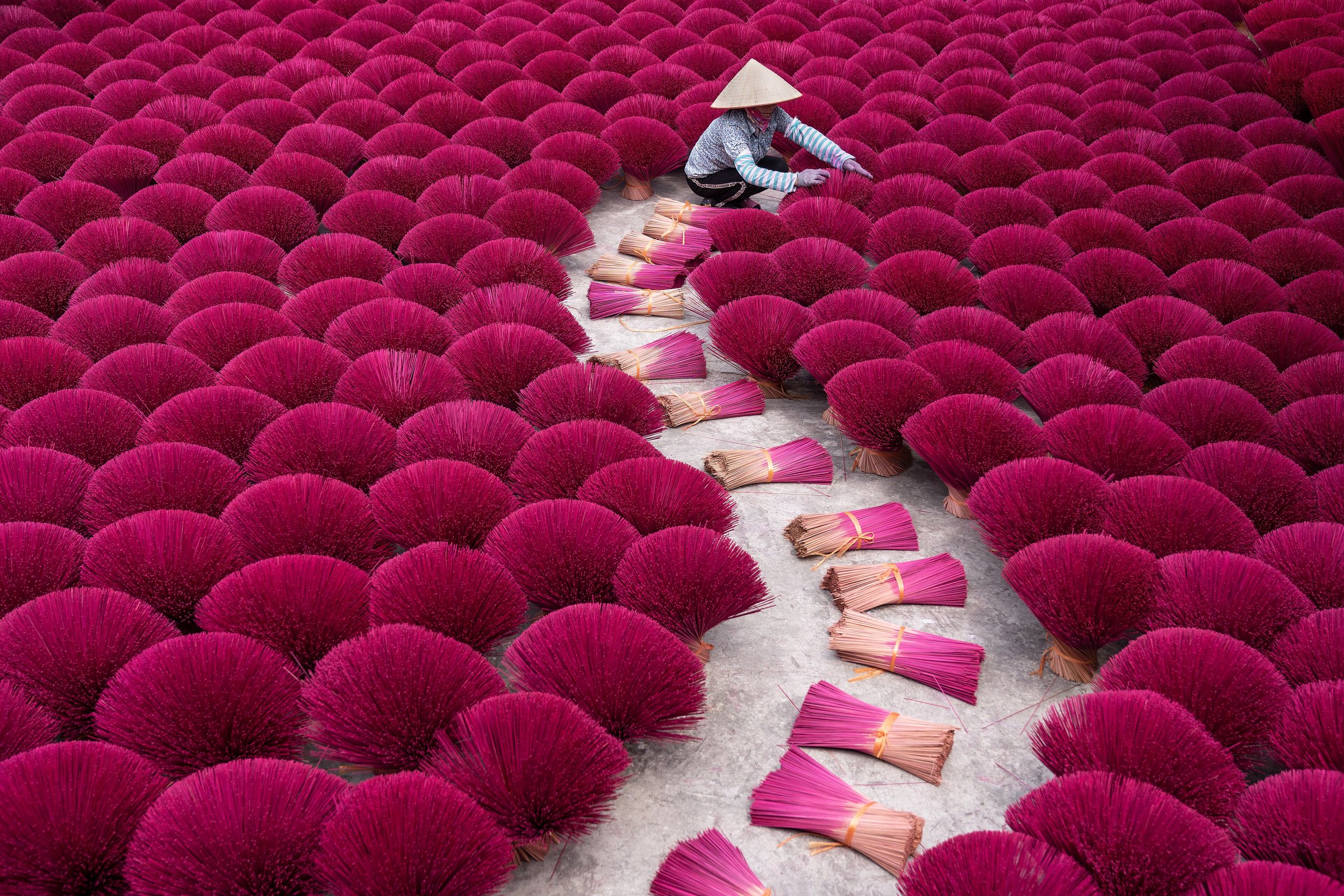
The Kinh (Viet) majorityNgười Kinh
Who are the Kinh?
The term Kinh (also written Người Kinh) is the official designation used by the Vietnamese state for the ethnic majority. Outside Vietnam the group is often called the Viet, a name that predates the current country name. The two terms refer to the same population and are used interchangeably in different contexts — Viet tends to appear in historical and linguistic writing, while Kinh is standard in contemporary administrative and demographic documents.
The Kinh constitute roughly 85 percent of Vietnam's total population. This large majority share means that Kinh language, law, and custom form the dominant framework of national public life, from the school curriculum to the legal system to media.
Language
The Vietnamese language (tiếng Việt) is the native tongue of the Kinh and the sole official language of the state. It belongs to the Austroasiatic language family, within the Mon-Khmer branch, though centuries of contact with Chinese produced an enormous stratum of Sino-Vietnamese vocabulary — estimates suggest that up to 60 percent of formal and literary vocabulary has Chinese-derived roots.
Vietnamese is a tonal language with six tones in the standard northern variety and five in most southern varieties. The modern writing system, chữ Quốc ngữ, uses a Latin alphabet with diacritical marks for tone and certain vowel distinctions. It was developed by Jesuit missionaries in the seventeenth century, refined over subsequent decades, and gradually displaced the older chữ Nôm script during the French colonial period. Chữ Quốc ngữ became the sole official script after 1945.
Regional accents differ substantially between the north (centred on Hanoi), the centre (Hue, Da Nang), and the south (Ho Chi Minh City), though mutual intelligibility is generally maintained.
Historical southward expansion
The historical homeland of the Viet people was the Red River Delta in what is now northern Vietnam. For roughly a millennium — from around 111 BCE to 938 CE — the region was under Chinese political control, a period that shaped Kinh institutions, writing, and governance models profoundly.
After regaining autonomy, successive Vietnamese dynasties pursued a long territorial expansion southward known in Vietnamese historiography as Nam tiến (southward advance). The process unfolded over several centuries. The Cham kingdom, which controlled the central coast, was progressively absorbed: the Cham capital Vijaya (near present-day Quy Nhon) fell in 1471 under the Le dynasty. By the seventeenth and eighteenth centuries, Kinh settlers and the Nguyen lords had extended effective control into the Mekong Delta, a region previously under Khmer influence.
This expansion was not uniform or always violent; it involved trade, intermarriage, and administrative incorporation alongside military conflict. Its legacy remains a point of scholarly discussion, particularly regarding the Cham and Khmer Krom communities whose territories were absorbed.
Settlement patterns
Kinh settlement has historically followed lowland and coastal environments suited to wet-rice agriculture. The Red River Delta in the north and the Mekong Delta in the south are the two most densely Kinh-populated regions. Between them, the narrow coastal plain running through the central provinces has supported Kinh communities in river valleys and fishing towns for centuries.
Upland and highland areas — the northern mountains, the Central Highlands (Tây Nguyên), and the western border zones — were historically inhabited by non-Kinh peoples and remain home to significant minority populations today. Kinh migration into highland areas accelerated during the twentieth century, driven by state-organised resettlement programmes from the 1960s onward and by voluntary economic migration. This has substantially changed the demographic composition of provinces such as those now forming the merged highland administrative units of the Central Highlands.
Today, Kinh communities are present in every part of the country, concentrated in cities, market towns, and lowland agricultural areas.
Relationship with the 53 recognised minority groups
Vietnam's state officially recognises 54 ethnic groups in total: the Kinh majority plus 53 minority nationalities (dân tộc thiểu số). These groups range in size from the Tay and Thai peoples, each numbering over a million, to very small communities of a few hundred. They speak languages from four distinct language families: Austroasiatic, Tai-Kadai, Sino-Tibetan, and Austronesian.
The constitutional and legal framework describes all 54 groups as equal. In practice, the Kinh language is the medium of state education, courts, and administration, which creates structural advantages for Kinh citizens and access barriers for those whose first language is not Vietnamese. Government programmes targeting minority areas have addressed infrastructure, healthcare, and schooling, though outcomes and the framing of those programmes are subjects of ongoing academic and policy debate.
Minority communities in the northern highlands — including the areas around Sapa and the Ha Giang region — and in the Central Highlands have distinct land-use traditions, customary legal systems, and cultural practices that sometimes intersect uneasily with national land law and development priorities. The relationship between majority and minority communities in Vietnam is not static; it is shaped by economic change, tourism, intermarriage, and evolving state policy.
Cultural and religious life
Kinh cultural identity is not monolithic. Regional differences in dialect, cuisine, and custom between north, centre, and south are significant and are acknowledged within Kinh society itself. Nevertheless, certain broadly shared features are widely noted by researchers.
Ancestor veneration is practised across most Kinh households regardless of formal religious affiliation. The ancestral altar (bàn thờ) is a standard feature of Kinh domestic space. Mahayana Buddhism, particularly as filtered through Chinese traditions, has deep historical roots, though the relationship between Buddhist practice and other folk religious elements — including the veneration of national heroes and tutelary spirits — is syncretic rather than doctrinally strict. Catholicism, introduced in the seventeenth century and significantly expanded during French colonial rule, is the professed religion of a substantial minority of Kinh, particularly in certain provinces of the north and south.
The lunar calendar structures key annual observances. Tết Nguyên Đán, the Lunar New Year, is the most significant, involving family reunion, ancestral rites, and a cluster of associated customs that vary locally. Other festivals tied to the agricultural cycle, local tutelary deities, and historical figures are observed at the commune and village level.
Where it is
Also known as / see also
Referenziert von
Quellen
- Vietnam National Authority of Tourism — VNAT abgerufen 29 August 2026
Supports: the rules and definitions on this page - Người Kinh (Trung Quốc) — Wikipedia (Vietnamese) (CC BY-SA 4.0) abgerufen 31 August 2026
Supports: background, Vietnamese edition
Current Zuletzt geprüft: 31 August 2026. Rules, fares and prices change — check the official source before acting on anything here. Report a mistake.
Picture credits (1)
Incense in Vietnam, Trantuanviet, CC BY-SA 4.0, Wikimedia Commons