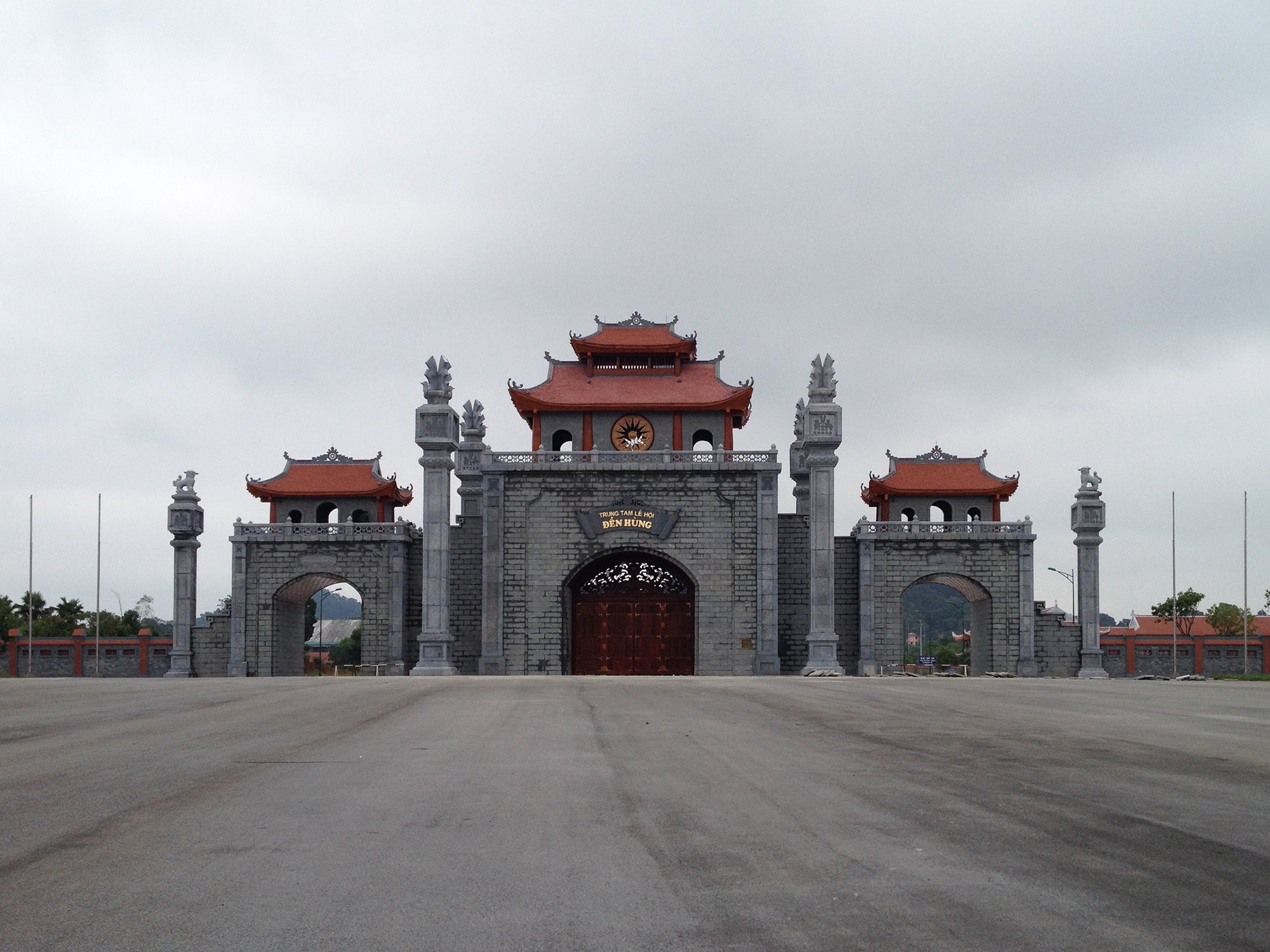
Hung Kings FestivalGiỗ Tổ Hùng Vương
Background and significance
The Hung Kings, known in Vietnamese as the Hùng Vương, are the legendary rulers credited with founding the Vietnamese nation under the name Văn Lang. Vietnamese tradition holds that there were eighteen successive Hung Kings, and the dynasty is placed by legend in the third millennium BCE, long before the historical record begins. The festival, formally called Giỗ Tổ Hùng Vương, is structured as an ancestral death commemoration — a giỗ — rather than a birthday celebration, reflecting the Confucian and folk-religious emphasis on honouring the dead. The phrase "Dù ai đi ngược về xuôi, nhớ ngày giỗ Tổ mồng Mười tháng Ba" — roughly, wherever you travel, remember the ancestor's death day on the tenth of the third month — is widely quoted as evidence of how deeply the observance is embedded in Vietnamese identity.
The Hung Temple site
The principal site of worship is Đền Hùng, a complex of temples spread across Nghĩa Lĩnh Hill in what is now Phu Tho province, formed in the 2025 administrative reorganisation from the former Phu Tho province. The hill rises to around 175 metres and holds several distinct temples arranged on ascending terraces. Hạ Temple (Lower Temple) sits near the base and is associated with the legend of Âu Cơ, the mythical mother of the Vietnamese people. Trung Temple (Middle Temple) was historically used for the Hung Kings to hold court. Thượng Temple (Upper Temple) at the summit is the main site of offerings and is where the principal ritual is performed during the festival. A further structure, Giếng Temple, is associated with two princesses of the Hung lineage. The complex is managed as a national historical and cultural site.
The national public holiday
Vietnam designated the tenth day of the third lunar month an official national public holiday in 2007, giving workers a paid day off. This made Giỗ Tổ Hùng Vương one of a small number of lunar-calendar dates recognised at the level of national legislation, alongside the Tết holiday period. The Gregorian-calendar date of the festival therefore shifts each year, typically falling in April. Government ceremonies at Đền Hùng are conducted at the national level, with senior state officials attending and presiding over formal rites. Separate, locally organised commemorations take place across the country, including in Ho Chi Minh City and Hanoi, reflecting the festival's function as a nationwide expression of shared ancestry.
Pilgrimage scale and logistics
The Đền Hùng site receives visitor numbers in the millions across the festival period, making it one of the largest annual pilgrimages in Southeast Asia by scale. Pilgrims travel from across Vietnam and from overseas Vietnamese communities. The approach roads to Nghĩa Lĩnh Hill become heavily congested in the days surrounding the tenth, and provincial authorities deploy significant resources to manage crowd flow and safety. Many pilgrims arrive on the ninth or eleventh to avoid the peak of the tenth itself. Offerings typically include bánh chưng (square sticky rice cake) and bánh dày (round sticky rice cake), both of which are linked by legend to the story of Lang Liêu, a Hung prince said to have created them. The ritual foods connect the act of pilgrimage directly to the founding mythology.
UNESCO recognition
In 2012, UNESCO inscribed the worship of Hung Kings in Phu Tho on the Representative List of the Intangible Cultural Heritage of Humanity. The inscription covers the practice of worship rather than the physical site, recognising the rituals, processions, folk performances, and community beliefs associated with the Hung Kings across Phu Tho and beyond. UNESCO's evaluation noted that the practice reinforces a sense of collective identity and continuity across generations of Vietnamese people. The inscription added international institutional recognition to a practice that Vietnamese authorities and communities had long treated as foundational to national culture. Phu Tho province also holds a separate UNESCO recognition for Xoan singing, a ritual musical form historically performed at Hung King temples.
Rituals and associated culture
The formal ceremony on the tenth follows a prescribed sequence involving the presentation of offerings, burning of incense, and the reading of ritual texts addressed to the Hung Kings. Both state and community versions of the ceremony follow this basic structure, though the national ceremony at Thượng Temple is the most elaborate. Processions, often featuring traditional costumes and ceremonial palanquins, form a visible part of the public events. Hát Xoan, the ritual singing genre indigenous to Phu Tho, is performed at temples in the area during the festival period. Folk games including wrestling, human chess, and boat racing are associated with the wider festival in the surrounding area. The combination of solemn ancestor rites and festive communal activity is characteristic of major Vietnamese lễ hội (festival-rites).
Where it is
Also known as / see also
참조 페이지
출처 목록
- Vietnam National Authority of Tourism — VNAT 접근됨 29 August 2026
Supports: the rules and definitions on this page - Hùng Kings' Festival — Wikipedia (CC BY-SA 4.0) 접근됨 31 August 2026
Supports: background - Giỗ Tổ Hùng Vương — Wikipedia (Vietnamese) (CC BY-SA 4.0) 접근됨 31 August 2026
Supports: background, Vietnamese edition
Current 마지막 확인: 31 August 2026. Rules, fares and prices change — check the official source before acting on anything here. Report a mistake.
Picture credits (1)
Trung tâm lễ hội đền Hùng 18-09-2015 1, Hoài Hương, CC BY-SA 4.0, Wikimedia Commons