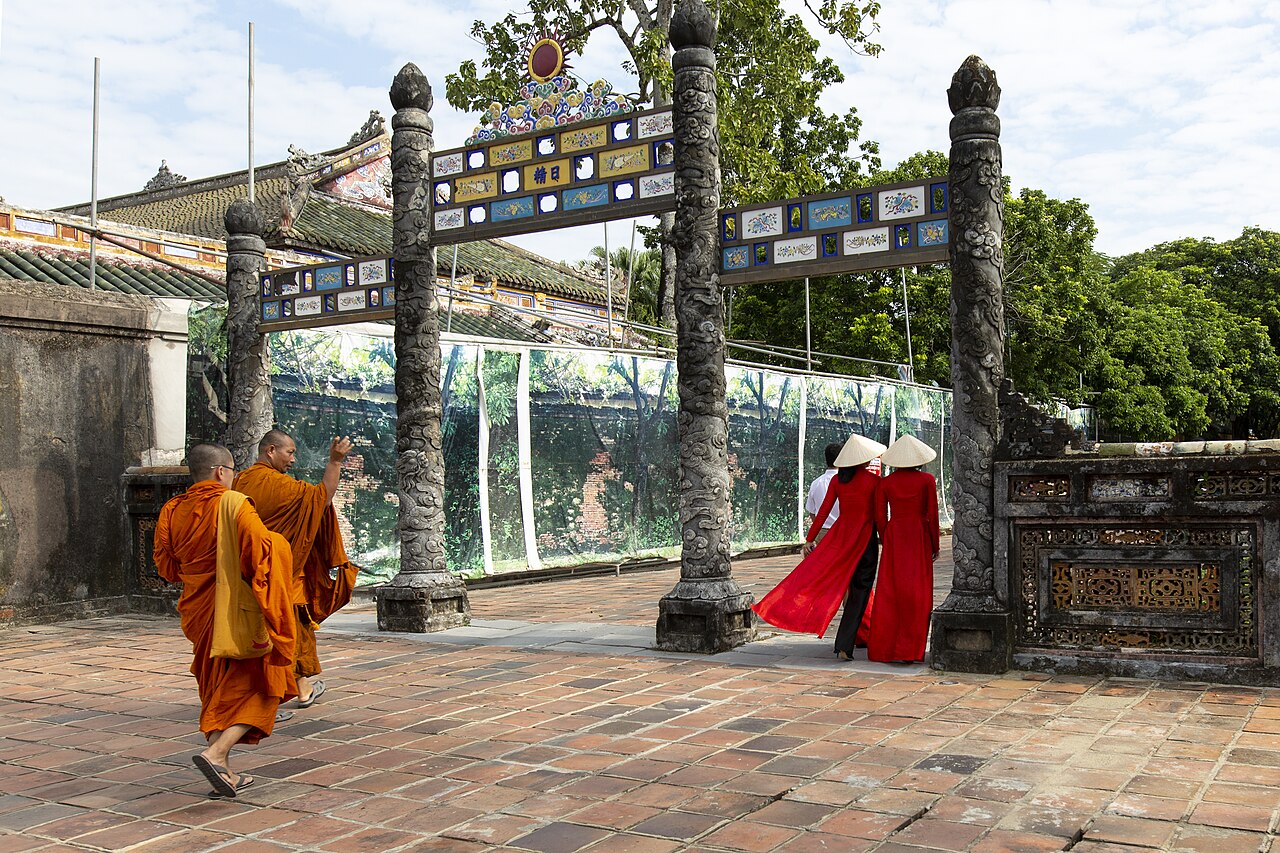
The ao daiÁo dài

Origins and evolution
The áo dài's form has shifted considerably over the centuries. Its earliest antecedents are the overlapping-front robes introduced under the Nguyễn lords in the eighteenth century, when the southern court at Huế sought to distinguish its subjects from those of the northern Trịnh lords. The garment was later codified under Emperor Minh Mạng in the 1830s as part of a broader standardisation of dress.
The silhouette recognised today — a long, close-fitted tunic with a mandarin collar, split to the hip on both sides, worn over wide-leg trousers — emerged principally in the 1930s. The designer Nguyễn Cát Tường, working in Hanoi and writing under the pen name Lemur, adapted European tailoring techniques to create a more form-following cut, sparking both enthusiasm and considerable public controversy. Subsequent decades brought further changes: shorter or longer hems, wider or narrower sleeves, and in the 1960s the áo dài miniature, a shortened and more fitted southern variant associated with Saigon fashion circles. Since the 1990s the garment has undergone a broad revival, with designers experimenting with printed fabrics, embroidery and asymmetric collars while retaining the essential two-panel structure.

When and where the áo dài is worn today
The áo dài occupies a formal but not rarified position in contemporary Vietnamese life. Its most visible everyday context is secondary education: female students at many state schools across the country wear white áo dài as a school uniform, typically on Mondays and during national observances. The sight of students cycling in white áo dài is closely associated with cities such as Huế, where the practice remains particularly consistent.
In professional settings, female staff at government offices, banks, national carriers and upmarket hotels are frequently required to wear the áo dài as a workplace uniform. Vietnam Airlines cabin crew wear a well-known version in a deep gold-and-purple palette. During Tết (the Lunar New Year), wearing an áo dài — often in red, peach or yellow — is common across generations, and the garment appears widely at engagement ceremonies, weddings and the formal receptions that follow. It is also worn at death anniversaries and some temple occasions, though dress codes vary by region and family practice.

The male áo dài
The male version of the garment, less frequently seen in daily life, follows the same basic structure — a long tunic split at the hip, worn over trousers — but is cut with a straighter, less fitted silhouette. Fabrics tend towards heavier silk or brocade in dark blue, black, deep red or ivory. Male áo dài appear most often at weddings (worn by the groom and sometimes male family members), at formal Tết gatherings, and during the ritual ceremonies of certain religious and cultural organisations.
Academic and civic ceremonies occasionally call for the male áo dài, and there has been renewed interest among younger Vietnamese men in wearing the garment at Tết as a conscious act of cultural affiliation. It is paired with a traditional flat turban-style headpiece called the khăn đóng in the most formal contexts, particularly in central Vietnam where Nguyễn-era court dress traditions are observed at heritage events in Huế.
Having an áo dài tailored
Hội An is the most established destination for having an áo dài made. The old town contains numerous tailoring workshops accustomed to working with visitors; turnaround times and the degree to which a tailor will discuss fit, fabric weight and collar height vary considerably between shops. Silk and silk-blend fabrics are widely available, and many tailors display sample panels of embroidered or printed cloth. A fitting session is standard practice, and garments made from measurements alone — without a fitting — carry a higher risk of poor result.
Hanoi also has a strong tailoring tradition, particularly around Hàng Gai street in the Old Quarter, where fabric merchants and áo dài workshops are concentrated. Ho Chi Minh City has tailors scattered across several districts, with Bình Thạnh and District 3 both having established reputations. In all cities, the quality of finish, choice of fabric and time allowed for alterations are the main variables affecting the final garment. Allowing more than one day for the process is advisable where possible.
Wearing an áo dài as a visitor
There is no prohibition on visitors wearing an áo dài, and doing so at a wedding invitation, a Tết gathering or a cultural festival is generally received positively by Vietnamese hosts. Having one tailored locally rather than purchasing a mass-produced version is widely regarded as the more considered choice. At formal events — particularly weddings and family ceremonies — it is worth asking the host whether wearing one is appropriate, as some families have preferences about who wears the garment and in what colours.
White is associated with mourning in Vietnamese custom, so wearing a white áo dài to a wedding or celebratory event would be unusual. Red, pink, peach and other warm tones are conventional for festive occasions. Pairing the tunic with the correct wide-leg trousers, rather than substituting other clothing, is the standard expectation. The garment is not considered appropriate for beach visits, markets or other informal settings where it would be conspicuously out of place.
The áo dài in contemporary culture
The garment occupies a notable position in Vietnamese design and fashion discourse. The annual Áo Dài Festival held in Ho Chi Minh City has, since 2014, provided a regular platform for both established designers and emerging makers to present new interpretations. Hanoi hosts related events around Tết and national holidays. Designers including Võ Việt Chung and Minh Hạnh have been prominent in internationalising the garment through runway presentations and diplomatic-occasion commissions.
Vietnam has submitted the áo dài for consideration as a UNESCO Intangible Cultural Heritage element, though as of mid-2025 this process remains ongoing and the outcome is not yet determined. Debate within Vietnam about the garment — including questions of which version is most authentically Vietnamese, how schools should implement uniform requirements, and how foreign adaptations should be received — continues across media and social platforms, reflecting the áo dài's status as a genuinely contested cultural symbol rather than a settled monument.
Where it is
Also known as / see also
Citato da
Fonti
- Vietnam National Authority of Tourism — VNAT consultato 29 August 2026
Supports: the rules and definitions on this page - Áo dài — Wikipedia (CC BY-SA 4.0) consultato 31 August 2026
Supports: background - Áo dài — Wikipedia (Vietnamese) (CC BY-SA 4.0) consultato 31 August 2026
Supports: background, Vietnamese edition
Current Ultima verifica: 31 August 2026. Rules, fares and prices change — check the official source before acting on anything here. Report a mistake.
Picture credits (4)
VN - bonzes et áo dài, PA, CC BY-SA 4.0, Wikimedia Commons · Áo dài - 34652751163, Akasumoto, CC BY 2.0, Wikimedia Commons · Áo dài - 35076059550, Akasumoto, CC BY 2.0, Wikimedia Commons · Áo dài trắng 2015-01-26, ÁO DÀI SÀI GÒN www.facebook.com/aodaisaigon.info/, CC BY 2.0, Wikimedia Commons