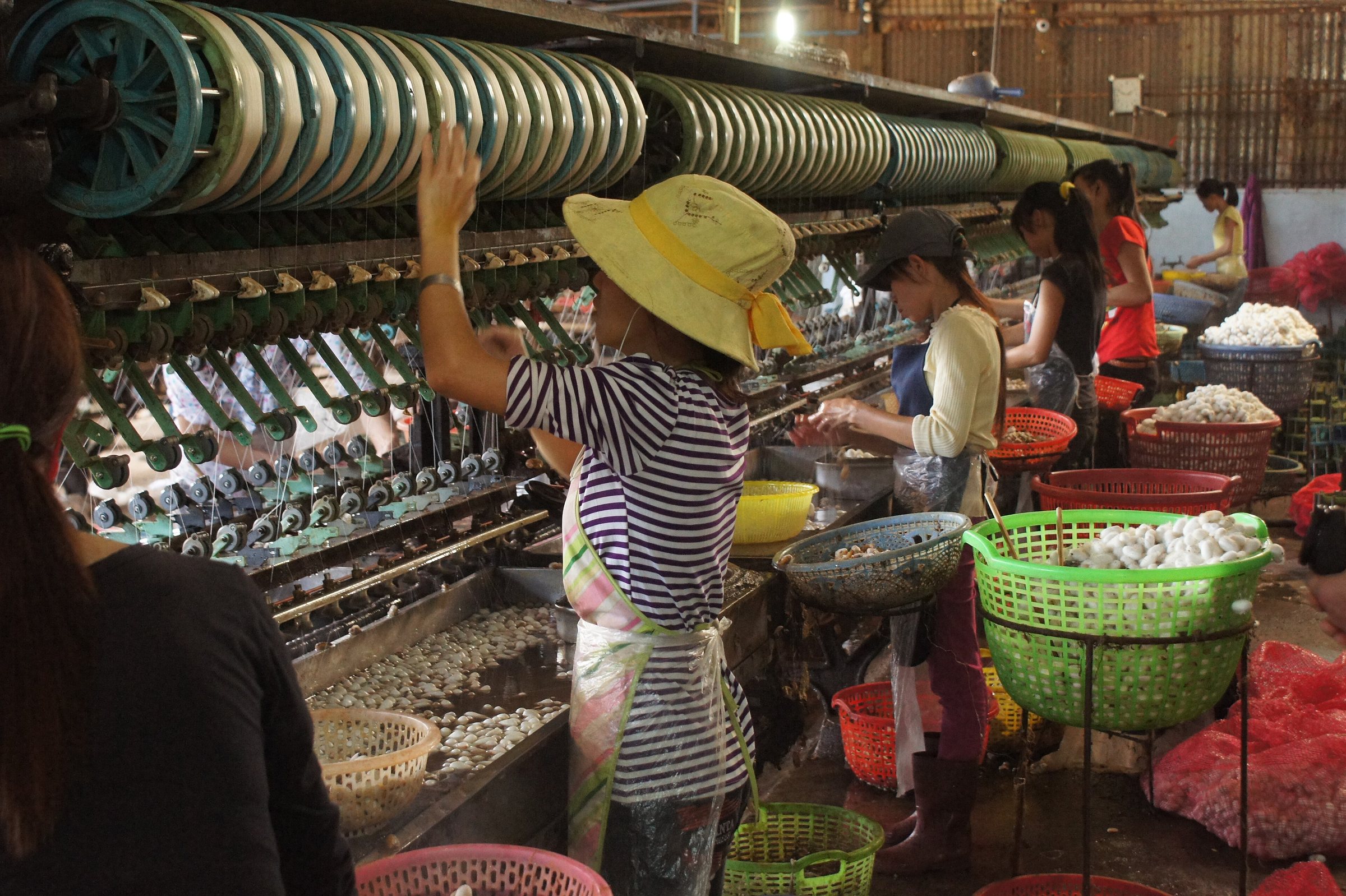
Textiles, garments and footwearDệt may và da giày
Scale and export position
Textiles, garments and footwear together form one of Vietnam's two or three largest export categories by value, consistently generating well over US$40 billion in combined annual export revenue in the early 2020s, though the figure fluctuates with global demand cycles. Vietnam competes with Bangladesh, China, India and Cambodia for orders, and its share of the global apparel export market places it consistently in the top three or four suppliers to the United States and the European Union.
The United States is the single largest destination for Vietnamese garments, absorbing roughly half of garment exports in recent years. The EU, Japan and South Korea are also significant markets. Trade agreements — notably the EU–Vietnam Free Trade Agreement (EVFTA, in force since August 2020) and the Comprehensive and Progressive Agreement for Trans-Pacific Partnership (CPTPP) — have shaped sourcing decisions, though the EVFTA's yarn-forward rules of origin remain a structural challenge for fabric-importing manufacturers.
Geographic clustering
Production is heavily concentrated in the south. Ho Chi Minh City itself hosts garment finishing, trading houses and design functions, while the bulk of cut-make-trim (CMT) manufacturing sits in the surrounding industrial zones. Following Vietnam's provincial consolidation on 1 July 2025, the areas formerly administered as Binh Duong province and parts of Dong Nai province are now incorporated into an expanded Ho Chi Minh City administrative unit, meaning that a large share of the country's textile and footwear factory floor space falls within a single provincial boundary.
Long An and Tay Ninh (now merged into broader southern provinces) carry overflow capacity. In the north, Hanoi and the Red River Delta industrial corridor — particularly the areas around Nam Dinh and Thai Binh — have a longer historical association with state-owned textile mills, several of which have been partially equitised. Footwear production for export is especially dense in the south, with major global sportswear suppliers operating large assembly campuses there.
Labour force and wage dynamics
The sector employs an estimated two to three million workers directly, with several million more in upstream and downstream roles. The workforce is predominantly female, particularly on sewing lines. Workers typically migrate from rural provinces in the north and central regions to factory towns in the south, creating a pattern of seasonal labour mobility around Tết.
Vietnam's minimum wage is set regionally in four zones, with Zone 1 (covering the core of Ho Chi Minh City) at the highest level. Minimum wages have risen steadily over the past decade, compressing margins for low-complexity CMT work. This has pushed some brands to compare Vietnam unfavourably with Bangladesh on pure labour cost, while others argue that Vietnam's productivity, infrastructure reliability and political stability justify the premium. Strikes, while legally constrained, occur periodically in industrial zones and are most common in garment and footwear facilities; they tend to cluster around wage negotiation periods and post-Tết returns.
Moving up the value chain
Much of Vietnam's garment industry has historically operated on a CMT or FOB (free on board) basis, meaning factories receive cut fabric or source fabric locally and assemble to specification, with design, branding and retail margin captured elsewhere. The strategic ambition of the Vietnam Textile and Apparel Association (VITAS) and of larger domestic groups such as Vinatex is to shift toward ODM (original design manufacturing) and OBM (original brand manufacturing), capturing more value per unit.
Progress has been uneven. Domestic fabric production remains insufficient for most export orders, so yarn-forward rules in trade agreements are difficult to satisfy without importing from China — which can defeat the tariff preference. Several large foreign-invested groups, including Taiwanese and South Korean conglomerates, have built integrated spinning-weaving-dyeing-finishing-assembly campuses in Vietnam, partly to satisfy these rules. Leather and synthetic-upper footwear is somewhat further along: Vietnam-based factories for brands such as Nike and Adidas handle more complex technical assembly than a decade ago.
Compliance, traceability and due diligence
Buyer requirements have intensified significantly since roughly 2020. European and American brands now routinely require first- and second-tier suppliers in Vietnam to demonstrate compliance with social auditing frameworks (BSCI, SEDEX/SMETA, SA8000), environmental standards and, increasingly, chemical restriction lists aligned with REACH or ZDHC (Zero Discharge of Hazardous Chemicals).
The EU's Corporate Sustainability Due Diligence Directive (CS3D) and equivalent national legislation in Germany (Lieferkettensorgfaltspflichtengesetz, in force since 2023) require larger European companies to map and audit their supply chains into Vietnam at factory and sub-contractor level. Physical traceability — knowing which spinning mill produced the yarn in a finished garment — is now a procurement question, not merely an ethical aspiration. QR-code and blockchain-based traceability pilots have been run by several brands sourcing from Vietnamese factories, though widespread adoption remains in progress. Factories unable to document their supply chain are increasingly at risk of losing orders from compliance-conscious buyers, regardless of price competitiveness.
Operating environment for foreign buyers and investors
Foreign brands typically engage Vietnamese factories either directly or through buying agents based in Ho Chi Minh City. Factory audit infrastructure — third-party social and technical auditors — is well established in the city. Industrial zones offer land lease, utilities and customs facilitation, though zone quality and logistics connectivity vary; zones with direct access to Cat Lai port or the road network toward Cai Mep-Thi Vai deep-water terminals command higher demand.
Foreign direct investment in textile and footwear manufacturing is permitted and common, with wholly foreign-owned factories the norm for major brands' strategic suppliers. Intellectual property protection for design and technical specifications remains a concern that buyers and licensors raise, though it is not specific to this sector. Currency risk is managed against the Vietnamese dong, which the State Bank manages within a crawling band; depreciation risk for dong-invoiced transactions is a factor in longer-term contracts.
Where it is
Also known as / see also
참조 페이지
출처 목록
- Ministry of Industry and Trade — MOIT 접근됨 3 September 2026
Supports: the rules and definitions on this page
This server cannot reach the domain; the link was not confirmed from here. - Vietnam country data — World Bank 접근됨 31 August 2026
Supports: the rules and definitions on this page
This server cannot reach the domain; the link was not confirmed from here.
Current 마지막 확인: 31 August 2026. Rules, fares and prices change — check the official source before acting on anything here. Report a mistake.
Picture credits (1)
Vie12-292 Seidenfabrik, Lusi Lindwurm, CC BY-SA 4.0, Wikimedia Commons