Setting up a companyThành lập công ty
Common structures for foreign investors
Most foreign investors in Vietnam choose one of three vehicles. A limited liability company (LLC) — called a công ty TNHH — is the most common for wholly foreign-owned or joint-venture operations. It can have one member or multiple members, and liability is capped at contributed capital. A joint-stock company (công ty cổ phần) issues shares and is required if the business later intends to list on a stock exchange. A representative office is not a separate legal entity and cannot conduct direct revenue-generating activity; it is used for market research, liaison and promotion. A branch is permitted in certain sectors — notably banking, insurance and law — but is not available to all industries. The appropriate structure depends on the sector, the scale of investment and the investor's long-term intentions, and these factors should be assessed with a licensed legal adviser before any application is submitted.
Licensing steps and realistic timelines
Establishing a wholly foreign-owned enterprise in Vietnam typically involves at least two sequential approvals.
- Investment Registration Certificate (IRC): Issued by the provincial Department of Planning and Investment (DPI) or, for projects in industrial zones, by the zone authority. The application requires details of the investor, the proposed business lines (expressed as Vietnamese Standard Industrial Classification codes), the investment location and the charter capital amount.
- Enterprise Registration Certificate (ERC): Issued after the IRC, this formally establishes the legal entity. It records the company name, registered address, legal representative and capital structure.
For projects that exceed capital thresholds or operate in sensitive sectors, a separate in-principle approval from a provincial People's Committee or the National Assembly may be required before the IRC stage, adding significant time. Once certificates are in hand, the company must engrave a company seal, register for tax, open a capital account, and complete sector-specific sub-licences where required (for example, in food safety, education or healthcare). In straightforward cases the IRC and ERC combined can take four to eight weeks; complex or large projects can take many months.
Capital requirements
Vietnam does not impose a universal minimum charter capital for most industries, but several sectors carry statutory minimums set by their governing legislation — real estate trading, banking, insurance, securities and certain financial services among them. For other sectors, investors must declare a capital figure that is sufficient and appropriate for the stated business activities; the DPI can query a figure it considers unrealistically low. Charter capital must be contributed within a defined period after the ERC is issued, and failure to contribute on time can lead to penalties or licence revocation. Capital brought in from abroad must pass through a dedicated direct investment capital account held at a licensed bank in Vietnam, and inward transfers must be documented carefully to allow later repatriation of profits and principal. There is no general restriction on repatriating profits, provided the company has fulfilled its tax obligations and the financial statements have been audited.
Sectors with foreign-ownership limits
Vietnam maintains a Negative List approach under its Law on Investment: most sectors are open to foreign investment unless specifically restricted, conditioned or prohibited. Restricted sectors include telecommunications, aviation, banking, media and publishing, real estate brokerage, and several areas of education. In these fields, foreign ownership is capped — commonly at 49% or 51% — and the company must have a Vietnamese partner holding the balance. Some sectors are closed to foreign capital entirely, including certain activities related to national defence and specified cultural heritage services. Vietnam's bilateral and multilateral trade commitments — including those under the EU–Vietnam Free Trade Agreement and CPTPP — have progressively opened some previously restricted sectors, but the schedules are detailed and change over time. Investors should verify current commitments against the specific sub-sector and business activity code before proceeding.
Nominee arrangements and the risks they carry
Because certain sectors cap or prohibit direct foreign ownership, some investors have historically used nominee arrangements — placing shares or assets formally in the name of a Vietnamese national while retaining beneficial control through side agreements. Vietnamese law does not recognise the concept of beneficial ownership in the way common-law jurisdictions do, and such arrangements carry serious risks. The nominee shareholder has full legal title to the shares; if they die, face creditors, or simply refuse to act as agreed, the foreign investor has limited enforceable recourse. Authorities have become increasingly alert to nominee structures, and companies found to be operating in restricted sectors without proper approvals can face fines, forced restructuring or cancellation of their licences. The consensus among Vietnam-based legal practitioners is that nominee arrangements should be avoided and that investment should be structured within the bounds of the law, even if this requires a genuine Vietnamese joint-venture partner.
Ongoing compliance obligations
Once operating, a foreign-invested enterprise faces several recurring obligations.
- Tax registration and filing: Corporate income tax, value-added tax, and personal income tax withholding must be filed on a regular cycle with the General Department of Taxation.
- Annual audited financial statements: All foreign-invested enterprises are required to have their financial statements audited by an authorised audit firm and submitted to the relevant authorities.
- Labour and social insurance: Employees must be registered for social, health and unemployment insurance, and payroll obligations apply to both Vietnamese and expatriate staff, though the rules differ.
- Licence renewals and amendments: Changes to charter capital, business lines, legal representative or registered address require amendments to the IRC and/or ERC. Sector-specific sub-licences may carry their own renewal schedules.
- Foreign contractor tax: Payments to foreign vendors may trigger withholding obligations.
Regulations in these areas are amended frequently; working with a local accounting firm is the standard practice for staying current.
A note on professional advice
This page is an orientation, not guidance. The legal framework governing foreign investment in Vietnam — principally the Law on Investment and the Law on Enterprises, together with their implementing decrees — is detailed, frequently amended, and interpreted inconsistently across provinces. What applies to a technology services company in Ho Chi Minh City may differ from what applies to an agro-processing facility in a rural province or a hospitality project in Da Nang. Sector regulators, the tax authority, customs and the central bank each have their own requirements. Before taking any steps — including choosing a structure, committing to a location or signing a memorandum of understanding with a Vietnamese partner — investors should engage a law firm licensed to practise Vietnamese law and an accounting firm familiar with foreign-invested enterprises. The cost of proper advice at the outset is consistently lower than the cost of correcting structural problems after incorporation.
Where it is
Also known as / see also
参照元
出典
- Vietnam Customs — General Department of Vietnam Customs アクセス日 3 September 2026
Supports: the rules and definitions on this page - Vietnam country data — World Bank アクセス日 31 August 2026
Supports: the rules and definitions on this page
This server cannot reach the domain; the link was not confirmed from here.
Current 最終確認: 31 August 2026. Rules, fares and prices change — check the official source before acting on anything here. Report a mistake.
Picture credits (1)
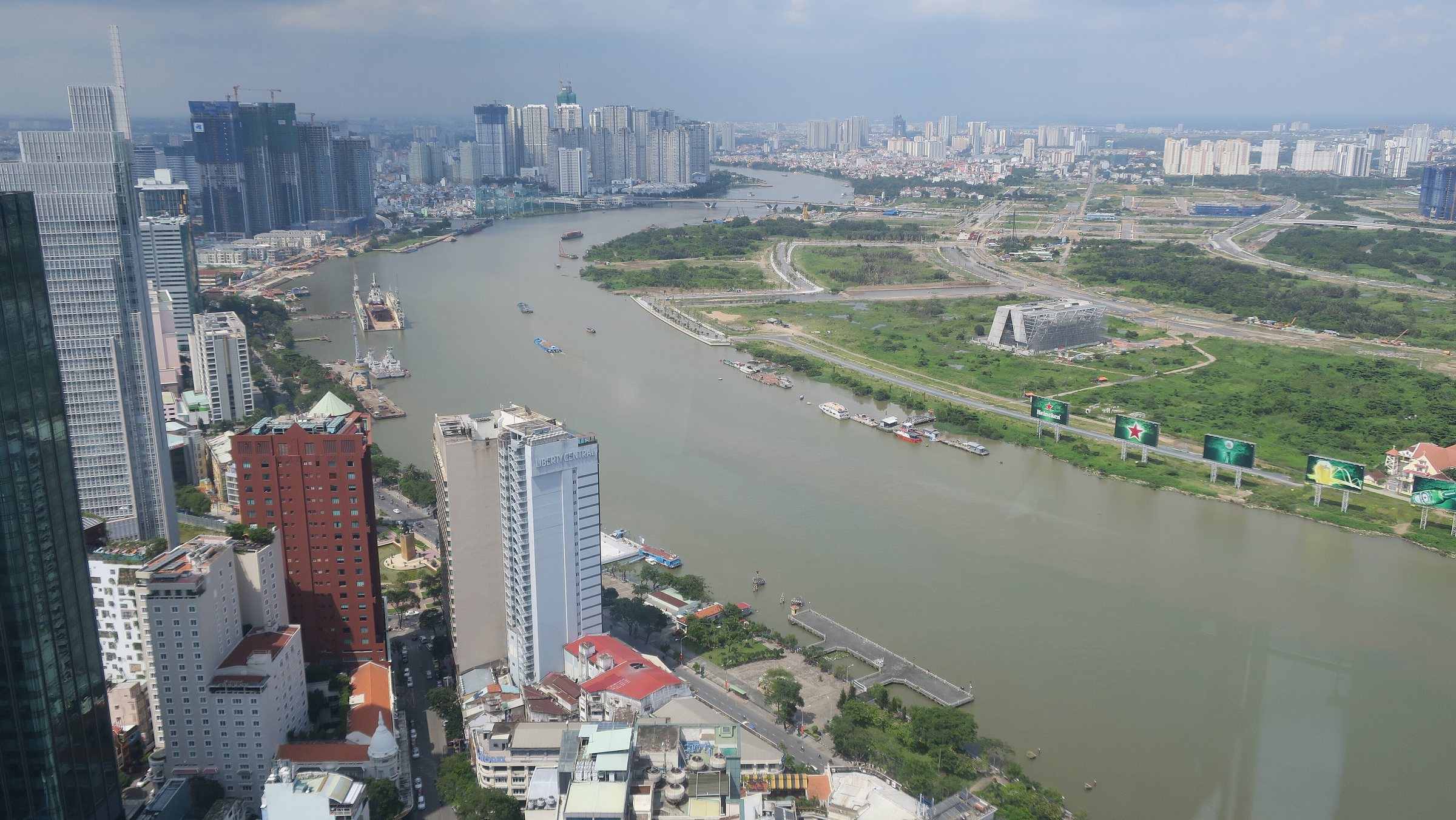
Saigon River and Thu Thiem in 2017, Terrazzo, CC BY 2.0, Wikimedia Commons