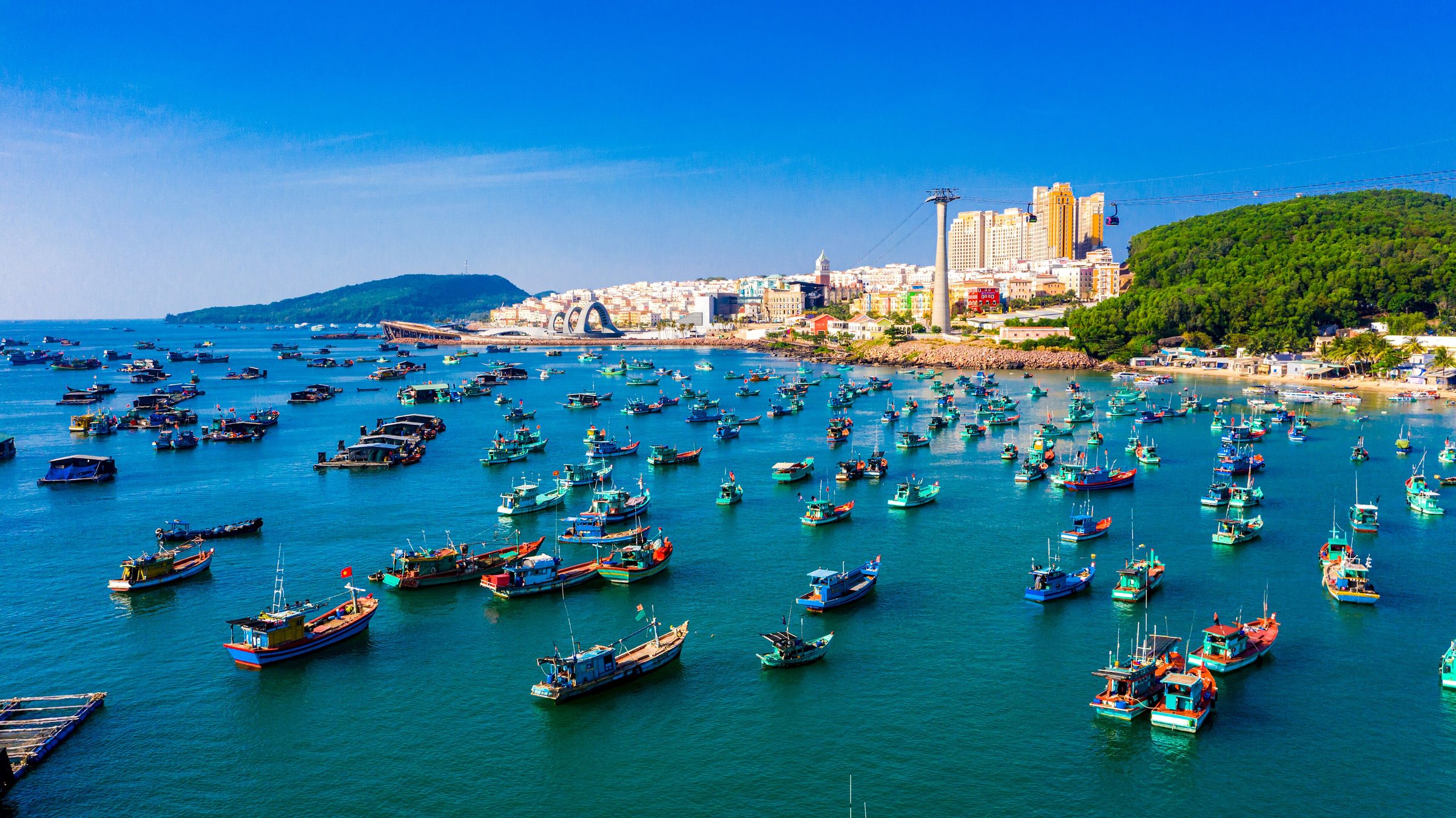
Seafood and aquacultureThủy sản
Scale and structure of the industry
Vietnam consistently ranks among the top five seafood-exporting nations by value. The industry divides broadly into two streams: capture fisheries, operating from coastal and offshore fleets, and aquaculture, which now accounts for the majority of export tonnage. The Vietnam Association of Seafood Exporters and Producers (VASEP) represents the processing and export sector and publishes periodic trade data, though figures shift substantially with exchange rates, feed costs and importing-country tariffs.
Processing is concentrated in purpose-built plants, many of which hold multiple international certifications. Vertically integrated companies control breeding, grow-out ponds, slaughter, filleting and cold-chain logistics under one ownership structure, which simplifies traceability audits but also concentrates market risk.
Pangasius: the delta's signature export
Pangasius hypophthalmus, known in trade as pangasius, basa or swai depending on the market, is a freshwater catfish farmed in floating cages and earthen ponds along the Mekong River and its distributaries. Đồng Tháp and An Giang provinces are the historical heartland of pangasius production, with additional volume from Cần Thơ and Vĩnh Long.
The fish grow rapidly on formulated pellet feed and reach harvest weight in six to eight months. White fillets are the primary export format, frozen and packed for retail or food-service use. The EU and the United States are the two most scrutinised destination markets: both have imposed import duties or inspection surcharges at various points, and the regulatory situation with each changes periodically. Exporters and buyers should verify current tariff schedules directly with customs authorities rather than relying on historical rates.
Shrimp: the higher-value crop
Farmed shrimp, principally whiteleg shrimp (Litopenaeus vannamei) and to a lesser extent black tiger shrimp (Penaeus monodon), represent the highest-value segment of Vietnamese seafood exports. Production is concentrated in the coastal provinces of the lower Mekong Delta — notably Cà Mau, Bạc Liêu and Sóc Trăng — where brackish water conditions suit intensive pond culture.
Farming systems range from super-intensive indoor tanks with artificial aeration to extensive mangrove-integrated ponds, the latter carrying a premium in certification markets. Disease, particularly Early Mortality Syndrome (EMS/AHPND) caused by Vibrio parahaemolyticus, has repeatedly affected yields since the early 2010s and remains a structural risk. Antibiotic residue checks by Japan, the EU and South Korea have led to shipment rejections in past years; exporters maintain testing logs and export health certificates issued by the National Agro-Forestry-Fisheries Quality Assurance Department (NAFIQPM).
Principal export markets and their inspection regimes
The United States, the European Union, Japan, South Korea and China collectively absorb the bulk of Vietnamese seafood exports, though their relative shares shift year to year. Each applies distinct inspection frameworks:
- United States: The FDA operates an import alert system; catfish specifically is regulated under USDA inspection rules following the 2008 Farm Bill provisions, meaning pangasius must meet equivalency standards with US catfish inspection. Anti-dumping duties on frozen warmwater shrimp have been applied intermittently and are subject to annual administrative reviews.
- European Union: Competent authority checks are handled by member-state border inspection posts. Vietnam is listed as an approved third country for fishery products, but the yellow-card issue (see below) adds additional scrutiny to wild-caught products.
- Japan: The Ministry of Health, Labour and Welfare sets MRL (maximum residue limit) standards that are in several cases stricter than Codex Alimentarius norms. Enrofloxacin, an antibiotic, is subject to a zero-tolerance rule.
- China: A significant and growing market, but one where informal trade through border gates has historically complicated traceability; formal export channels require Chinese customs registration of Vietnamese processing plants.
The EU yellow card on illegal, unreported and unregulated fishing
In October 2017 the European Commission issued Vietnam a yellow card under its IUU (Illegal, Unreported and Unregulated) fishing regulation. The card does not ban imports outright but triggers enhanced documentary checks on all fishery products of Vietnamese origin entering the EU, increasing the administrative burden for importers and adding the risk of escalation to a red card — which would constitute a trade ban on wild-caught products.
The card reflects concerns about vessel monitoring systems, port-state controls, flag-state responsibilities and the traceability of catch certificates. Vietnam has enacted legislative reforms through amendments to its Law on Fisheries (2017) and subsequent decrees, and has engaged with EC inspectors in periodic review missions. As of the time of writing the yellow card remains in place; the situation is actively evolving and companies sourcing wild-caught Vietnamese seafood for EU sale should monitor Commission communications directly. Aquaculture products such as farmed pangasius and farmed shrimp are not directly implicated by the IUU card, though reputational spillover is a noted commercial concern.
Sustainability certification
Several third-party certification schemes operate across Vietnamese aquaculture and capture fisheries, each with different market recognition:
- ASC (Aquaculture Stewardship Council): The most widely recognised standard in European retail for farmed shrimp and pangasius. Certification requires audits against criteria covering water use, chemical inputs, social conditions and biodiversity impacts.
- BAP (Best Aquaculture Practices): Operated by the Global Seafood Alliance, BAP certification is common among suppliers to US food-service buyers.
- MSC (Marine Stewardship Council): Applicable to capture fisheries. Vietnamese fisheries certified or in assessment under MSC are limited in number; the IUU card complicates progress toward certification for some fisheries.
- GlobalG.A.P. and organic schemes: Present in niche segments, particularly mangrove-integrated shrimp targeting premium European and Japanese retail.
Certification does not guarantee market access and does not substitute for compliance with importing-country food safety law, but it is increasingly a baseline expectation for major retail buyers in Europe and North America.
Operational considerations for buyers and investors
Companies sourcing Vietnamese seafood or considering investment in processing capacity should be aware of several structural characteristics. Land and water rights for pond aquaculture in the Mekong Delta are governed by leasehold arrangements whose terms and renewal conditions have changed over successive land law revisions. Feed cost volatility — soy and fishmeal inputs are largely imported — directly affects farm-gate margins and can shift rapidly with global commodity markets.
The administrative reorganisation of July 2025, which merged Vietnam's 63 provinces into 34 and removed the district tier, affects the jurisdictions responsible for issuing aquaculture licences, environmental impact assessments and export health certificates. Buyers relying on supplier documentation should confirm that certificates reference the current provincial authority rather than a now-abolished administrative unit. Processing plant registrations held with foreign competent authorities (EU, FDA) are tied to plant addresses and do not automatically lapse, but any address change arising from administrative boundary revision may require notification to the relevant authority.
Where it is
Also known as / see also
Referenciado por
Fontes
- Thủy sản — Wikipedia (Vietnamese) (CC BY-SA 4.0) truy cập 31 August 2026
Supports: background, Vietnamese edition - Vietnam country data — World Bank truy cập 31 August 2026
Supports: the rules and definitions on this page
This server cannot reach the domain; the link was not confirmed from here.
Current Última verificação: 31 August 2026. Rules, fares and prices change — check the official source before acting on anything here. Report a mistake.
Picture credits (1)
An Thoi fishing harbour Sunset Town Sun World Phu Quoc Vietnam, Vivu Vietnam, CC BY-SA 4.0, Wikimedia Commons