Ports, logistics and infrastructureCảng biển và logistics
Deep-water container ports
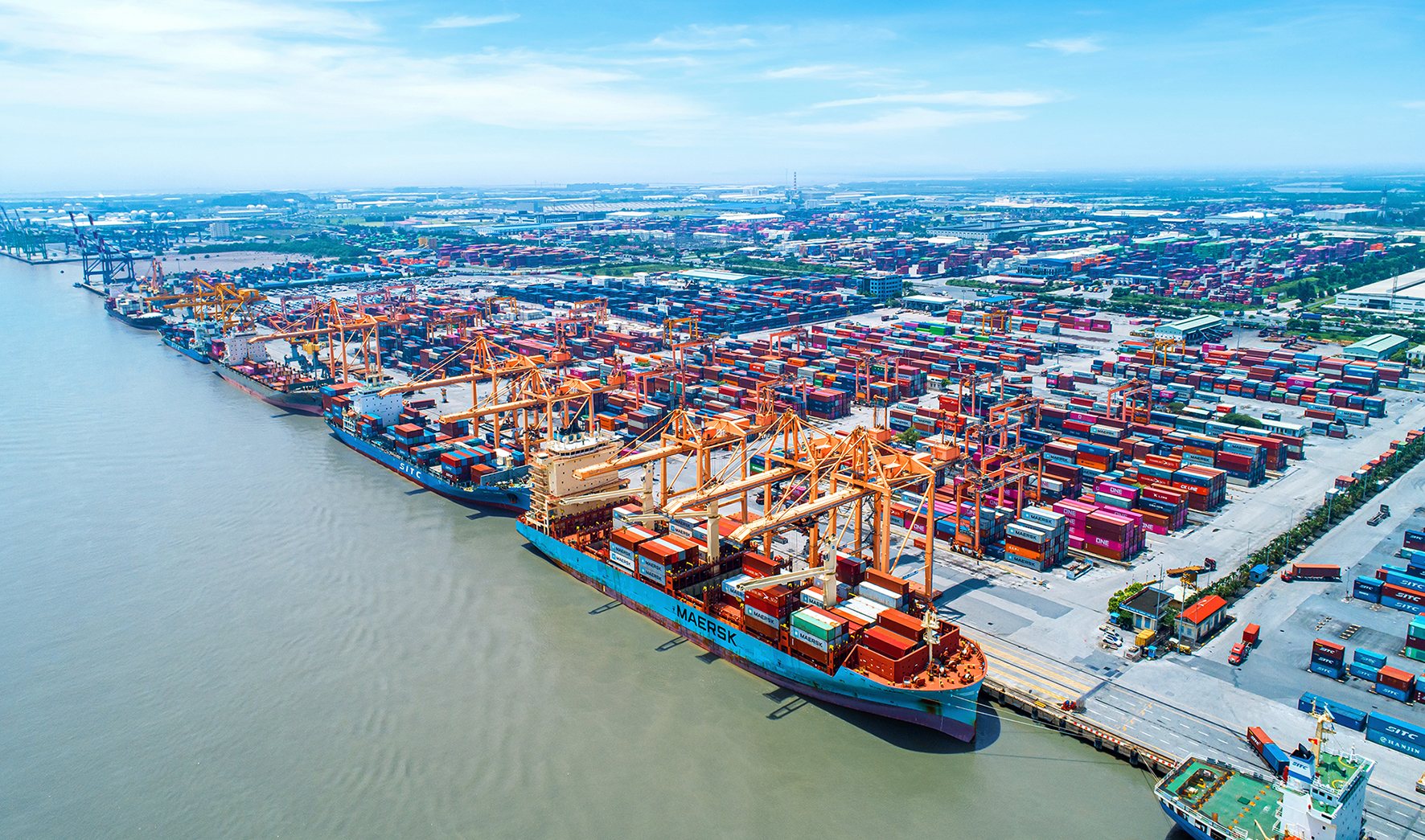
The two port complexes that handle the bulk of Vietnam's international container traffic are Cai Mep-Thi Vai in the south and Lach Huyen in the north.
Cai Mep-Thi Vai, located in Ba Ria-Vung Tau province south of Ho Chi Minh City, is Vietnam's only port cluster currently capable of receiving ultra-large container vessels (ULCVs) on direct transoceanic services to North America and Europe without transhipment through Singapore or Port Klang. Multiple terminals operate within the complex, including those jointly developed with international terminal operators such as PSA and AP Møller-Mærsk. Utilisation rates have historically been uneven, with some berths underused while others face congestion, partly a function of feeder connectivity from smaller southern ports.
Lach Huyen, the deepwater extension of Hai Phong port, opened its first phase in 2018 and is designed to serve the manufacturing-heavy north, including the dense cluster of electronics and component factories in Hanoi's surrounding provinces. It can accommodate vessels that the older inner-harbour Hai Phong terminals cannot.
North–south road and rail corridors
Vietnam's primary overland freight artery is National Highway 1 (Quốc lộ 1), which runs approximately 2,300 kilometres from the Chinese border at Lang Son down to Ca Mau at the southern tip of the Mekong Delta. Road freight dominates domestic goods movement, but Highway 1 passes through many town centres, creating bottlenecks that raise transit times and costs.
The North–South Expressway project is progressively extending a controlled-access motorway along the same corridor. Sections have opened incrementally since the early 2010s; completion of the full route remains a multi-year infrastructure commitment. Where finished, expressway segments significantly cut heavy-vehicle journey times compared with Highway 1.
The Reunification Railway (Đường sắt Thống Nhất) covers the same corridor on metre-gauge track. It carries passengers and some freight, but the single-track metre-gauge system imposes severe capacity limits and slow speeds. A separate high-speed rail project linking Hanoi and Ho Chi Minh City has been approved in principle, though construction timelines and financing remain subjects of ongoing political and technical discussion. Freight is not the primary design purpose of the high-speed line.
Air cargo and the Long Thanh project
Air freight is disproportionately important to Vietnam relative to its overall trade volume, because the country exports high-value, time-sensitive goods — notably smartphones, semiconductors and electronics components — that justify airfreight costs. Samsung, Intel and other major manufacturers ship significant volumes by air from facilities near Hanoi and Ho Chi Minh City.
Noi Bai International Airport (Hanoi) and Tan Son Nhat International Airport (Ho Chi Minh City) handle the majority of cargo. Tan Son Nhat is widely regarded as operating close to or beyond its practical capacity for both passengers and freight, constrained by its urban location and the limited possibility of adding runway infrastructure.
Long Thanh International Airport, under construction in Dong Nai province (now part of the broader Ho Chi Minh City metropolitan region following the 2025 provincial merger), is the flagship response to this capacity problem. The first phase targets completion in the late 2020s and is designed with dedicated cargo infrastructure from the outset. The project has faced repeated schedule revisions, land clearance complications and debate over phasing and financing, so published timelines should be treated with caution.
The logistics-cost problem
Logistics costs as a share of GDP have consistently been estimated to be higher in Vietnam than in regional peers such as Thailand or Malaysia, though the precise figures are contested and methodologies vary between studies. The structural causes are broadly agreed upon: an overdependence on road freight, an underdeveloped warehousing and cold-chain sector, fragmented trucking operators, administrative procedures at ports and borders, and infrastructure bottlenecks that force circuitous routing.
The World Bank and various Vietnamese government bodies have identified logistics efficiency as a binding constraint on export competitiveness and on the ability of domestic producers to integrate into global supply chains. Reform efforts have focused on reducing port dwell times, digitising customs documentation through the National Single Window system, and encouraging consolidation among small freight operators. Progress is acknowledged but incremental.
Cold-chain logistics deserves specific mention: Vietnam's agricultural export sector — fruit, seafood, vegetables — loses a meaningful proportion of perishable produce to spoilage during transit, a problem that has attracted both domestic and foreign investment in refrigerated warehousing, particularly around the Mekong Delta and the central highlands.
Border trade with China
Vietnam shares a land border of roughly 1,300 kilometres with China, and border trade is a substantial and structurally significant part of the bilateral economic relationship. The main formal crossings for goods traffic are Mong Cai (Quang Ninh province, connecting to Dongxing), Lang Son (connecting to Pingxiang, with the Huu Nghi/Youyi Guan gate), and Lao Cai (connecting to Hekou in Yunnan).
Lang Son handles particularly high volumes of agricultural produce moving northward — Vietnamese fruit and vegetables, most notably — and manufactured inputs moving southward. The crossing has been subject to periodic and sometimes severe congestion, often linked to Chinese customs procedures, phytosanitary inspections, or policy changes on the Chinese side that Vietnam's exporters cannot easily anticipate. Bottlenecks in 2021–2022 left thousands of trucks queued for days, accelerating discussions about reducing dependence on fresh-produce trucking in favour of rail or greater use of sea routes.
Rail freight between the two countries uses the metre-gauge line through Lao Cai and a separate line through Lang Son, but cross-border rail capacity is limited by gauge differences within China's own network and by customs procedures. Expanding rail's share of China-bound freight is a stated policy goal but faces both technical and diplomatic coordination challenges.
Inland waterways and the Mekong Delta
Vietnam's inland waterway network is most developed in the Mekong Delta, where a dense grid of canals and rivers has historically been the primary mode of moving rice, seafood and other agricultural goods to Ho Chi Minh City and onward to ports. Waterway transport is slow but cheap and handles bulk commodities well.
The delta's geography also presents a road infrastructure challenge: building and maintaining bridges and roads over the numerous waterways is expensive, and several key river crossings have only been bridged in recent decades. The Can Tho Bridge, completed in 2010, was significant in connecting the delta's largest city to the national highway network without reliance on ferry crossings.
For northern Vietnam, the Red River system offers some waterway capacity, though it is less developed for commercial freight than the southern network. Investment in improving river port facilities and integrating waterway routes with road and rail is part of longer-term infrastructure planning, but waterways remain an underdeveloped component of the national logistics system outside the Mekong Delta.
Where it is
Also known as / see also
مُشار إليه من
المصادر
- Vietnam Customs — General Department of Vietnam Customs تم الوصول إليه 3 September 2026
Supports: the rules and definitions on this page - Vietnam country data — World Bank تم الوصول إليه 31 August 2026
Supports: the rules and definitions on this page
This server cannot reach the domain; the link was not confirmed from here.
Current آخر تحقق: 31 August 2026. Rules, fares and prices change — check the official source before acting on anything here. Report a mistake.
Picture credits (1)
CANG TAN VU, TUNMCHP, CC0, Wikimedia Commons