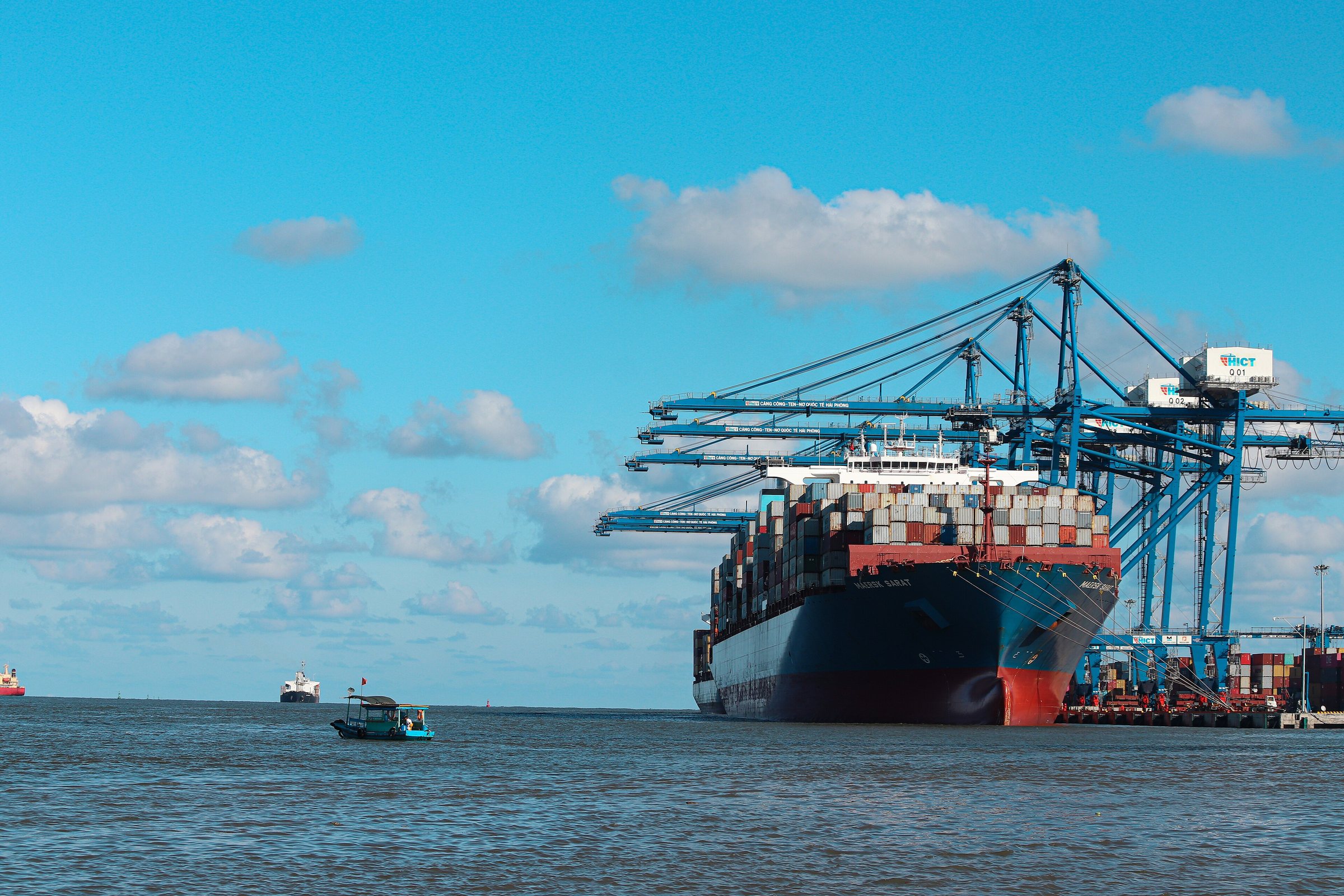
Exports, imports and trade agreementsXuất nhập khẩu
The export basket
Vietnam's export economy is dominated by electronics and electrical equipment, a category that grew sharply after Samsung established large-scale manufacturing in Bắc Ninh and Thái Nguyên provinces from around 2009 onwards. By the early 2020s, electronics and phones alone accounted for roughly a third of total merchandise exports by value, though the precise share shifts with global demand cycles.
Garments, footwear and textiles form the second major pillar, supplied by factories concentrated in the Red River Delta, the South-East region around Hồ Chí Minh City, and the central coastal provinces. Seafood — principally shrimp, pangasius catfish and tuna — is a significant third category, with processing clusters in the Mekong Delta provinces of Cà Mau, Bạc Liêu and An Giang. Wooden furniture, machinery parts and rubber round out the upper tier of the export list.
The United States, the European Union, China and South Korea are consistently Vietnam's four largest export destinations, though their relative ranking shifts year to year. Japan and ASEAN member states absorb a smaller but stable share.
Import dependence on components
Vietnam's export success rests on a significant structural dependency: the country imports a large proportion of the components, raw materials and machinery that its factories process or assemble before re-exporting. This makes the trade balance more complex than headline surplus figures suggest.
China is the dominant source of imports, supplying fabric, electronic components, industrial machinery and chemical inputs. South Korea is the second-largest import partner, driven largely by intra-company flows within Samsung and LG supply chains. This means that a portion of what appears as Vietnamese export value was created in Chinese or Korean factories upstream.
Critics and trade analysts have noted that this limits the domestic value-added content of Vietnam's exports and leaves manufacturing vulnerable to supply-chain disruptions — a pattern made visible during the 2020–2021 period of pandemic-related logistics stress. Developing deeper domestic supplier capacity is a stated policy priority, though progress has been uneven across sectors.
Trade agreements in force
Vietnam is party to several significant multilateral and bilateral trade agreements that affect tariffs, rules of origin and market access.
- CPTPP (Comprehensive and Progressive Agreement for Trans-Pacific Partnership) — Vietnam ratified this agreement in 2018. It links eleven Pacific-rim economies including Canada, Australia, Japan and Mexico. For Vietnamese exporters, the key benefit is preferential tariff access to markets such as Canada and Mexico that had no prior bilateral deal with Vietnam. Rules of origin requirements — specifying how much of a product must originate within member countries — are a significant compliance consideration, particularly for garments.
- EVFTA (EU–Vietnam Free Trade Agreement) — entered into force in August 2020. It eliminates or reduces tariffs on the great majority of goods traded between Vietnam and the 27-member European Union over a staged schedule running to roughly a decade. The agreement also contains provisions on intellectual property, procurement and labour standards, the latter linked to ILO convention commitments.
- RCEP (Regional Comprehensive Economic Partnership) — entered into force for Vietnam in January 2022. This is the world's largest free-trade area by participating GDP, covering ASEAN members plus China, Japan, South Korea, Australia and New Zealand. For Vietnam, RCEP consolidates and in some cases extends existing ASEAN-based agreements, and its rules of origin are generally less restrictive than those in CPTPP.
Vietnam also maintains bilateral agreements with Japan, South Korea, the Eurasian Economic Union and Chile, among others.
The United States trade relationship and tariff exposure
The United States has been Vietnam's largest single export destination for most years since the 2000s, absorbing electronics, garments, footwear and furniture in large volumes. This relationship generates a substantial bilateral trade surplus in Vietnam's favour — one of the largest the United States runs with any individual country — and that imbalance has drawn repeated attention from American trade authorities.
As of 2025, there is no comprehensive bilateral free-trade agreement between Vietnam and the United States; trade proceeds largely under normal WTO terms. The United States has at various points initiated investigations under Section 301 of the US Trade Act and reviewed whether Vietnamese currency practices constitute an unfair trade subsidy, though outcomes of these reviews have varied.
The broader exposure is structural: because such a large share of Vietnamese exports flow to a single partner that views the surplus as a political issue, any shift in US trade policy — whether tariff increases, import restrictions or currency-related measures — carries outsized consequences for Vietnamese manufacturers. This risk became more concrete during the 2018–2019 US–China trade dispute, which simultaneously diverted some Chinese manufacturing to Vietnam and increased scrutiny of Vietnamese export origins.
Rules of origin and compliance considerations
Rules of origin are among the most practically important and frequently misunderstood aspects of Vietnam's trade agreements. A product does not automatically benefit from preferential tariffs simply because it is shipped from Vietnam; it must meet specific criteria proving sufficient transformation or local content occurred within the qualifying territory.
For garments under CPTPP, the standard rule requires yarn-forward origin — meaning yarn, fabric and finished garment must all be produced within CPTPP member countries. This is demanding for Vietnamese manufacturers who source fabric heavily from China, which is not a CPTPP member. Some exceptions and short-supply provisions exist, but navigating them requires careful documentation.
Under EVFTA, garment rules are fabric-forward, which is somewhat less restrictive but still requires that fabric be sourced from Vietnam or the EU. Electronics rules differ again and are typically defined by a change in tariff heading or a regional value-content threshold.
Mis-declared origin — where goods are transshipped through Vietnam without genuine transformation to access preferential tariffs — has been identified by both US and EU authorities as a concern. Vietnamese customs authorities have increased scrutiny of origin certification in response to international pressure, particularly on goods in categories where Chinese producers face high external tariffs.
Current direction and contested questions
Several aspects of Vietnam's trade position remain genuinely contested or in active development as of mid-2025.
- The degree to which Vietnam benefits from, versus merely facilitates, US–China trade diversion is debated among economists. Some research suggests genuine manufacturing relocation; other analysis points to thin transformation adding limited domestic value.
- Negotiations toward a US–Vietnam bilateral trade agreement have been discussed at various points but no agreement is in force, and the timeline and likelihood of one remain uncertain.
- Vietnam's accession to the CPTPP created expectations among some domestic industries of significant market-opening from the UK, which joined the agreement in 2023 under the name CPTPP (UK accession), adding a further export destination.
- Compliance with EVFTA's labour-standard provisions — particularly ILO conventions on freedom of association — is monitored by the European Parliament and has been a point of ongoing dialogue between Hanoi and Brussels.
Trade policy in Vietnam is administered primarily by the Ministry of Industry and Trade (MOIT), with the Ministry of Finance overseeing tariff schedules and the General Department of Vietnam Customs handling origin certification and enforcement.
Where it is
Also known as / see also
مُشار إليه من
المصادر
- Xuất nhập khẩu — Wikipedia (Vietnamese) (CC BY-SA 4.0) تم الوصول إليه 31 August 2026
Supports: background, Vietnamese edition - Vietnam country data — World Bank تم الوصول إليه 31 August 2026
Supports: the rules and definitions on this page
This server cannot reach the domain; the link was not confirmed from here.
Current آخر تحقق: 31 August 2026. Rules, fares and prices change — check the official source before acting on anything here. Report a mistake.
Picture credits (1)
Container Ship at the Hai Phong International Container Terminal 01, Nathan.cima, CC BY-SA 4.0, Wikimedia Commons