Energy and power supplyNăng lượng
Generation mix
Vietnam's electricity system has historically rested on three pillars: large hydropower stations in the northern and central highlands, coal-fired thermal plants concentrated in the north-east (notably the Quang Ninh and Hai Duong clusters) and the south, and gas-fired combined-cycle plants drawing on offshore fields in the south-east. As recently as 2015, coal and hydro together accounted for the overwhelming majority of installed capacity. By the early 2020s that picture had changed substantially: Vietnam added more solar capacity in 2019–2020 than almost any country in the world over a comparable window, driven by a feed-in tariff programme that expired and was then suspended, leaving the regulatory framework unsettled. Wind, both onshore and offshore, followed a similar incentive-driven surge. The result is a generation mix that is now more diverse but also more complex to manage, with a large share of variable renewables sitting alongside ageing baseload plant.
The coal-to-renewables transition
Vietnam committed at COP26 in 2021 to phasing out unabated coal power by 2040, a pledge embedded in the Just Energy Transition Partnership (JETP) signed with a group of donor nations in December 2022. The partnership involves substantial financing commitments, though the precise disbursement mechanisms and conditionalities remain under negotiation and the timeline is contested among Vietnamese policymakers, who must balance decarbonisation goals against energy security and industrial competitiveness.
In practice, several coal projects that were already under construction or in advanced planning continued to proceed after the COP26 pledge, reflecting the long lead times and sunk costs involved. New coal permitting has, however, slowed markedly. The transition places a corresponding burden on the speed at which gas infrastructure — including LNG import terminals at Thi Vai and Son My — can be brought online to provide dispatchable backup for variable renewables.
Solar and wind build-out
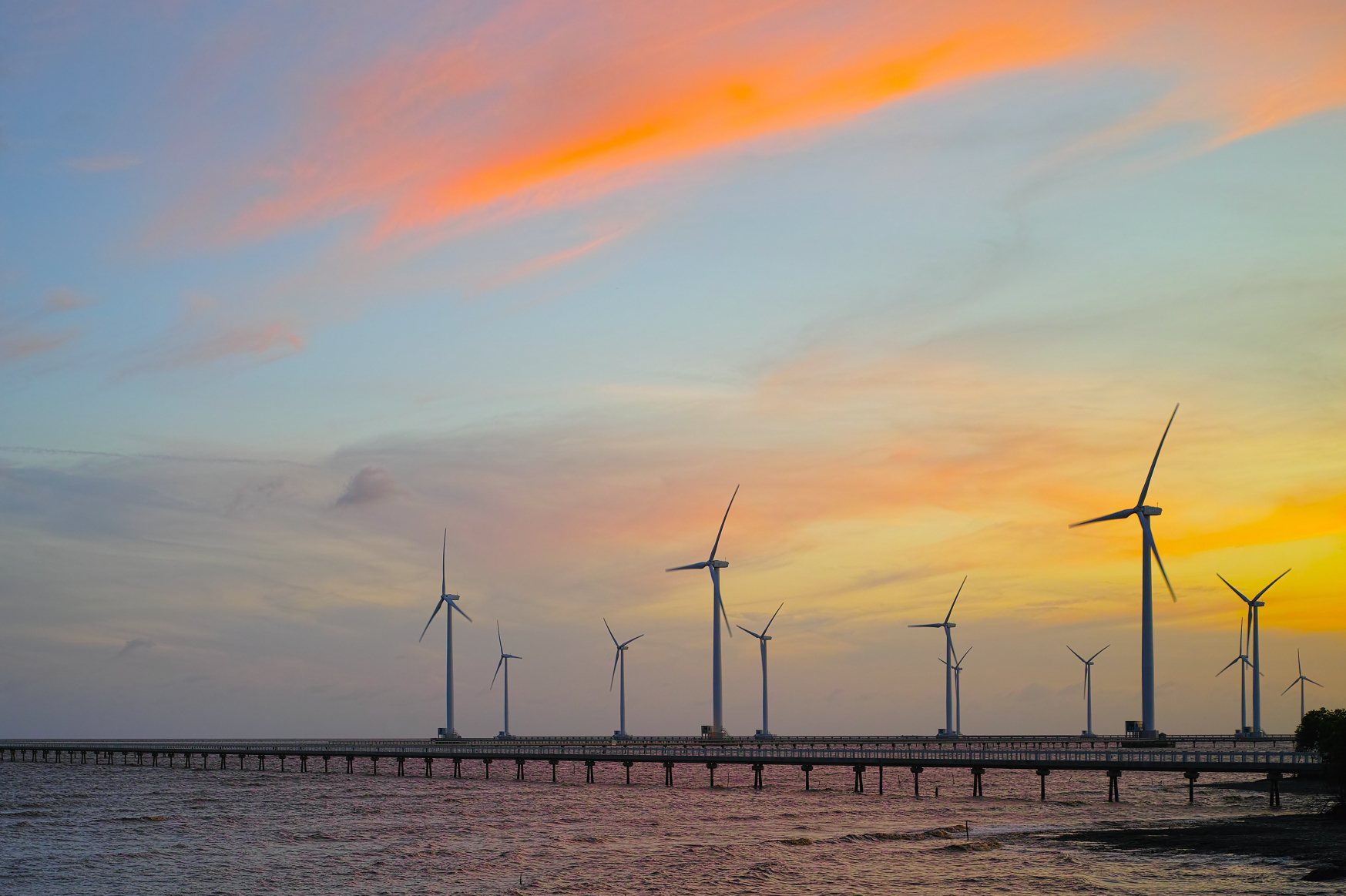
Feed-in tariffs introduced in 2017 for solar and extended through subsequent decisions triggered a rapid build-out concentrated in the south-central coastal provinces — Ninh Thuan and Binh Thuan in particular — where solar irradiance and wind resources are strongest. Installed solar capacity grew from negligible levels to over 16 GW by the early 2020s. Onshore wind expanded significantly in the same period, with Gia Lai, Dak Lak, Ninh Thuan and the Mekong Delta provinces among the main locations.
Offshore wind remains at an early stage. The southern and south-central coastline, along with parts of the Gulf of Tonkin, have been identified in planning documents as priority zones, but permitting, grid connection rules and the absence of a clear auction framework have delayed commercial development. Several international developers — including European utilities — have signed memoranda of understanding but projects have not yet reached financial close as of mid-2025.
- Solar concentration risk: the clustering of capacity in Ninh Thuan and Binh Thuan has caused curtailment when local transmission cannot absorb output.
- Auction transition: Vietnam has been moving away from administratively set feed-in tariffs towards competitive auctions, but successive delays have left a pipeline gap.
Grid constraints and curtailment
The speed of renewable installation outpaced grid investment, producing a structural mismatch between where power is generated and where it is consumed. The 500 kV north–south backbone transmission line — Vietnam's primary inter-regional link — carries power from the resource-rich centre and south towards the industrial north, but its capacity is limited and losses over long distances are significant. Efforts to build a second 500 kV circuit and to expand 220 kV regional networks have been underway, though procurement and right-of-way processes have repeatedly extended timescales.
In the south-central solar belt, curtailment of renewable output has at times been substantial, reducing returns for project developers and complicating bankability calculations for new investment. EVN (Électricité du Viêt Nam), the state utility that operates the national grid, publishes curtailment data but the figures are subject to varying interpretations by developers and government officials. Transmission investment is identified as a binding constraint in successive iterations of the national power development plan.
Northern supply shortfalls
The northern grid — centred on Hanoi and the surrounding industrial provinces that host a large share of Vietnam's electronics and textile manufacturing — has experienced recurring supply shortfalls during summer peaks, most acutely in 2023 when a combination of low reservoir levels after below-average rainfall, constrained coal supply and insufficient north-bound transmission capacity led to rotating power cuts. Industrial parks in Bac Ninh, Bac Giang and Hung Yen, home to suppliers for Samsung, LG, Foxconn and other major manufacturers, were among those affected.
The shortfalls drew significant attention from foreign chambers of commerce and prompted Vietnamese authorities to accelerate transmission projects and review reservoir management protocols. The northern grid's vulnerability reflects its historical dependence on large hydro — Son La and Hoa Binh are the two largest stations — which is subject to hydrological variability, alongside coal plants that require reliable domestic and imported fuel supply chains.
Manufacturers operating in the north have responded by assessing backup generation capacity, though this adds cost and complexity to operations.
Power Development Plan 8
Power Development Plan 8 (PDP8), approved by the government in May 2023 after years of revision, sets out the trajectory for Vietnam's electricity sector to 2030 with a vision to 2050. Key features include targets for offshore wind capacity, a significant role for LNG-to-power, continued growth in solar (including rooftop), and the phase-down of coal's share. The plan also envisages hydrogen playing a role in the longer-term mix, though the technology and cost assumptions behind this are speculative at present.
PDP8 has been criticised by some analysts and developers for setting ambitious capacity targets without fully resolving the regulatory, land and grid infrastructure questions needed to reach them. Subsequent implementing regulations — covering, among other things, the auction mechanism for new renewables, grid connection standards and power purchase agreement terms — have been issued incrementally and remain a work in progress. Investors typically treat the plan as a directional signal rather than a firm contractual framework.
Investor and business considerations
Foreign manufacturers and investors evaluating Vietnam's power sector typically focus on several interconnected questions:
- Reliability at site level: industrial parks vary in the quality and redundancy of their internal grid connections. Due diligence on specific locations should assess historical outage frequency and the park operator's backup arrangements.
- Power purchase agreement terms: EVN is the counterparty for most large-scale power purchase agreements. Its financial position, the enforceability of contracts and the history of tariff renegotiations are subjects of scrutiny for project finance lenders.
- Direct Power Purchase Agreements (DPPA): a pilot framework allowing large industrial consumers to purchase renewable power directly from generators — bypassing EVN for the energy component — has been under development for several years. Implementation has been slower than anticipated, though regulations have moved forward incrementally.
- Carbon and ESG reporting: manufacturers under pressure from global customers to demonstrate low-carbon supply chains are interested in the grid emission factor and in access to renewable energy certificates (RECs). The market for RECs in Vietnam is nascent and the verification framework is still developing.
- Currency and repatriation: power projects generate dong-denominated revenue against dollar- or euro-denominated debt, creating foreign exchange exposure that has been a persistent concern for international lenders.
The overall picture is of a sector with genuine resource strengths and policy ambition, but with regulatory and infrastructure gaps that create meaningful project risk. Conditions are changing and investors are advised to seek current legal and technical advice specific to their sector and location.
Where it is
Also known as / see also
Citato da
Fonti
- Năng lượng — Wikipedia (Vietnamese) (CC BY-SA 4.0) consultato 31 August 2026
Supports: background, Vietnamese edition - Vietnam country data — World Bank consultato 31 August 2026
Supports: the rules and definitions on this page
This server cannot reach the domain; the link was not confirmed from here.
Current Ultima verifica: 31 August 2026. Rules, fares and prices change — check the official source before acting on anything here. Report a mistake.
Picture credits (1)
Bạc Liêu windpower farm (cropped), [Tycho] talk , http://shansov.net, CC BY-SA 3.0, Wikimedia Commons